I came in at 3 kilograms (that was 6.6 pounds, back in the early 1950s). At that time, the ‘shelter’ I lived in was my parent’s responsibility. That continued in much the same way, until I married in 1980.
ALSO READ : RIP Jay Pillay: Learning by Pretending to Die: Tying it all up
I was then working in Tongaat, and we rented the shelter we lived in. And to rent means to live in someone else’s shelter, and to pay them for living there. In addition, I paid for the services I used, like electricity and water. The house had a floor area of about 90 square metres. All I’ll eventually need is 1.54 square metres – keep in mind this minimum requirement, this magic number. Ninety square metres meant I had a ‘freedom factor’ of 58 (90 divided by 1.54 = 58). I had 58 times more space than I will need at the end.
I changed jobs in 1981, and had to relocate to Durban. The first house we bought had a floor area of about 115 square metres. That gave a freedom factor of 75 (115 divided by 1.54 = 75). I had 75 times more space than I’ll need at the end.
The shelter was a free-standing property, and the legal description of our ownership was full title. We owned everything enclosed by the just-visible tops of four steel rods that marked the corners of the land. (By we I mean my wife and myself – we were (and still are) married in community of property).
Another job change occurred in 1994, and this time we moved to Richard’s Bay. We rented a company flat, which was part of ONE building that consisted of four units.
(We were in Unit 4). If we bought Unit 4, it would have been by SECTIONAL TITLE. We’d have owned just our SECTION of the building, while the land it stood on was common property, owned by ALL four owners of the four units. I’d guess the floor area was 100 square metres, giving me 65 times more space than I’ll need at the end.

Well, I thought, there’s just four ways in which you can relate to the shelter you live in:
- You can be a dependent minor, living rent-free in your parents’ home
- You can be a tenant, renting the building
- You can own the free-standing building, by full title, OR
- You can own only YOUR unit (in a block of units), by sectional title.
A year or two after I retired, in about 2012, I discovered another way of owning the shelter you live in.
LIFE RIGHTS was not an easy concept to get my mind around. With this system, I buy the right to live in the shelter, for life. I buy the right, and not the shelter. Of course, I will continue to pay for all the services I use; all I own is the right to live in the shelter until my death. And as the probability of death increases, the life rights system makes incredible sense. I don’t have to worry about where I live until I die. My kids don’t have to worry either. That’s sorted.
Let’s consider a one-bedroom unit that I buy via life rights. I’d still pay around the going rate if it had been full title, or sectional title. I may live in the unit for 20 years (my father was retired for 23 years). When I die, the entity that owns the unit (recall that I own only the right to live there) will pay back to my estate either 100% of my purchase price, or whatever the agreed percentage was at the time of buying. While I appreciate (pun intended) that the house may have doubled in value, I’m okay with that. I am assured of a place to live in until death – and that brings infinite peace of mind.
ALSO READ : RIP Jay Pillay: Learning by Pretending to Die: Estates, wills, and lists – yes, LISTS
And what’s my freedom factor with a one-bedroom unit, if its area is about 38 square metres? If you calculated it as 25 (38 divided by 1.54), you’re right. I still have 25 times the space I’ll need at the end.
When I arrived at three kilograms, I needed frail care for a few years. I realise that it’s likely that as death approaches, I may need frail care again. Who’s going to provide that? Here’s another thing. There’s frail care for a 3kg person (with zero luggage and (nearly) no history). And there’s frail care for a 73kg person (with lots of luggage and history). A lifetime of difference separates these two!
Most life rights entities offer their residents preferential acceptance at frail care establishments. Some may even have a frail care facility on their property. Looking at my father’s last years, it’s likely that I will need frail care in the final year of my life. Death due to old age is prolonged and expensive. (Given the choice, I’d tick the box for a quick and clean heart attack or an instantly fatal brain haemorrhage. But who’s going to give me the choice?) Yes, frail care is expensive (up to R20,000 per month), but that’s the cost of dying.
Life rights, with frail care? I love it. Life rights, with frail care, up to the death of the second-dying of us as a married couple? That’s even better.
When it’s all over, I’ll need an accommodation unit with a floor area of 1.54 square metres (remember our magic number?). I’ll be perfect, with a freedom factor of exactly one (1.54 divided by 1.54 = 1). I will have exactly the floor space I need, with no freedom – but that’s what I need. I came in at three kilograms – that’s life. When I leave, all that I need will be 1.54 square metres. But I’ll be heavy enough to require six adult carriers. That’s death.
To complete this picture, I must add this. After cremation (that’s what I prefer), there’ll be about a litre of me left. Yes, one litre. That’s me, done and dusted finished and flamed.
In the last blog of this series, I’m going to cover six difficult questions.
- Why do so many couples, like us, live in houses far larger than we need?
- Why are our over-sized houses filled with things we’re unlikely to use in the time that we probably have left?
- Why don’t we slim down what we have, to match our needs?
- Is there a difference between me owning things, and things owning me?
- Is our sentimental and emotional attachment to things (which is very real) sufficient reason to hold on to them, right until death parts us?
- Could we actually enjoy ‘freeing’ ourselves from stuff we are unlikely to need?
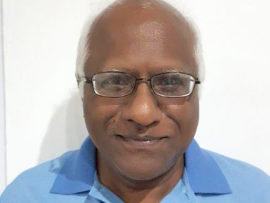 Jay Pillay’s first two critical decades were spent where his first decade began – in Pietermaritzburg. After studying at ML Sultan Technikon in Durban (anyone remember that place?), he then joined the sugar industry, working in Tongaat, Durban, and Xinavane – a sugar mill village 120km north of Maputo. Oh yes – there was a brief period of unfaithfulness, when he flirted with aluminium in Richard’s Bay. Upon retirement, he and his wife Dorothy – settled in Southport.
HAVE YOUR SAY
Like our Facebook page, follow us on Twitter and Instagram