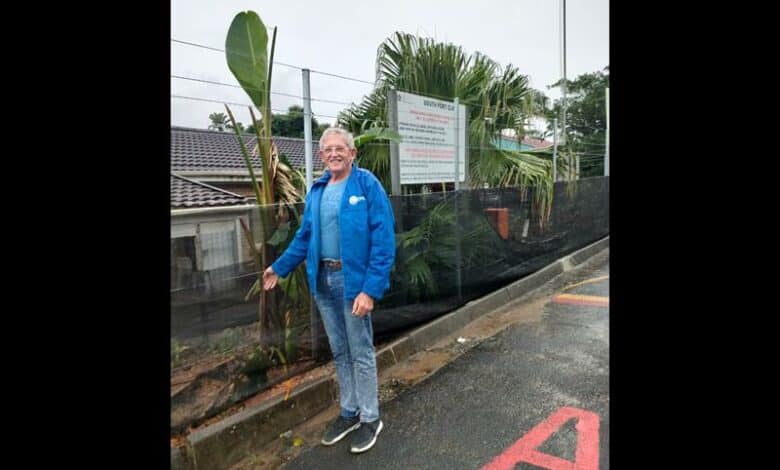
I have spoken to Thembalakhe Sibozana, Compliance Officer from the Department of Agriculture, Forestry and Fisheries.
Sibozana, who inspected the trees, has a B.Sc Environmental Studies. He has confirmed that the trees that were felled at the Southport Clinic are not protected milkwood trees.
They are, in fact, umdoni trees and could be felled without a permit. As the trees were not touching, they could not be construed as a protected forest.
It is understandable that some residents mistook the umdoni trees for milkwood trees, as they are similar. The umdoni tree does not have the milky latex that the milkwood tree has, and although they look similar, there is a distinct difference.
The milkwood tree, Sideroxylon inerme subsp. inerme (aMasethole or white milkwood, Afrikaans: wit-melkhout, Xhosa: Ximafana, Zulu: Umakhwelafingqane) is one of South Africa’s coastal protected trees. It has dense foliage, black berries and small, dainty white flowers. There are a number of subspecies of the milkwood tree; the tree’s formal name means ‘iron-wood’ in Greek, referring to its very hard timber. Being a protected tree, it is illegal to damage, move or destroy milkwood trees.
The Sideroxylon inerme is a semi-coastal, sturdy, broadleaf evergreen tree with dense foliage, white bisexual flowers and edible purplish-black berries. It has leathery, spiral leaves, which, like the berries, contain milky latex, and this is one of the identifiers, which differentiates it from the umdoni tree. Young branches and new leaves are covered with fine hairs.
The milkwood, which can reach 15 metres, is valued in traditional medicine; it attracts birds, monkeys and other animals to its flowers and fruits. The speckled mousebirds eat the flowers; birds, bats, monkeys and bush pigs eat the fruit. It is also cultivated as an effective firebreak.
The umdoni tree, Syzigium cordatum, is also known as the water berry tree. The name is derived from the fact that the umdoni tree is found near rivers and streams and it bears clumps of berries which are enjoyed by vervet monkeys, bush babies and some birds; it also reaches a height of up to 15 metres.
I will be inviting Sibozana, the DFFE’s senior forester, to deliver a presentation about trees and the legislation relating to indigenous and protected trees.
The following topics will be included in Sibozana’s talk: the importance of trees, types of forests, natural forests, special measures to protect forests and trees, protection of certain trees, licence application process and licence application requirements. I will advise Ward 16 residents of the date, time and venue when the talk will be given.
I would like to assure the residents of Ward 16 that the trees that were felled at Southport Clinic were not protected milkwood trees, and, in due course, other trees will be planted to replace the felled trees.
CLR JOHN WILLIAMS
Ward 16
HAVE YOUR SAY
Like the South Coast Herald’s Facebook page, follow us on Twitter and Instagram