
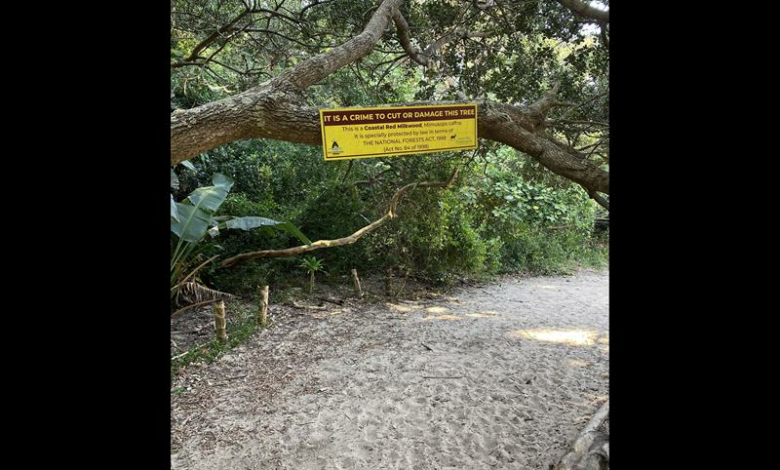
If you live along the KZN South Coast, you have probably walked past a coastal red milkwood (Mimusops afra, formerly Mimusops caffra) without giving it much thought, yet culturally in the province, Mimusops caffra is considered a royal timber tree of excellent quality.
These hardy indigenous trees are perfectly adapted to our coastline. Their twisted, sometimes gnarled branches withstand salty sea breezes, while their evergreen foliage provides food and shelter in our coastal environment.
The coastal red milkwood is particularly noticeable along our sandy coastline and primary dunes, where it is more common than the white milkwood (Sideroxylon inerme).
Although both belong to the Sapotaceae family, they are different species in different genera.
However, there is something important to know about both of them: they are both protected trees.
Because they look similar and both bleed a milky latex when damaged, they are easily confused.
They both occur naturally along the eastern coastline, from the Eastern Cape through KZN and into southern Mozambique, and are an important part of our coastal and dune forests. However, they can be distinguished by their genus, growth habits, and fruit, with the white milkwood having small, round, purplish-black berries.
Coastal red milkwood (Mimusops afra) has small, creamy-white flowers which provide food for pollinators, while its orange-red fruits are enjoyed by birds, monkeys and other wildlife which also help disperse its seeds.
Both the coastal red milkwood and white milkwood are protected under national legislation in South Africa. It is illegal to cut, damage, destroy, disturb, transplant, or collect or trade any part of either tree without the appropriate formal licence or permit from the Department of Forestry, Fisheries and the Environment (DFFE).
In KZN, the red milkwood was traditionally valued as a high-quality timber tree. But today, its greatest value may simply be in remaining alive and standing. A mature coastal tree cannot be replaced overnight. When we remove one tree, we lose years of shade, habitat, food and shelter – and an important piece of our natural coastal heritage.
So next time you see a gnarled evergreen tree standing up to the sea breeze, take a closer look. It may be a coastal red milkwood or, if you are even luckier, a white milkwood: appreciate and protect these old beings who have been guarding our shores their whole lives.
HAVE YOUR SAY
Like the South Coast Herald’s Facebook page, follow us on Twitter and Instagram