
Sapref’s flaring irks communities
As Sapref Refinery shuts down production, the company has warned that it will be releasing some chemicals into the atmosphere through its stacks.
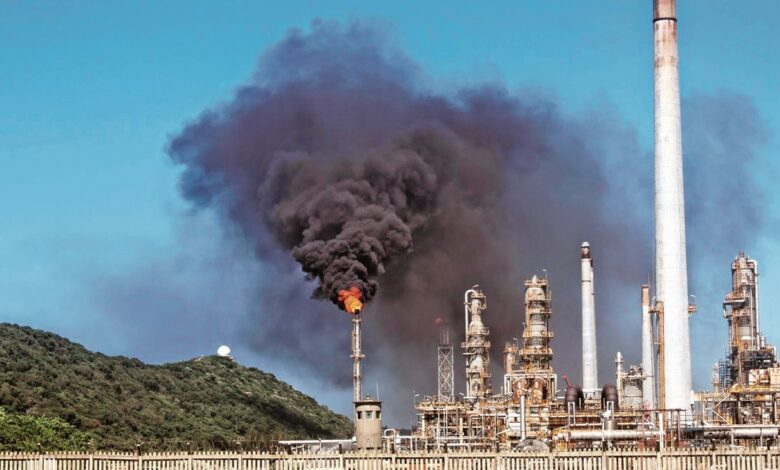
RESIDENTS that live next to Sapref Refinery said they are waiting for a report from the company to tell them what kind of chemicals are being released into the atmosphere after an announcement was made that there will be flaring and steam venting over the next two weeks.
ALSO READ: Refinery rocked by explosion
On Thursday, March 31, Sapref Refinery announced that it has started the process of shutting down its production units.
“We are commencing with the staggered shutting down of our units followed by a decontamination phase. We will work to ensure minimal impact on the environment and our community. We apologise for any inconvenience you may experience,” read the statement.
The company’s sustainable development manager, Hlengiwe Hlela said the ongoing flaring is a safety mechanism to allow for safe burning of the hydrocarbon gas from process units as part of the shutting down process
Shell Downstream South Africa and BP South Africa, who are joint owners of the company, announced in February that fuel production at the facility will be stopped at the end of March. Both companies said they were looking at various options regarding the future of the company, including selling it to new owners.
As the flaring and steam venting commenced at the beginning of the month, Desmond D’sa, who is the South Durban Community Environmental Alliance’s (SDCEA) coordinator, said he received a number of complaints from people who got sick after inhaling the fumes that were released.
“People as far away as Isipingo could smell this pollution and it made them sick. Were are not even aware of what kind of chemicals we are inhaling because the company has not told us. They owe it to the community to say what is in the air that we are breathing. We have submitted questions and we hope to get a reply,” said D’sa.
Hlela said the gases emitted include sulphur dioxide, nitrogen dioxide and carbon dioxide.
“Emissions from flaring are reported to our licensing authority as required by our air emission license. Measures are taken to reduce the duration and rate of flaring in order to minimise any impact to the surrounding community. Our environmental standby team is available to investigate and respond to any community complaints that maybe received during the shutdown process,” she said.
KwaZulu-Natal Premier, Sihle Zikalala recently announced that the province was in talks with the national government about buying Sapref in order to preserve jobs and boost the economy.
Established in 1963, Sapref accounted for 35% of South Africa’s refinery capacity, producing 2.7 billion litres of petrol per year.
DID YOU KNOW?
Click on the words highlighted in red to read more on this and related topics. To receive news links via WhatsApp or Telegram, send an invite to 061 694 6047 The South Coast Sun is also on Facebook, Twitter, Instagram and Pinterest – why not join us there?
Do you have more information pertaining to this story? Feel free to let us know by commenting on our Facebook page or you can contact our newsroom on 031 903 2341 and speak to a journalist. (Comments posted on this issue may be used for publication in the Sun)