
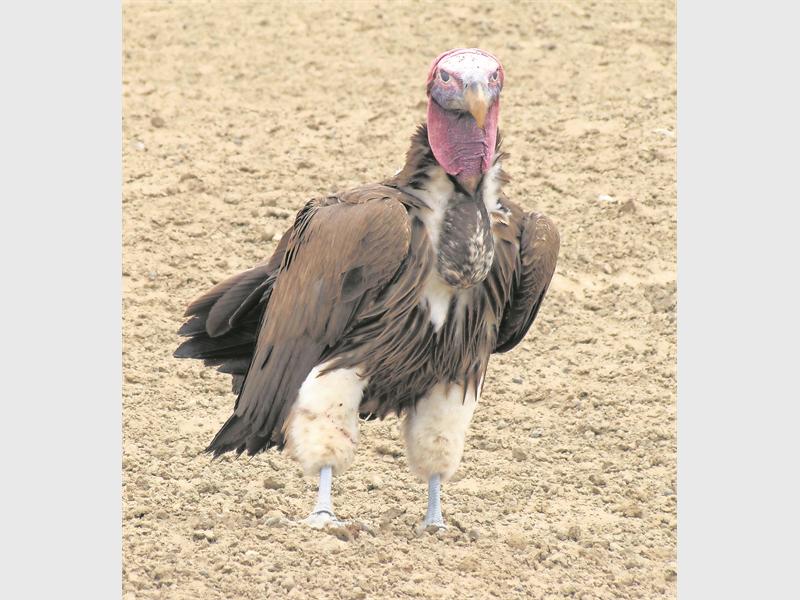
KNOWN as Bomber Command, the lappetfaced vulture is a very big, heavy bird which flies at a low altitude.
With its wonderful eyesight, it locates carcasses easily.
Arriving first with its huge, stout bill, it tears and rips open tough carrion. It even eats skin and ligaments that smaller vulture species cannot handle.
The lappetfaced vulture dominates over all other species at a carcass, and feeds until it is satisfied, then retires to the periphery of a group. It may loaf for hours after feeding.
They also kill small mammals, down to the size of a hare. It kills barbel and nesting flamingoes and eats flamingo eggs.
It is usually silent, even at carcasses, and has a rarely heard shrill whistle.
Sadly, apart from the huge arid areas of Namibia and Botswana, it is now uncommon and is only seen in South African game parks. The nest is a huge platform of sticks up to 3m in diameter, 100cm deep and is lined with grass, hair and skin. Its preference is to locate it in flat-top thorn trees.
The nest may be used for many years in succession.
It lays one egg, with incubation lasting 56 days. Nestlings stay for 125 to 130 days and are dependent on their parents for up to six months after the first flight.
This bird’s Zulu name is iNqe.