

Find work around the world with a motor body repair qualification
The motor body repair industry is opening doors for young men and women with a range of qualifications they can use to secure exciting career prospects locally and internationally.
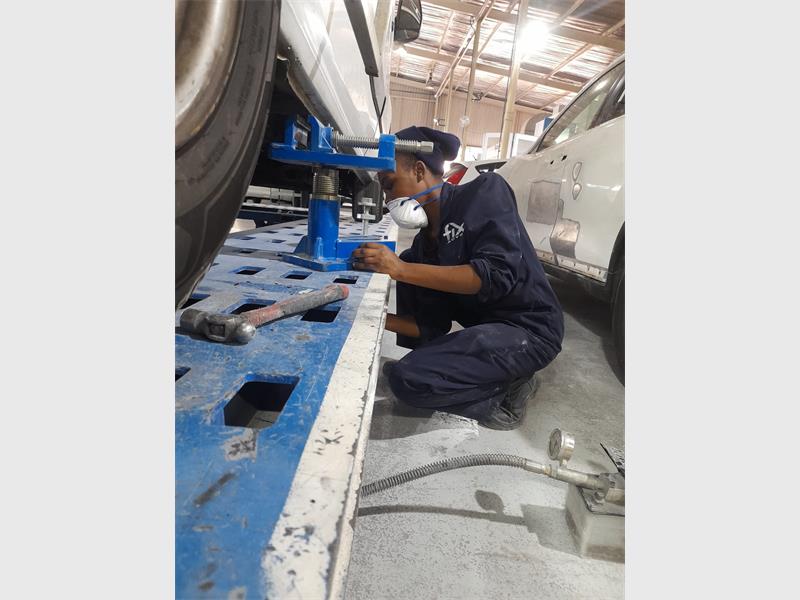
“Gone are the days when the sector was regarded as dull and for men only,” said manager at the Motus Technical Academy in Wadeville Lee de Sousa.
“The qualifications are highly sought after, here and abroad. Women are also making waves in the industry, with their innate attention to detail among the skills opening many doors for them.
“Anyone can succeed in the learnerships we offer, regardless of the challenges they may face in their circumstances. All you need is a passion for the trade, commitment and discipline.”
His career is a testament to this, having started as an apprentice motor mechanic at Lindsay Saker.
“I then moved over to Audi, when Audi and VW were one entity. After the two brands were separated, I was allowed to open an Audi workshop in Braamfontein and moved to various other branches in the group to gain experience.
“This journey took me from motor mechanic to foreman, service advisor and service manager to, eventually, the training division, where I found my passion. I have never looked back.”
Richard Green, national director of the South African Motor Body Repairers’ Association (SAMBRA), said apprenticeships are an excellent means to develop a trade-specific skill.
SAMBRA is a proud affiliate of the Retail Motor Industry Organisation (RMI) and represents almost 1 000 motor body repair businesses across South Africa, accounting for over 80% of all insured repair claims in the country.
“Many South African industries, like motor body repairers, desperately need skilled artisans. Apprentices have a good chance of entering the industry full-time. An apprenticeship combines theory, practical work and work experience in a chosen trade field.
“With a listed trade, such as panel beating or spray-painting, it ends in a trade test and you receive an artisan certificate of competence,” explained Green.
It usually takes three to four years to achieve artisan status, after which employment is guaranteed should the parties agree to a continued employment relationship.
The Quality Council for Trades and Occupations monitors apprenticeships in South Africa (QCTO) and the National Artisan Moderation Body (NAMB) oversees the quality assurance of apprenticeships on behalf of the QCTO.
Green reiterated that an apprenticeship is not something you can flit in and out of as it suits you. It requires commitment and meeting the terms of a formal contractual agreement.
Paying his passion forward, de Sousa invites matriculants and other youth into the academy during school holidays to see what it is all about.
“They experience all the aspects of a motor body repair business, from admin to support and take part in training sessions, including hands-on supervised training,” he said.
Motus has four academies – Germiston (motor mechanic), Wadeville (diesel mechanic, auto electrical, spray painting and automotive body repair), Bloemfontein (auto electrical, diesel and motor mechanic) and Cape Town (diesel mechanic, auto electrical and motor mechanic).
They have accredited trade tests for diesel mechanics, motor mechanics, motorcycle and scooter mechanics, auto electrical, automotive body repair and spray painting.
To enter any of the learnerships, the candidate must have a Grade Nine certificate.
There are no compulsory school subjects required, but maths, physical science, technical drawing and theory (N1 or N2) are recommended, as this helps to understand course material in the curriculum, de Sousa explained.
De Sousa said the Wadeville and Cape Town academies have their trade test centre with accreditation to test all the trades offered.
Exciting news for those interested in entering the MBR industry is that Lee has helped to introduce a new qualification, vehicle damage quantifier.
He explained that the Motus Technical Academy in Wadeville has been accredited for training and testing for this qualification.
“With this new qualification, many people in the industry, like panel beaters and spray painters, will inspect vehicles for assessing damage and quoting. It is also a value-added qualification for insurance assessors,” de Sousa concluded.
Green advised anyone interested in an apprenticeship to speak to qualified artisans and visit their workplaces to see what the job entails.
They can also contact their local TVET college advisory centre or SAMBRA for guidance HERE.