SDCEA health workshop calls for people-centred approach
Local activists come together to educate communities.
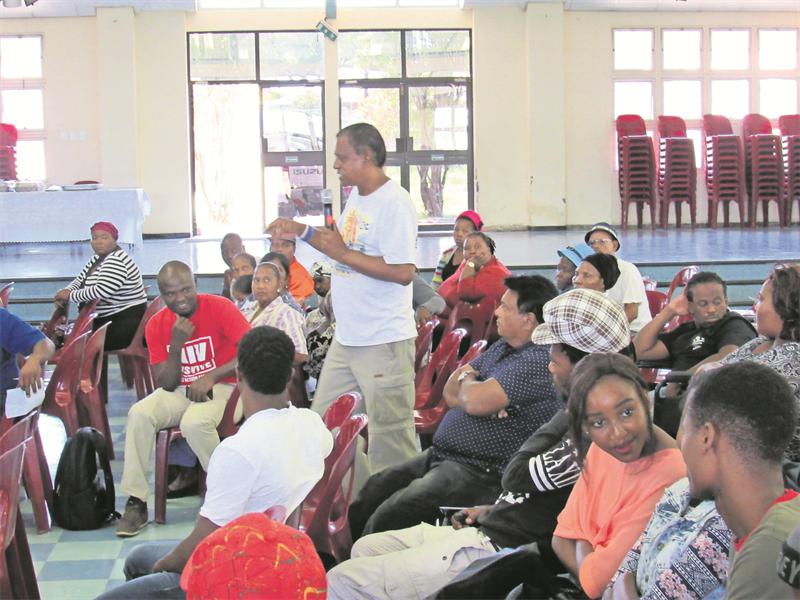
THE South Durban Community Environmental Alliance (SDCEA) hosted a health workshop at Austerville Community Centre recently to educate the community on healthcare issues and ways to combat them.
Members of SDCEA, groundWork, the Treatment Action Campaign (TAC), KZN Environmental Network, Thokoza Women’s Hostel, the Cancer Association of South Africa (CANSA) and Ubunye BamaHostel (UBH) met with South Durbanites to discuss health issues and toxic environments.
“Each participant addressed the complexity of healthcare in South Africa and abroad. Issues ranged from the hyper-commercialisation of food and pharmaceutical industries, to more critical issues such as access to basic healthcare services and medication.
Most important was the constant call from speakers for a more people-centred grassroots health movement,” said SDCEA volunteer, Shannon-Leigh Landers.
SDCEA co-ordinator, Desmond D’Sa spoke about poisonous chemicals passed through domestic products, genetically modified food, insecticides and exposure to high levels of air pollution and how they affect health.
TAC’s Sandile Khumalo and Thokoza Women’s Hostel’s Thembisile addressed the gathering on pharmaceutical companies.
“Thembisile included the issue of gender in her discussion, an often overlooked topic in health conversations. She noted that communication among people is tantamount to building solidarity, as it is only through communication that solidarity can be forged and people can empower themselves.
Thembisile also learned that women at the Thokoza hostel feel discriminated against at clinics based on their gender and their health status. This is aggravated by the fact that people with different diseases are forced to access separate clinics which often results in stigmatisation.”
Cultural myths and witchcraft were also part of the discussion including their impact on tackling illnesses like cancer, HIV and TB.
“Such myths often contradict biomedical practises which can hinder efforts to prevent and intervene in health issues.
However, it is important for activists to be cognisant of and sensitive to conflicting perspectives when facilitating health programmes, as mediating culture and biomedicine is a very delicate process which requires equal dialogue between affected groups and activists.”
SDCEA environmental officer, Noluthando Mbeje and groundWork’s Rico Euripidou then provided feedback on a recent National Health Assembly they attended.
“It became evident at the assembly that health is a political issue as it extends beyond just healthcare to include the food we consume, the air we breathe, the water we drink and, most importantly, the people who benefit from healthcare services (women and children being the most vulnerable group).”
Euripidou proposed that centralisation of the healthcare system negatively impacts on health.
“His presentation highlighted that in countries with more equitable healthcare, the life expectancy rate is higher. He used Cuba as an example of how a decentralised and localised health system yields successful outcomes.”
He added that a people’s health movement was necessary to fight for better health practises.
Mbeje agreed with Euripidou and said there needed to be solidarity between organisations locally, provincially and nationally in conjunction with health professionals.
Those attending the meeting were asked to go out and engage with others in order to disseminate the information they had received.
“It is hoped that through effective dialogue, a strong people’s health movement can be formed to challenge global health injustices. It was suggested and agreed at this meeting that we take all this information to the grassroots communities, starting with Newcastle followed by the South Durban communities such as Umlazi and Kwamakutha. The aim is to reach to as many organisations, activists, communities including grassroots communities as possible.”
Do you have more information pertaining to this story?
Feel free to let us know by commenting on our facebook page or you can contact our newsroom on 031 903 2341 and speak to a journalist.
DID YOU KNOW?
Click on the words highlighted in red to read more on this and related topics.
To receive news links via WhatsApp, send an invite to 061 876 3179
The Southlands Sun is also on Facebook, Twitter, Instagram and Pinterest – why not join us there?
(Comments posted on this issue may be used for publication in the Sun)