
Back to his roots
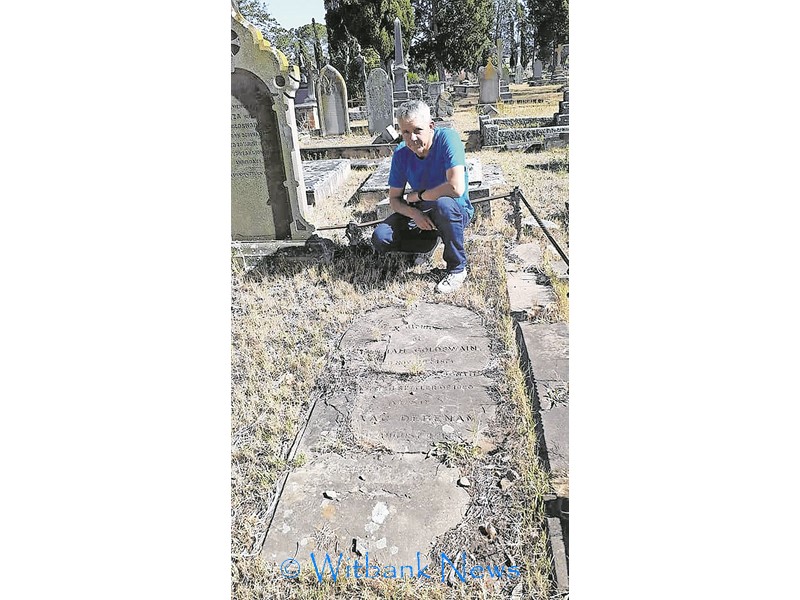
On an old and battered gravestone one can still clearly make out the words Jeremiah Goldswain and on the other, Eliza
The surname Goldswain often is a good conversation starter.
The first thing many people ask is – what surname is that?
Mr Colin Goldswain, also fondly known as Die Engelsman from the regular column in WITBANK NEWS, “In my eie ink geskryf” went to Grahamstown last week to visit two historical graves in South Africa.
On an old and battered gravestone one can still clearly make out the words Jeremiah Goldswain and on the other, Eliza.
This is where Die Engelsman’s roots come from.
History tells us after the Napoleonic wars, Britain experienced a serious unemployment problem.
Therefore, encouraged by the British government to immigrate to the Cape colony, the settlers started a journey to an unknown continent.
Amongst them was a settler named Jeremiah Goldswain whose memoirs play an important role in understanding and unraveling history.
His chronicles that covered a period from 1819 to 1858 are of great historical value because it was his eye-witness accounts of historical events.
Jeremiah was born in 1802 in Buckinghamshire.
He sailed to South Africa on board the “Zoroaster”, landed in Port Elizabeth in May 1820, settled in the Albany District, and was involved in three Frontier wars.
He witnessed the effects of the Cattle Killing of 1856. After the 1851-52 war, he moved to Grahamstown, where he died in 1871.
Jeremiah was known as a storyteller of note and his accounts of everyday happenings were written in long hand without paragraphs and full stops.
One of Jeremiah’s descendants, Ralph Goldswain transcribed his chronicles and gave a glimpse into who Jeremiah was.
“Jeremiah never sat back and minded his own business: He was a man who acted, and that often brought him into danger. Apart from that he had some accidents, and the combination of those two things produced, over a long life on the frontier, some near-death moments. Eliza was his guardian angel, always making sure that he was well served during those moments, sometimes having to put her foot down and take charge. She assessed each situation and, being intelligent and commonsensical, always knew what to do, often knowing better than the doctors. It was largely due to her that Jeremiah survived to live a natural lifespan. From his being gored by a cow and thrown by a horse, to such things as poisoning himself by eating a suspicious bean and being struck by lightning, Eliza always knew what to do,” Ralph wrote.
“Jeremiah’s legacy is one that still echoes throughout the ages. It gives us a glimpse of the hardships, the hilarious moments, the encounters and everything that happened in that time,” Die Engelsman said.
Because of the historical value of the graves there is a project that was launched to restore Jeremiah’s gravestone to preserve it for generations to come.
The Wesleyan Church is one of many national monuments in Bathurst, a town only 30km away from Grahamstown.
This church is an archetypical example of the type of Wesleyan churches that would have been present throughout rural areas in the early 1800s.
The church houses Jeremiah’s family Bible.
The church survived being besieged in the Frontier Wars and services are still held in the church every Sunday.
Morley House, also in Bathurst, is also preserved as a national monument because of its historical value.
It is one of the few 1820 settler dwellings to have survived looting during the Frontier War of 1834.
It was Jeremiah’s house.
Then there is the famous “The Pig & Whistle”.
It was originally built by settler blacksmith Thomas Hartley as the original Bathurst forge in 1821.
In 1853 Jeremiah bought it for his son-in-law.
He added rooms where the forge had been and turned it into an inn called the Bathurst Arms.
The inn survived fire and looting during the frontier wars, and during World War II was renamed “The Pig & Whistle” by servicemen from the nearby air school.
Jeremiah surely would have smiled if he knew how important his chronicles were.
And he would have been proud to see how the Goldswain-surname lives on.