
The South African dream: what will it take to build a truly prosperous country?
The future is not predetermined. It has to be built – step by step, decision by decision, leader by leader, citizen by citizen.
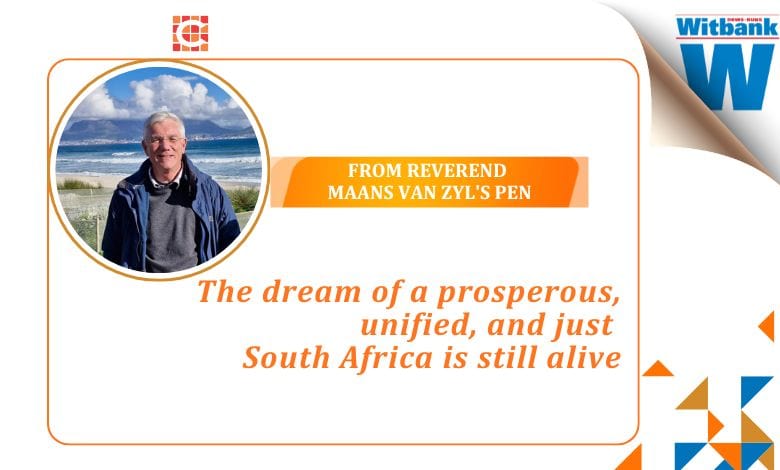
Every nation has a dream. Not a fairy tale, but a shared vision of what must be present for a person to live a decent life: safe communities, meaningful work, reliable leadership, and a future that brings hope. The dream of a prosperous, unified, and just South Africa is still alive, despite the frustrations, inequalities, and uncertainties of recent years. The question is not if we have a dream. The question is if we have the leadership and collective character to make the dream a reality.
A country between disappointment and hope
When researchers ask South Africans how they feel about the country today, many say “disappointed.” But disappointment is not despair. Research into future scenarios for the nation finds hope, especially among younger people who believe that things can improve, even when change happens slowly. The possible futures for South Africa revealed by scenario studies are stark. There is a future of division, inequality, distrust, and politics that focus only on survival. There is a future of authoritarianism and extraction, where resources benefit a few at the expense of many. And there is a future in which the country builds the infrastructure it needs, reduces inequality, and strengthens social bonds. A nation “in step with itself.” One factor in all these possible futures holds the key to which one actually comes to pass: leadership. Not just political leadership. Leadership in society as a whole.
The leadership question is paramount
Most agree that South Africa’s biggest problem is not a lack of policy or solutions. It is a lack of ethical leadership. When leadership fails, corruption thrives, institutions collapse and trust in government evaporates. Growth falters. Reconciliation and cohesion suffer. Leadership is not just technical competence. It is a moral matter. The best leadership has vision, courage and selflessness. It places the needs of the people and the nation above all else. Nations thrive when their leaders serve and unite rather than dominate and divide, build trust rather than exploit power. Evidence consistently supports the argument that ethical leadership results in enhanced public participation, improved policy implementation and social stability. When the leader is accountable, prosperity flourishes.
Prosperity is not only economic
We usually think of prosperity in economic terms: jobs, infrastructure, growth. These things are vital. But a nation’s long-term prosperity also depends on something less tangible: trust. Trust makes it possible for people to collaborate, invest and plan. When trust breaks down, everything becomes more difficult – even governance, growth and social cohesion. Trust can be restored through transparency, fairness and consistent ethical conduct by institutions and citizens alike. So national revival is both a structural and moral matter. Economic revitalisation is not enough. Character counts.
The historical wounds that continue to affect the social dynamics of today’s South Africa would be impossible to understand without its past. There are decades, generations of unequal relations, exclusions and processes that have caused relational wounds that still affect how people relate to each other today. Many young leaders carry emotional and psychological burdens stemming from past injustices, identity struggles, and mistrust of institutions. Research on student leadership in South Africa shows how much of the past persists today. Being a leader causes young people to relive the past in moments of injustice, struggle, and points of unresolved tension. However, these moments also create empathy, resilience and a deep desire for transformation among young leaders. This is important. There is a connection between healing and development. Societies can’t develop sustainably without addressing emotional and relational wounds.
READ MORE: Coffee with Reverend Maans – the moral compass for a nation in need
Compassion as a national resource
The most surprising finding from leadership research in South Africa is the prevalence of compassion. Compassion is a social strength, not a weakness. Compassion has a net effect of strengthening social bonds, fostering cooperation and building resilience in the face of stress (Singer & Bolz, 2013). People feel more connected when they feel heard, seen and valued. They are more willing to work together and invest in shared futures. Compassionate listening – engaging with people’s lived experiences – helps communities absorb shocks, reduce violence and re-integrate. This connects with the African philosophy of Ubuntu – people are human through relationships. Prosperity is not individual success, but the success of the whole community.
READ MORE: https://tinyurl.com/zfyz95ud
Leadership starts early – and it’s ubiquitous
Leadership development must begin early – and it must be ubiquitous. Leadership potential can be fostered in early childhood and outside of formal structures for political leadership. Early responsibilities, role models, and experience can shape a child’s potential to lead. Families, schools and communities are all likely to be incubators for future leaders. Generic leadership training is not sufficient. Character is forged through example, accountability and challenge. Adversity, when supported by relationships, can be a potent experience for leadership development, building resilience and ethical courage to face challenges. This means that leadership development is a national programme. It involves parents, teachers, community organisations and institutions working together to foster responsibility and integrity from an early age.
READ MORE: Coffee with Reverend Maans – the moral compass for a nation in need
Citizens are not spectators
A thriving nation does not depend on politicians. Active citizenship matters. When citizens engage, organise and call institutions to account, governance strengthens. When citizens retreat into survival mode, public institutions decline. Great societies partner government, business and civil society. They build a shared social compact – a commitment to community.
The decision we must make
We stand at a crossroads. South Africa is rich in resources, creativity, and young people who can and should thrive. But potential does not guarantee progress. The decisions that will determine our future are ethical decisions. They are leadership decisions. They are our decisions. Will the leaders of today remain self-serving? Will we remain passive? Will division win out? These are not theoretical questions. They are asked and answered every working day in offices, classrooms, communities, and institutions across the country.
READ MORE: Over a cup of coffee, Reverend Maans van Zyl digs into time management failures
Over a cup of coffee, Reverend Maans van Zyl observed that defensive leadership silences trust; teachable leadership restores it
— WitbankNews (@WitbankN) March 2, 2026
Read more here: https://t.co/eQ3uVT3HJ1 pic.twitter.com/pnSq5kzJj7
A realistic but hopeful conclusion
A prosperous South Africa is not an impossibility. The recipe for prosperity is well known: good leadership, strong institutions, social cohesion, quality education, engaged citizenship, compassionate engagement, and shared vision. The history of nations shows that they can recover, reform, and renew themselves. But sometimes transformation requires more than adopting a policy. It requires moral courage, relational healing and a willingness to take responsibility as a people. The dream of a prosperous South Africa is still alive. The question is whether we, as individuals and leaders, will live in a way that makes this dream a reality. The future is not predetermined. It has to be built — step by step, decision by decision, leader by leader, citizen by citizen. And perhaps that is the most encouraging thing of all.
This column is the opinion of the writer and does not represent the views of Witbank News.
Over a cup of coffee, Reverend Maans van Zyl looks at punctuality
— WitbankNews (@WitbankN) April 1, 2026
https://t.co/9I8o8cxLwC #reverendmaans #witbanknews #opinion pic.twitter.com/KJ9ZhpJ0be
Your city, your story, as it happens. Stay in the loop with WITBANK NEWS.
Find us on our website, Facebook, X, Instagram or TikTok
Got a tip? Email: info@witbanknews.co.za