WATCHING a pack of African wild dogs on the hunt is a beautiful experience; the co-ordination of the hunt, the subtleties in their communication and the feverish excitement is captivating.
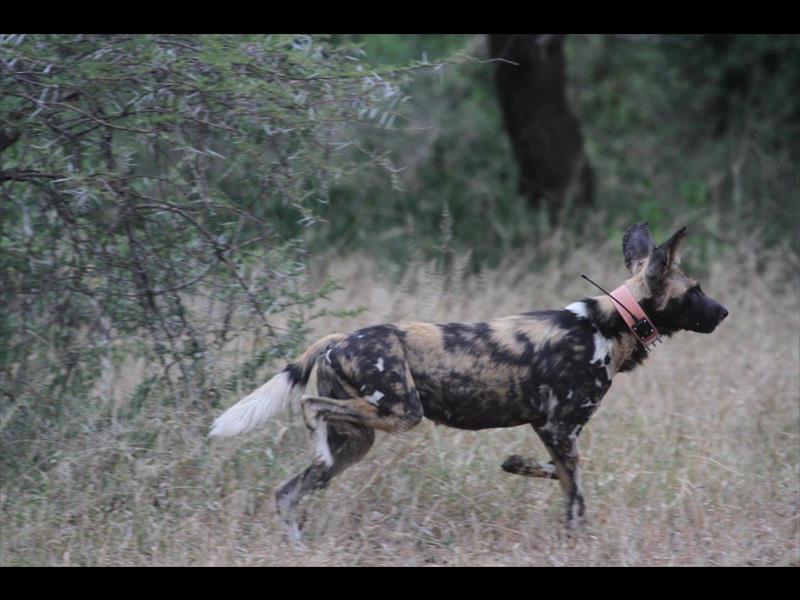
At a recent sighting like this, I overheard someone in another car who said, ‘Watching wild dogs is a magical experience, but seeing the collars on them is a shame.’
Although there are negative attitudes towards collars on wild animals, they provide managers and researchers with an invaluable tool for conservation, in carnivores in particular.
Adequate conservation of wild dogs requires an in depth understanding of what drives their population numbers.
This involves obtaining reliable estimates of their numbers and their pack structures in protected areas.
However, that is far from simple. Wild dogs utilise an enormous area where opportunistic observations are as rare as the dogs themselves.
Wild dogs can also cover this enormous area very quickly which further decreases the chance of catching a glimpse of this endangered species.
In order to keep tabs on the whereabouts and status of wild dogs, managers and researchers alike have used collar technology.
Without doubt, collars have revolutionised our understanding of all large carnivores.
Collars are effectively transmitters attached to a ‘belt’ that is then fitted onto an animal’s neck area.
These transmitters are either programmed to emit a Very High Frequency (VHF), transmit a location to a satellite or to transmit a location via a local cellphone network.
Management
From a management side, collars are an essential tool. Take for instance wild dogs that may break out out of a reserve and travel very quickly over fairly inaccessible land.
The only way to track and locate individuals is by their collars in order to mitigate potential conflict with farmers and community members.
Not only do collars relay information on the whereabouts of specific individuals, but they are also used to answer relevant ecological questions. For example, all the packs of wild dogs in KZN are collared and we can ask such questions as what is the size of the area used by each pack, how often do these packs visit water, what is the location of the breeding den.
Collars don’t hamper the survival of individual wild dogs as was found in Hluhluwe-Imfolozi Park where wild dogs with collars had the same survival rates as those without collars.
Also, when the collars are placed, the utmost care is taken to ensure that the collar is neither too heavy nor too tight on the individual.
The use of collars have proved to be the best way of tracking and understanding this endangered carnivore, without which we would not be able to conserve them effectively.
More information
Find more Wild Dog information at www.wagsa.org.za. The Endangered Wildlife Trust’s National Wild Dog Metapopulation Project is supported by Jaguar Land Rover South Africa, Land Rover Centurion, Investec, GCCL² and Painted Wolf Wines and in KZN is carried out through collaboration with Ezemvelo KZN Wildlife, WildlifeACT, Wildlands Conservation Trust and the participants within the KZN Wild Dog Advisory Group and the Wild Dog Advisory Group of South Africa.
If any readers observe Wild Dogs outside of protected areas, please note the location of the sighting, whether the animal is wearing a tracking collar and identify, or ideally, photograph any characteristic markings. Please notify David Marneweck with the above information on 082 4481721.