Humans affect water levels
A study into interactions between ground and lake water levels in response to different water uses is currently underway after water level records indicated Lake St Lucia's vulnerability to adjacent stream flow reduction from plantations.
WHILE the cyclical nature of weather patterns means droughts are inevitable, there is a growing awareness of human-induced consequences on our water resources.
As reported by iSimangaliso, not unexpectedly, water levels in the 36 000 hectare Lake St Lucia system dropped last winter to just above mean sea level.
This, coupled with lower rainfall between July and October in 2014 than in 2013, led to increased salinity levels in the system’s northern sections.
‘The Lake St Lucia system is in a better state than during the previous drought, from 2002 to 2010, when there were extremely low water levels, desiccation of large areas of the lake, and extreme hypersalinity,’ said iSimangaliso CEO Andrew Zaloumis.
According to Nicolette Forbes of Marine and Estuarine Research (MER), this is largely due to iSimangaliso’s mouth management strategy which, since 2012, has allowed the Mfolozi River to enter the estuary via a spillway.
Water abstraction from the lake for human use, as well as rapidly increasing commercial plantations, may have exacerbated decreases in lake water levels.
Relative to the high volumes naturally flowing in and out, these abstractions were considered low.
However, an examination of water level records indicates the lake’s vulnerability to abstraction and adjacent stream flow reduction from tree plantations.
An iSimangaliso-commissioned study to look at interactions between ground and lake water levels in response to different water uses is currently underway.
Winter game and bird viewing
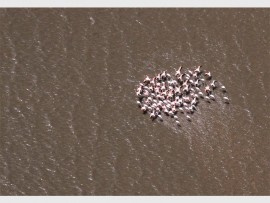
An aerial winter water bird survey counted over 16 500 water birds across the lake, including 4 248 Greater Flamingos, 4 100 Greater White Pelicans and over 965 Caspian Terns with 300 active nests.
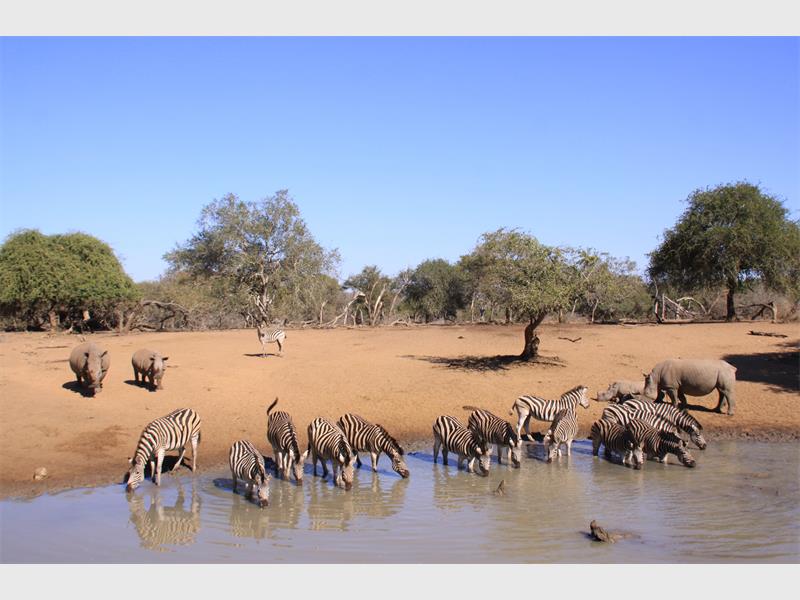
To encourage good winter game and bird sightings, a system of boreholes is in place throughout the park.
Auxiliary water systems, including Western Shores’ uBhejane Pan and Mkhuze’s kuMasinga Hide, have been activated.