Richards Bay man finds 137-year-old cannonball
War relic dating back to Anglo-Zulu war discovered in Meerensee park
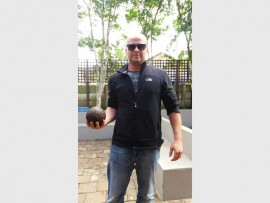
USING a metal detector to search for old coins, a Richards Bay man on Sunday found something far more valuable – a relic from the annals of history.
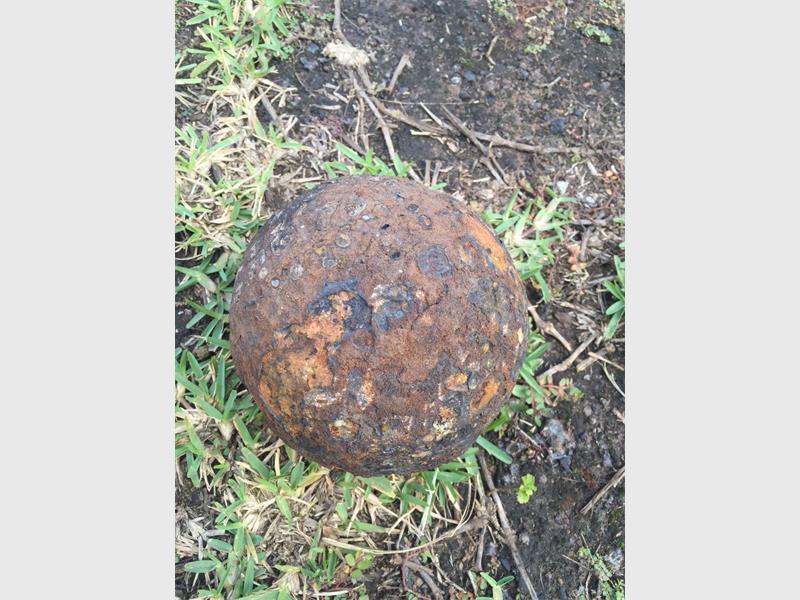
Ron Blom was screening an area near swings at a Meerensee park when the detector suddenly blared its signal next to a tree.‘I started digging and excavated 30cm deep when I hit this object.‘I carefully removed the soil to slowly expose its shape and that is when I suspected I had found a cannonball,’ said Ron.
First task was to make sure it was not still ‘live’, and SAPS Explosives Unit Captain Gawie Visagie inspected the ammunition and gave the all clear, adding that the cannonball dated back to pre-World War I.
Local historian and author JC van der Walt then verified its origin and significance – a cannonball fired on 24 April 1879 by the British forces on the Zulu impi guarding uMhlathuze‘s shores.
‘The cannonball in question is a symbol of British intimidation during the Anglo-Zulu War.
‘During the war, the British forces suffered a massacre at Isandlwana on 22 January 1879.
‘Some 10 400 additional troops arrived to relieve the troops trapped at eShowe for 72 days and to defeat the Zulu nation at Gingingdlovo, and finally at Ulundi on 4 July 1879.
‘Five large war ships arrived under command of Commodore Frederick William Richards, the man after whom Richards Bay was named.
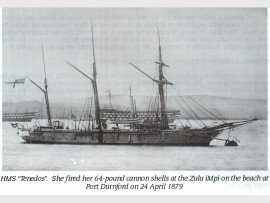
‘One ship, HMS Tenedos, fired her shells (including this one) at Zulu impi who gathered at the beaches of uMhlathuze (later Richards Bay) and eSikhawini.
‘This was done as a show of strength in an attempt to get the coastal Zulus to surrender.
‘The anchor of HMS Tenedos is on display at the eShowe museum.
‘This cannonball is an important relic of the Anglo-Zulu War,’ said van der Walt.