
South African automotive market sustains momentum
June new vehicle sales in South Africa show 18% increase year-on-year

With the close of the first half of 2025, new vehicle sales showed steadfast upward momentum in line with the Automotive Business Council’s (Naamsa) projection.
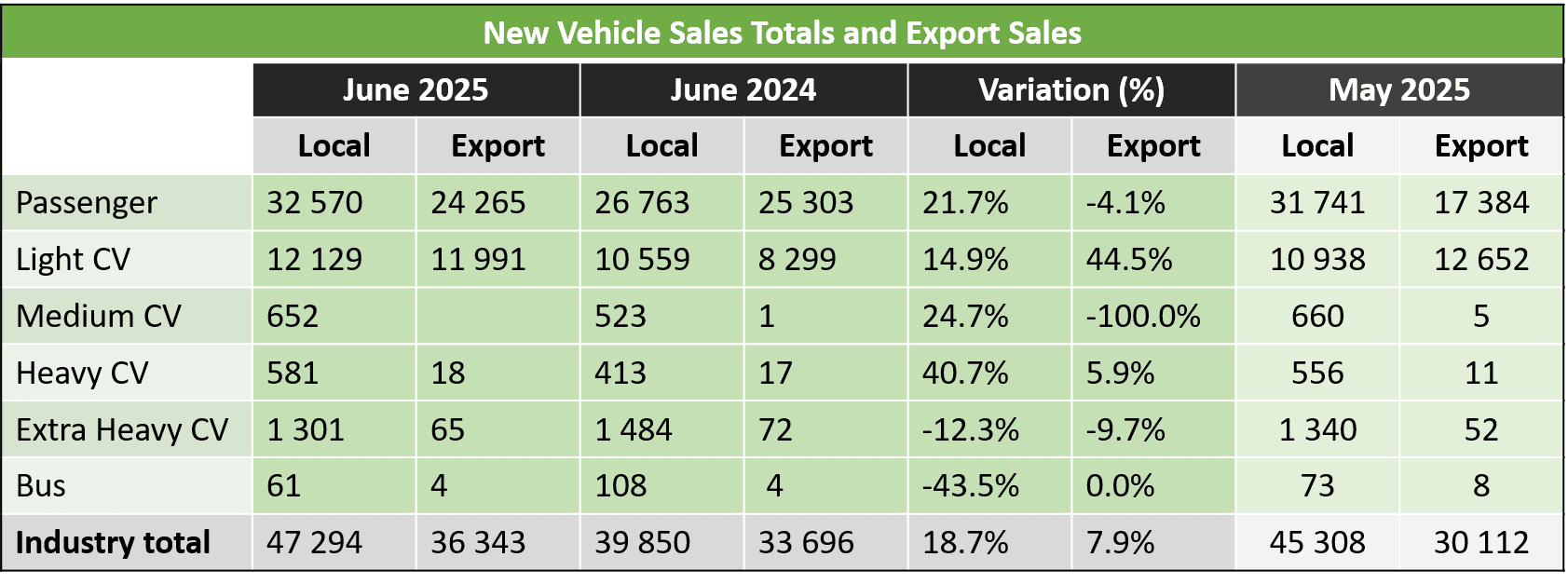
June’s new vehicle sales came to 47 294 units, 7 444 or 18.7% up from last year’s 39 850 units, reflecting a consistent recovery in demand from consumers and fleets.
ALSO READ: Cautious optimism ahead despite 2024 vehicle sales decline
Of this, 40 621 (85.9%) represented dealer sales, around 8.2% sales to the vehicle rental industry, 3.2% to industry corporate fleets, and 2.7% to government sales.
The passenger car market registered a 21.7% increase, from 26 763 units sold in June 2024 to 32 570 sold this June (accounting for almost 70% of the month’s vehicle sales).
Compared with June 2024’s figures, increased sales were seen in the categories of new light commercial vehicles, bakkies and mini-buses (14.9%) and medium trucks (24.7%), while the heavy truck segment saw a decrease of 3.1%.
Toyota topped the total vehicle sales chart with 11 690 local unit sales, followed by Suzuki Auto (5 221), Volkswagen Group SA (4 973), Ford Motor Company (3 058) and Hyundai Automotive South Africa (2 905).
Source: Naamsa
The first half of the year saw an overall increase of 13.6% in new vehicle sales largely supported by an influx of affordable imported models, with new light vehicle imports by OEMs increasing by 25.6% year-to-date between January and May. However, domestic sales by OEMs of locally manufactured models decreased by 14% in the same period.
“The first half of 2025 has shown just how resilient and responsive our domestic market is. Strong consumer demand, supported by positive economic fundamentals, has helped the automotive sector deliver impressive growth amid global turbulence,” said Naamsa CEO Mikel Mabasa.
Since the fourth quarter of 2024, domestic vehicle sales have been growing.
ALSO READ: Online car sales in South Africa: What’s possible, what’s not and why
The toll of geopolitical and trade-related disruptions aside, vehicle exports increased by 2 647 units, or 7.9%, to 36 343 units this June from 33 696 in June 2024.
“South Africa’s automotive industry has long relied on a thriving export engine to sustain production volumes and attract investment. However, the current trade policy shifts, particularly from the United States, pose a real challenge to this model,” said Mabasa.
Looking forward, while the automotive sector has ended the first half of the year on strong footing with consistent performance in domestic new vehicle sales, the second half of the year will see the industry navigate a more complex environment, with risks such as food inflation and the volatility of oil prices requiring monitoring, and the need for ongoing engagement and negotiation over automotive exports to protect the sector’s trade position and export earnings.
Don’t have the ZO app? Download it to your Android or Apple device here:


HAVE YOUR SAY
Like our Facebook page and follow us on Twitter.
For news straight to your phone invite us:
WhatsApp – 060 784 2695
Instagram – zululand_observer