Sad farewell to Durban activist
The city held a memorial service and funeral last week to bid a sad farewell to former PR councillor, Judy Mulqueeny.
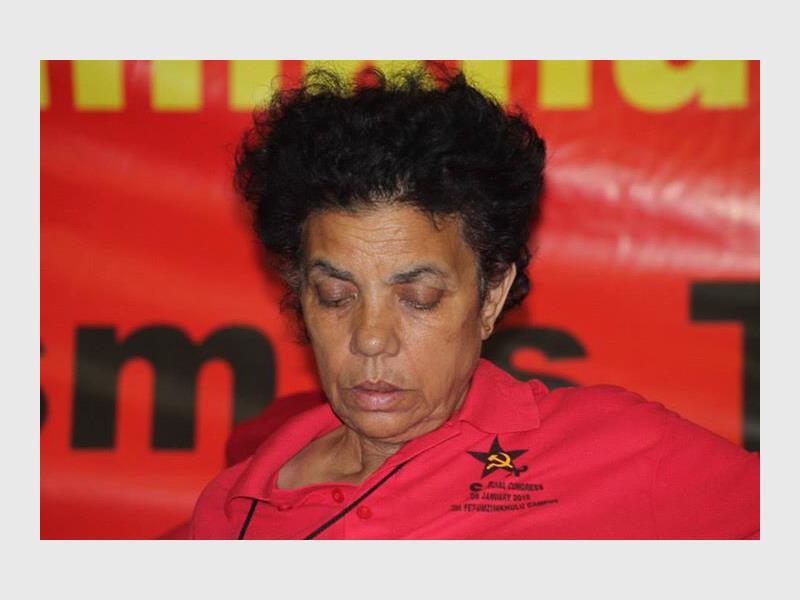
CITY councillors and officials paid their respects last week at the memorial service for Ward 33 PR Councillor, Judaline (Judy) Mulqueeny, who died recently after a courageous battle with cancer.
A memorial service was held at the Durban City Hall on Friday, 12 June and her funeral took place on Sunday, 14 June.
Judy was born on the 29 December 1949 in Durban into a humble working class family. She was the second of four children and attended St Augustine Primary School in Durban excelling academically with her name featuring on the honours board.
From an early age, Judy was acutely aware of the unjust system of apartheid. She and her sister would sneak out under the cover of darkness to play in a whites only playground in Albert Park which was a stone's throw away from her family home. She attended Bechet High School where she completed her matric with top honours in spite of having to depend on bursaries for her academic advances. Even at that early age, the tenacious and resilient character that later defined her political posture, was evident.
Although relatively reserved, Judy’s material conditions sharpened her high working ethic and fighting spirit. After high school went to work and with a student loan supplement was able to raise enough funds and enrolled into a BA degree at Howard College. The political upheavals of the early 70s, characterised by student uprisings, influenced her stay throughout university and when she continued with her post graduate studies at UCT, the glaring political inequality troubled her and unearthed in the quiet unassuming young Judy a militant attitude towards the unjust and brutal system of apartheid, coupled with the racial segregation policy of the then government that broke down Judy’s family.
In this regard Judy lived and grew up separately from her sister and other family members who were darker skinned because they were classified as “other coloured” while Judy was classified as a “Cape Coloured” given her fair complexion. In protest Judy eventually left the country to pursue her academics studies and continue her teaching career across the border in Lesotho.
Upon arrival in Lesotho in the early 80s she taught in Mafeteng village where she was inspired by that country's farming co-operatives (Letsema) which left an indelible mark that would define her area of passion in her life of activism. While teaching in Lesotho, she also pursued post graduate studies at the National University of Lesotho. It was during this period that she witnessed the brutal Maseru Massacre, an experience that shocked her to the core.
During the same period she met exiled South African Jeff Radebe and subsequently joined the SACP. After the unbanning of Political Organisations in 1990, she returned to South Africa to help rebuild the structures of the ANC and SACP in KwaZulu-Natal. She was also elected the first ANC branch secretary in Newlands East and served with the likes of Trevor Bornom, Dr Ndlovu, Tom Jafta, KK Nkosi and Nhlanhla Buthelezi.
Judy’s commitment, her bias and relentless fighting for the poor, downtrodden and vulnerable especially women, is well documented. She played a significant role in opposing the privatisation of Durban metro buses in early 2000s amidst seething tensions in the alliance in defence of public transport as the only reliable mode of transport for the working class.
Again in 2006 not fearing to stand alone even if it came at a great personal loss, she took up a fight against Durban Metro for their planned demolishing of the early morning market near Berea which was a symbol of Durban’s culture of trading which spanned decades, to impose a new super mall which would’ve had devastating implications for Durban’s survivalist traders.
As a communist she led the offensive and galvanised all social formation in the sector such as StreetNet led by Pat Horn and the proposed development was arrested on its tracks. It was this fighting spirit, activism, dedication and the selfless advancement of grassroots politics that earned her immense respect among hawkers and traders on the streets of Durban and this relationship characterised her role as a councillor.
Judy’s passion for the arts can be traced back generations in her musically gifted family with the father, a seasoned guitar player. She was also known to indulge in poetry sessions in town and never missed the festival of the writer. She was an avid reader and also took up creative writing as part of her spiritual journey to heal and liberate her soul and recently had taken to photography to further express her artistic intuition.
Even in her hospital bed when Judy felt that there was not enough intensity in the delivery of SACP Programmes she charged that the SACP was not a boardroom organisation and that its members must be on the ground to respond to the latest battle she took up as far back as 2009 to defend residents of Flamingo Court in Umbilo from building highjackings, excessive levies, evictions, water cuts and deplorable living conditions.
With the newly launched SACP branch she organised residents into task teams that would collectively address challenges they faced and insisted that this was only possible through maximum unity and that the residents take ownership of this fight and empower themselves through training on sectional titles, which she arranged.
She is survived by her older brother Leonard and younger sister Veronica, nieces and nephews and the rest of the Mulqueeny clan as she fondly referred to them.