Trees doomed through mis-identification
Eight trees in St Thomas Road, Musgrave, have been ringbarked after mis-identification by a team contracted to the Parks Department.
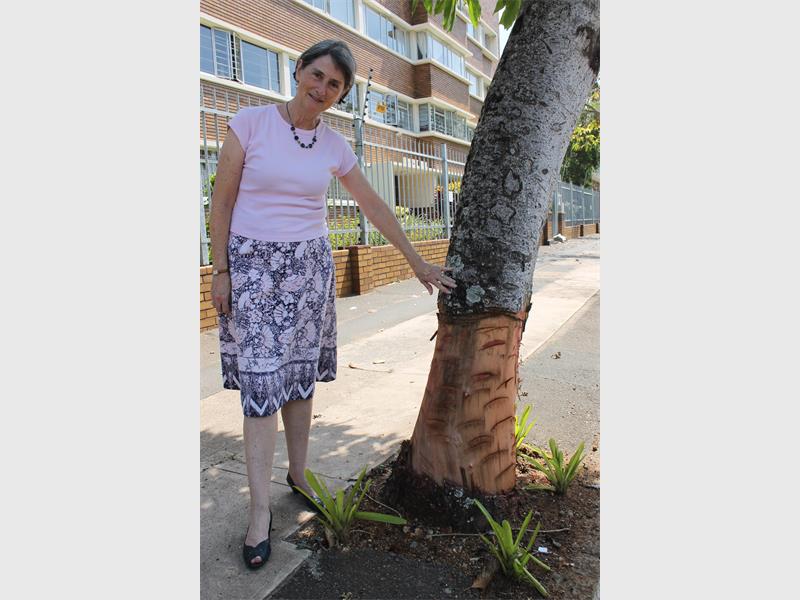
MISCOMMUNICATION has been blamed for the death sentence of a row of trees in St Thomas Road which were mistakenly ringbarked by contractors acting for the Municipality.
Musgrave resident, Sue Burrows raised the alarm when she expressed her shock and disappointment after noticing that a number of trees in St Thomas Road had been ringbarked, and were doomed to die. Burrows said what was was now a lovely, shady pavement, will become bleak and bare because of it.
When approached for comment, eThekwini Head of Communications, Tozi Mthethwa said a contracted team was deployed by eThekwini Municipality on 25 January to Coronation Road in Berea to control a listed invasive alien plant, Triplaris americana (commonly known as the Ant tree), however mis-identification resulted in the eight Magnolia champaca (Champak) street trees being treated in St Thomas Road instead.
“The damaged trees will be replaced with suitable street trees, and measures will be put in place to ensure that such an incident does not occur again,” she said.
Burrows said she had contacted the Parks Department about this, and was saddened by this response. “It was a grievous error indeed and the repercussions will be felt for many years while the replacement trees slowly grow to maturity,” she said.
She also raised the question whether it was council policy not to replace street trees as they die.
“The short section of Musgrave Road near my home has lost several trees over the past few years and none of these street trees have been replaced. I was informed by Parks recently that all the trees in the council nursery are currently less than one metre in height. This sounds like poor forward planning. Surely in this case the department could source replacement trees that are more advanced than that. I hope the municipality will arrange for their replacement at the same time as the St Thomas trees are replaced,” she said.
BOX???
eThekwini's invasive plant policy
THE City's Head of Communication, Tozi Mthethwa said the Municipality’s Early Detection and Rapid Response (EDRR) team responds to reports of emerging weeds throughout the municipal area.
“Emerging weeds are plants with invasive tendencies. They have established outside of their natural distribution range, but not yet widely so. They often have horticultural value, but can impact negatively on natural ecosystems, biodiversity, livelihoods or human health. Timeous eradication or control of these plants may save the Municipality and its ratepayers millions of rands in future control costs,” she said.
Mthethwa said the Durban Invasives website (https://www.durbaninvasives.org.za) ensures that spotters, who notice emerging weed species, can quickly report them. Once verified, a team is assigned to implement control. The public is invited to register as spotters, and participate in ensuring that emerging weeds are eradicated.
eThekwini Municipality had partnered with the South African National Biodiversity Institute (SANBI), Duzi Conservation Trust (DUCT), local conservancies, and Ezemvelo KZN Wildlife, to collectively control emerging weed species.
She said eThekwini, as a local authority, has a legal responsibility to control invasive alien species on properties it owns. This is in terms of the regulations pertaining to Alien and Invasive Species under section 97(1) of the National Environmental Management: Biodiversity Act, 2004 (Act No. 10 of 2004).
“The early detection and rapid response programme is one initiative aimed at fulfilling municipal obligations. Other programmes are focused on clearing invasive alien species in important environmental areas. In addition to improving the environment, these programmes aim to develop skills and alleviate poverty,” said Mthethwa.
The public are invited to submit queries about the need to control invasive alien plants to the Environmental Planning and Climate Protection Department.
Email: Bheka.Nxele@durban.gov.za or contact 031 311 7875.