The entity admits that the city's water and sanitation service 'is not sustainable'.
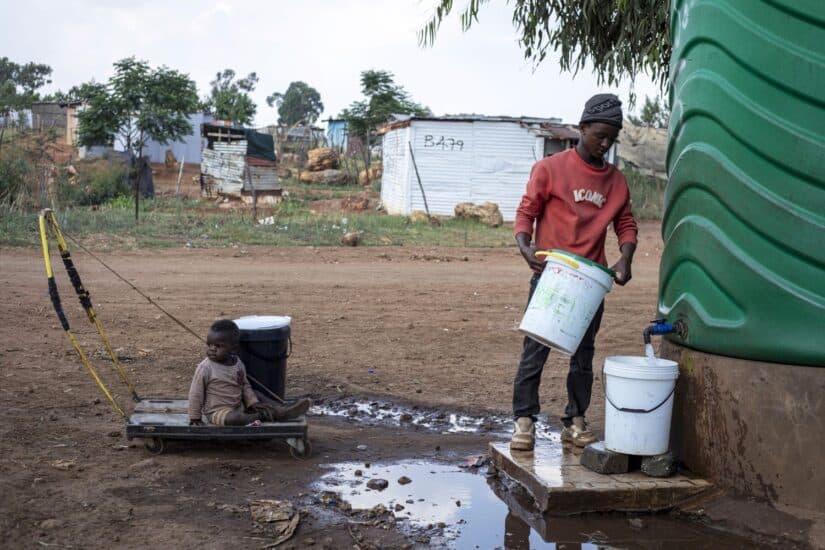
A quick look at the stats and capex budget explains why many residents are continuously experiencing water outages. Picture: Per-Anders Pettersson/Getty Images.


In its business plan for 2026/27, which accompanies the various draft budgets and tariffs for the next financial year, Johannesburg Water is uncharacteristically blunt about the situation it finds itself in.
It says the city’s “water and sanitation service in [sic] is experiencing serious challenges and is not sustainable”.
It explains: “Long-term under-investment, weakening financial performance and declining services have put CoJ’s [City of Johannesburg’s water and sanitation services] into a compromised position.”
It highlights a “long-term and ongoing decline in service performance” – and the numbers are truly astonishing.
Non-revenue water
Stunningly, in the last 18 years, the percentage of so-called “non-revenue water”- which is water that is produced and supplied but does not generate revenue because of various losses throughout the distribution system through leaks, bursts, inaccurate metering and theft – has increased from 29.4% (2007) to 44.8% (2025).
This means practically half of the potable water supplied by the city is never billed for.
Of this, physical losses were 24.8%, unbilled authorised consumption (basically faulty metering) was 11.7% and commercial losses 9.7%.
The commercial losses include so-called “deemed customers”, which the city says is unique to Joburg.
CoJ water billing system
There are currently 99 000 customers within this category in Soweto, Orange Farm and Alexandra, and they are being billed at a flat rate of 20, 10 or six kilolitres (kl). However, Joburg Water says “investigations have indicated that the actual consumption of these deemed customers ranges between 50 kl and 60 kl”.
It is busy converting these to metered area, but progress is slow.
Bizarrely, as part of the strategic shifts in its “Turnaround Strategy 2024”, it reckons through establishing “capacity for effective implementation” it will reduce non-water revenue to 30% in 2028.
This is practically impossible.
More startling stats
In addition to the non-revenue water stats, Joburg Water says there has been:
- An 8.97% increase in the frequency of water mains bursts, from 301 to 328 per 100km per year between 2012 and 2025;
- A 28% reduction in water storage capacity for the distribution system from 39 to 28 hours of average consumption between 2012 and 2022, compared to a benchmark of 48 hours, increasing the vulnerability of the CoJ’s water supply to cuts in electricity supply, and resulting in more frequent and longer water supply interruptions;
- A 20.89% increase in the number of sewer overflows from 384 to 464.21 per 100km per year between 2012 and 2025;
- A 19% decline in wastewater treatment performance from 86 to 70 between 2013 and 2022, as measured by the Green Drop audits; and
- Increasing wastewater treatment capacity deficits that limit economic development.
Reason for water outages
The second bullet point is one of the major reasons many residents are continuously experiencing outages.
If reservoirs only have, on average, a day’s worth of storage capacity, any problems with bulk supply from Rand Water or with electricity supply will necessarily result in cuts to residents and businesses within a day, on average.
This is why the utility now publishes daily updates for the systems in its various regions, which detail the status of each tower or reservoir.
To manage the supply deficit, Joburg Water often resorts to throttling of water either during the day or overnight at its reservoirs or towers.
‘Long-term’ underinvestment
Its capex is simply not keeping up with the required demands.
The entity says rather matter-of-factly “there has been long-term and systematic under-investment in both asset renewal and asset expansion to cater for new growth”.
“Investment today is lower than it was 15 years ago,” it adds.
“Consequently, there is a large backlog in investment needs. Low investments over a long period of time have had an impact on the reliability and quality of services, and on the ability of CoJ to meet increasing demands for water and sanitation services as a result of an increasing population and new developments.”
Development, services impacted
The lack of infrastructure is a real constraint on development.
In recent years, development in Kyalami has been constrained and the utility now also cites Lanseria as a choke point.
The latter has “been identified as a key economic zone in the northwestern catchment of the CoJ, but urban development is being constrained due to the lack of wastewater treatment infrastructure”.
Joburg Water says its renewal backlog, which is defined as an asset with its remaining useful life being between zero and two years and which is due for upgrading, totals R26.4 billion.
Given that the replacement cost of all its infrastructure is estimated by Joburg Water at R127 billion, this means 20% of its pipes, sewers and treatment plants are due to be replaced.
It currently says this comprises:
- Water and sewer capacity upgrading backlog – R12.8 billion;
- Wastewater treatment works (WWTW) capacity upgrading – R5.8 billion;
- Sewer conveyance network replacement – R3.1 billion;
- Water supply network replacement – R2.7 billion; and
- WWTW infrastructure renewal/equipment replacement – R2 billion
Its proposed capex budget for 2026/27 is R1.96 billion.
This article was republished from Moneyweb. Read the original here.