This sharp increase has been attributed to the large uptake of Covid-19 Social Relief of Distress (SRD) grants.
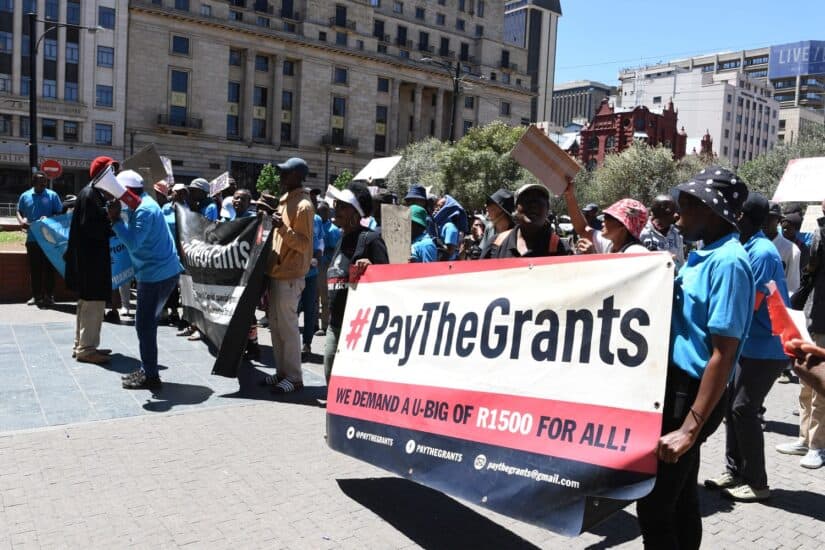
Protesters over SRD Sassa grants outside Pretoria High Court on October 29, 2024 in Pretoria, South Africa. Picture: Gallo Images/Lefty Shivambu


Social grant reliance in South Africa has increased sharply over the past two decades, reflecting both expanding state support and growing economic pressure on households.
According to data compiled by Statistics South Africa (Stats SA), between 2003 and 2025, the share of individuals receiving social grants more than tripled, while household-level access also widened significantly.
The country’s official statistics agency released the General Household Survey (GHS) on Tuesday, highlighting how social assistance has become an increasingly central part of household income for millions of South Africans.
Social grant recipients increase sharply
The survey revealed that between 2003 and 2025, the percentage of individuals who benefited from social grants increased from 12.8% to 39.5%, while the percentage of households that contained at least one individual who received a grant increased from 30.8% to 50.6%.
This sharp increase has been attributed to the large uptake of Covid-19 Social Relief of Distress (SRD) grants, which were introduced in 2020 for unemployed people. The survey noted that “social grants continued to play a critical role in household livelihoods”.
The GHS tracks development progress and identifies persistent service delivery gaps in the country. Findings for this report were collected between January and December 2025.
Social grants remain main source of income
The survey highlighted that for 23.4% of households in the country, social grants were not just a ‘helping hand’ but a primary source of income.
“Salaries and wages remained the main source of income for more than half (54.3%) of households, although this share varied considerably between provinces, from 68.2% in the Western Cape to 39.0% in the Eastern Cape,” Stats SA said.
The agency said data showed that living conditions for many households improved, though unevenly.
“Most households resided in formal dwellings (84.2%), while 12.1% continued to live in informal dwellings,” the survey found.
Access to utilities increases
The survey highlighted that South Africans saw an increase in access to utilities over time. “Access to improved water, sanitation, and electricity increased over time,” said the agency.
“Despite declines in access to water in Limpopo (‑10.6 percentage points) and Mpumalanga (‑4.2 percentage points), access to improved sanitation increased substantially in the Eastern Cape (54.6 percentage points), Limpopo (37.9 percentage points), and KwaZulu‑Natal (30.6 percentage points) since 2002, driven in part by the installation of ventilated pit latrines.
“Although access to piped water increased by only 1.3 percentage points between 2004 and 2025, this translated into an additional 6.7 million households gaining access to safe piped water.”
More households connect to electricity
Stats SA’s findings revealed that the proportion of households connected to mains electricity increased from 76.7% in 2002 to 90.6% in 2025, accompanied by a substantial decline in the use of wood (from 20.0% to 8.0%) and paraffin (from 16.1% to 1.9%) as the main sources of energy for cooking.
However, due to its relative abundance, wood was used by 37.6% of households in Limpopo and 16.3% in Mpumalanga.
The agency said about three-fifths of households had refuse removed, although access to refuse removal services remained highly unequal.
“While 84.9% of urban households received refuse removal services, only 13.0% of households in rural areas did,” noted the survey.
How households live
The statistics agency also found that more than four-fifths (84.7%) of households reported burning waste at least occasionally.
“Despite the potential environmental benefits of recycling, only one-tenth (10.5%) of households separated recyclable materials, and an even smaller proportion recycled these materials formally,” read the survey.
“Access to the internet continued to expand rapidly, reaching 85.6% of households by 2025, while access to mail services continued to decline.”
The survey found that more than two-thirds (67.4%) of households no longer had access to any mail services.
Most households are headed by mothers
Stats SA emphasised that families continue to play a central role in child development, although living arrangements remain diverse. The survey revealed that most children lived with their mothers only.
“Nearly one in five children (18.5%) lived with neither biological parent, while fewer than a third (31.4%) lived with both parents and almost half (45.9%) lived with their mothers only,” the survey found.
“Orphanhood affected 11.2% of children. Just over a quarter (26.6%) of households were single‑person households, while nuclear households accounted for 38.9%. Female‑headed households comprised 42.6% nationally, with a higher prevalence in rural areas (47.6%).”
Early childhood development
The survey noted that participation in early childhood development (ECD) programmes remained uneven.
“Just over one‑third (36.3%) of children aged 0-4 years attended ECD facilities, while more than half (50.2%) stayed at home. School participation was near universal up to age 15 (97.1%), although many learners remained in school beyond the expected age, with 8.8% of 21‑year‑olds still attending secondary school.
“Educational attainment continued to improve steadily: the proportion of adults aged 20 years and older with no education declined from 11.4% in 2002 to 2.6% in 2025, while the share with at least a National Senior Certificate (Grade 12) increased from 30.7% to 53.5%.
“Almost two‑thirds (65.1%) of learners attended no‑fee schools, although attendance varied substantially by province, ranging from 90.1% in Limpopo to 48.4% in the Western Cape. Medical aid coverage remained stable at around 15.5%, with marked provincial disparities.
“Coverage was highest in the Western Cape (25.9%) and Gauteng (22.1%), and lowest in Limpopo (8.2%) and KwaZulu‑Natal (9.5%). Black African individuals accounted for more than half (52.2%) of all medical aid beneficiaries.”