
Although the US president did not delete any names of countries before he signed Agoa, het can still do it, an economist says.
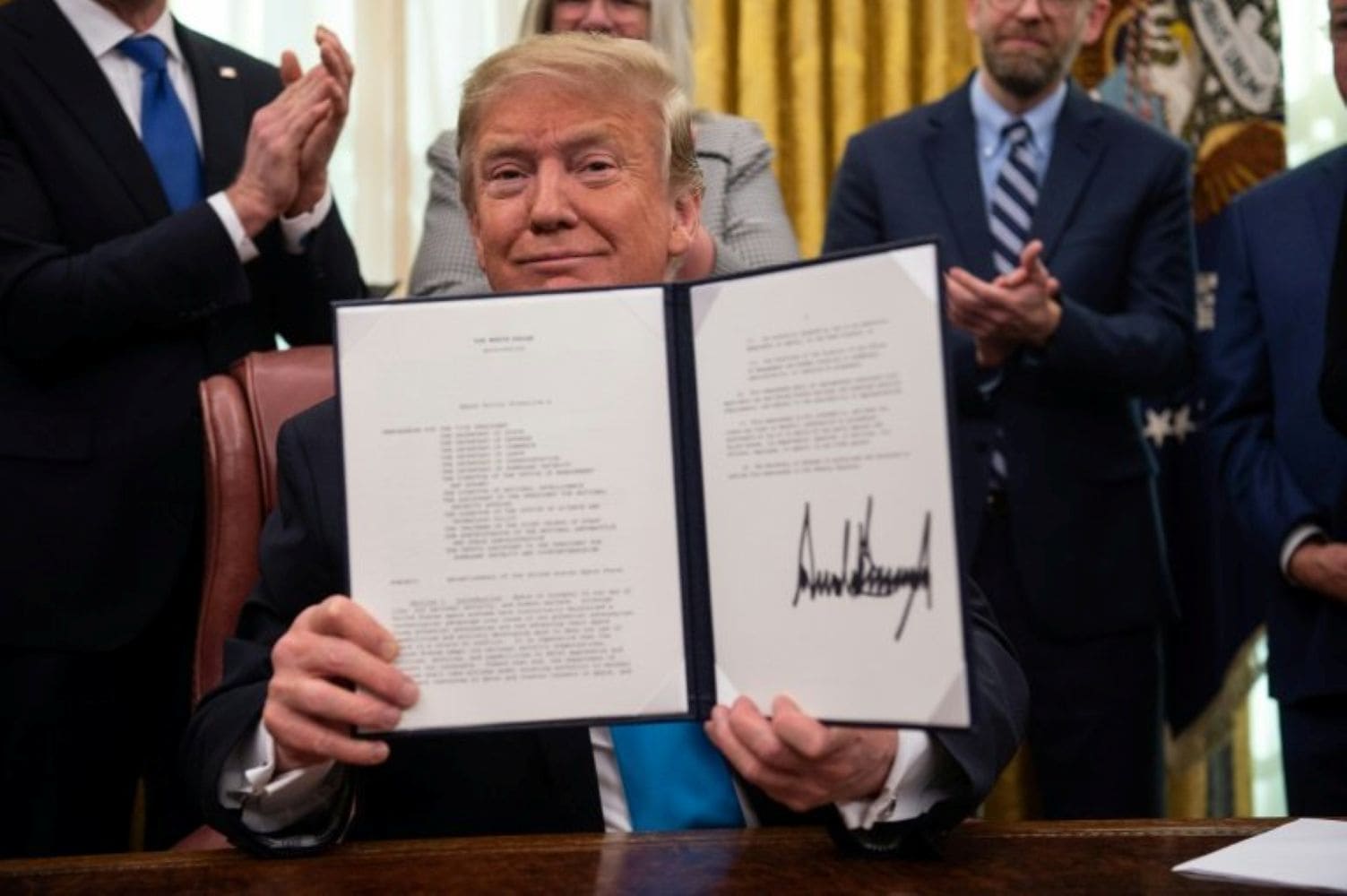
US President Donald Trump after signing a bill into law. Picture: AFP/NICHOLAS KAMM


United States (US) President Donald Trump signed Agoa into law for another year on Tuesday night and the best news is that South Africa is included, a decision that carries significant implications for South Africa’s economy.
The African Growth and Opportunity Act (Agoa) received a one-year extension from the US Senate and President Donald Trump on Tuesday, although there is still a chance that certain countries will be removed from the list of eligible nations if certain criteria are not met, Brendon Verster, senior economist at Oxford Economics Africa, says.
“Although the extension keeps Agoa alive for another year, its short duration only provides a temporary reprieve for some African nations.”
The US Senate approved a one-year extension of Agoa, a slightly trimmed-down period from the three-year extension the House of Representatives approved in mid-January. According to a statement by US trade representative, Jamieson Greer, Trump also signed the extension into law, which will now run to the end of 2026 with retroactive effect from 30 September 2025.
ALSO READ: Tau welcomes Agoa vote, still talking to US about trade
Committee decides if Senate and House disagree on Agoa
Oxford Economics Africa earlier flagged that, should the Senate and House versions differ, a conference committee would be formed to resolve the differences, and both chambers must approve the final text.
Only then would the bill go to the President, who can sign it into law or veto it. However, the House concurred with the Senate’s one-year extension, allowing Trump to sign the bill into law.
According to Greer, countries have to establish or make continual progress toward establishing a market-based economy, entrenching the rule of law, allowing political pluralism and the right to due process.
In addition, countries have to eliminate barriers to US trade and investment, enact policies to eliminate poverty, combat corruption, and safeguard human rights. Greer also stated that “We must also make sure that the programme enhances US-Africa trade and will work with Congress over the next year to modernise the programme to align with President Trump’s America First Trade Policy.”
“In our view, this means that certain countries may still be excluded after the extension if they do not meet the necessary requirements or, in any way, defy Trump’s ‘America First’ agenda,” Verster says.
ALSO READ: South Africa still negotiating for Agoa inclusion
Agoa clears final hurdle, but Africa not in the clear yet – economist
“Agoa cleared its final procedural hurdle, but Africa is not in the clear just yet, since Trump has the power to remove certain nations. Although Trump’s ‘Liberation Day’ tariffs effectively negate Agoa and while the programme has so far shown little evidence of long-term industrialisation, not all goods are covered by Trump’s tariffs, meaning that duty-free trade would still apply in some cases, while non-Agoa countries will face the higher most-favoured-nation.”
The most favoured nation rate would also apply if any of Trump’s tariffs were unwound. Verster points out that the extension only gives some certainty for existing exporters, since the current extension only runs until the end of this year.
“Still, the one-year term is also much shorter than previous multi-year extensions, discouraging long-term investments in manufacturing and value chains. In essence, the extension is preferable to a full lapse, but it is by no means a long-term solution.
ALSO READ: Agoa ends today, but Tau still optimistic it will be renewed
Only one-year Agoa extension, but political and economic win for Africa
“Although this is only a one-year reprieve for Agoa, it is still a political and economic win for countries that benefit from the Act and highlights that the US retains an interest in Africa, although it is less than under previous administrations. Trump had the power to terminate Agoa or exclude certain nations before signing but this risk remains relevant even after the extension.”
Verster says while the extension keeps the legal framework of Agoa alive, Trump and Greer retain the prerogative to exclude countries based on eligibility criteria, such as progress toward a market-based economy and the protection of human rights.
“This discretion has been exercised before. In 2024, under president Joe Biden, Uganda, Gabon, Niger and the Central African Republic were removed from the list after failing to meet eligibility requirements based on the protection of human rights.”
He points out that this makes it plausible that South Africa and other countries with deteriorating ties with the US could still be excluded at a later stage. “Despite the extension, we think Pretoria must continue efforts to improve relations with Washington over the coming months or risk exclusion over eligibility requirements.”
ALSO READ: Trump’s tariffs will override Agoa, hitting automotive sector hardest
US says we must ensure Agoa enhances Africa/US trade
Greer said in a statement that in the 21st century, Agoa must demand more from its trading partners and yield more market access for US businesses, farmers and ranchers to build upon the benefits it has historically provided to Africa and the United States.
“We must also make sure that the programme enhances US/Africa trade and will work with Congress over the next year to modernise the program to align with President Trump’s America First Trade Policy.”
ALSO READ: Sharp decrease in SA automotive exports in December due to uncertainty around US tariffs
Passing and signing of Agoa unexpected twist during strained diplomatic relations
Frederick Mitchell, chief economist at Aluma Capital, says it was an unexpected twist amidst strained diplomatic relations. “The Agoa extension arrives at a precarious time for South Africa, which has faced scrutiny from US lawmakers. The perceived “problem situation” concerning South Africa’s foreign policy stances, particularly regarding Israel and accusations of human rights violations from the Trump Administration have cast a long shadow.
“Nevertheless, South African trade, industry and competition minister Parks Tau expressed relief over the extension, recognising its potential to bolster business stability at a time when the economy is in dire need of growth.”
For South African exporters Agoa traditionally facilitated duty-free access to the US market, supporting various sectors, such as agriculture and manufacturing. “However, the current context presents a paradox: while the extension technically exists, it feels almost irrelevant given the existing tariffs that undermine its benefits.
“As a result, businesses in these sectors face the grim prospect of losing market share in the US. Due to the high tariffs, firms may experience closures and significant job losses, exacerbating an already challenging employment landscape.”
ALSO READ: Agoa extension ‘a good basis’ for stronger SA-US relations – Tau
Agoa and B-BBEE: additional layers of complexity
Mitchell says the agricultural sector, employing around 920 000 individuals, represents a vital part of South Africa’s economic fabric. However, recent governmental policies introduced additional layers of complexity.
“New Broad-Based Black Economic Empowerment (B-BBEE) requirements stipulate that agricultural exporters must meet specific racial criteria to access export permits. Critics argue that these measures unfairly disadvantage white-owned farms and could stifle the very growth that South Africa desperately requires.
“While the Agoa extension provides a temporary lifeline for South African exporters, it is evident that substantial reforms are needed to ensure sustainable growth and competitiveness in both the agricultural and manufacturing sectors.
“Addressing regulatory burdens, fostering an enabling environment for investment and balancing transformation objectives with economic realities are paramount. This way, South Africa can hope to navigate its complex international relationships while driving economic growth and job creation in the years to come.
“The path forward will require collaboration between the government, private sector and stakeholders to realise the full potential of South African industries amidst challenging global dynamics.