
Chirping with Kloof Conservancy – Wahlberg’s Eagle
Find out more about this feathered Highway resident below.
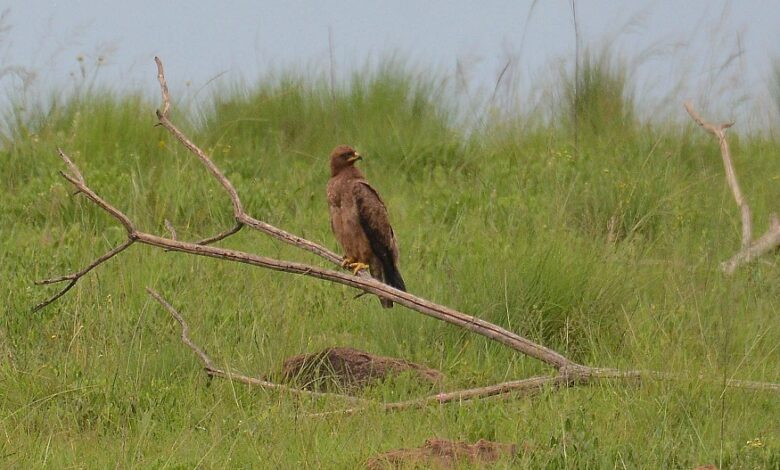
IN the Highway area, we are privileged to have an exceptional range of raptors from the tiny Little Sparrowhawk to the majestic Martial Eagle. In between, there are many others, and in this edition, we feature a seasonal visitor that comes to our area to nest and breed – the Wahlberg’s Eagle.
Also read: Chirping with Kloof Conservancy – Cape Robin Chat
Description
This is a small eagle at 58cm and 1kg in weight. Their plumage is mostly brown, but it’s not as simple as that because there are three colour morphs. All variations have a yellow bill with a dark tip, and the talons are yellow. The most common colouration is dark brown while the most extreme variation is what is known as a pale morph, where the head and neck are creamy white with the rest of the upper parts a dark grey-brown. To complicate things further, there is an intermediate morph which has colouration in between the two described but more brownish than creamy white.
It may be easier to identify them in flight as they have very straight-edged wings which form a distinctive cross with the body. The tail is also very diagnostic as it is long and very straight-edged.
Distribution
The Wahlberg’s Eagle is an intra-African migrant visiting South Africa in the summer months to nest and breed and moving to north of the equator during our winter. In South Africa, it is found from Durban northwards, including most of the northern provinces
Habitat
You will find the Wahlberg’s Eagle in well-wooded areas although it may also be found in farming areas where there are tall trees available for nesting.
Feeding
The Wahlberg’s Eagle will feed on a large range of prey, which includes reptiles, small mammals and many species of birds. Hunting is usually done from a perch or from an aerial dive, but they generally won’t pursue prey.
Breeding
The Wahlberg’s Eagles are monogamous and pair for life, and there is also a strong bond between the adults as they are very often seen together and seldom singly. As the nesting season is quite short, the Wahlberg’s Eagles tend to reuse the same nest over many years, and they refurbish it as soon as they arrive in South Africa. Many pairs have multiple nest sites which they use selectively each year. Only one egg is usually laid, and this takes approximately 45 days to hatch. Fledging occurs after approximately 73 days, and the young need to learn fast as they have a long trip to the equator within a few months of hatching.
Predators and threats
Although listed as Least Concern by the International Union for Conservation of Nature (IUCN), there is concern that habitat reduction will impact on population numbers. The population densities in nature reserves are significantly higher than elsewhere.
Local information
Durban is at the southern extreme of the distribution range of the Wahlberg’s Eagle. There is a nest in Krantzkloof Nature Reserve which is thought to be the most southern nest for this species.
Interesting facts
Wahlberg’s Eagles fall in the category of ‘booted’ eagles because their legs are feathered down to their ankles.
For more from the Highway Mail, follow us on Facebook, X and Instagram. You can also check out our videos on our YouTube channel or follow us on TikTok.