Chirping with Kloof Conservancy – The Common Waxbill
Find out more about this feathered Highway resident below.
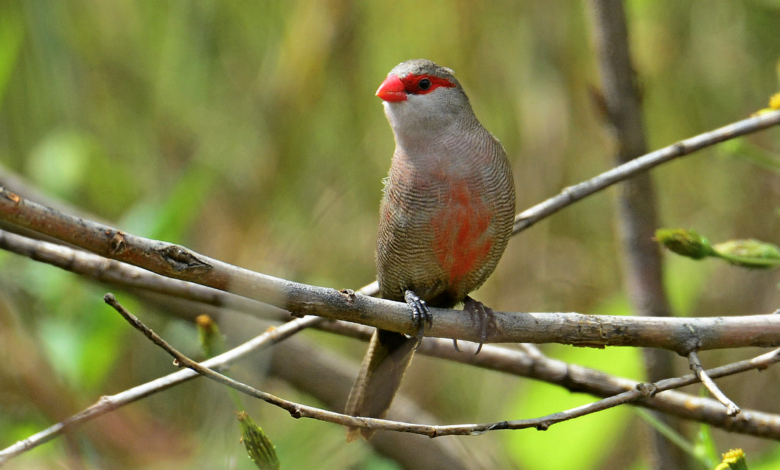
THIS week, we take a look at a tiny but pretty bird, the Common Waxbill. Although tiny, they are not difficult to spot because they often appear in open grasslands in largish family groups.
Also read: Chirping with Kloof Conservancy – Emerald-Spotted Wood Dove
Description
The Common Waxbill is a very small bird at approximately 12cm in length and only 8g in weight. What they lack in size,they make up in appearance with a bright red beak and a red mask or eye stripe. They also have a bright red underbelly, and to complete the look, their chest is a light brown with a neat pattern of close brown bars (stripes). Males and females are identical in appearance.
Distribution
They are found across the entire area of South Africa, even in the drier parts, but they are more commonly found in the wetter, eastern parts of the country.
Habitat
Because they are seedeaters, their habitats tend to be restricted to places where grasses are in abundance. They will often be spotted feeding along riverbanks which usually have healthy reeds and bullrushes.
Feeding
The Common Waxbill’s diet consists primarily of seeds and flowers from sedges, grasses and some trees. They will also feed on the occasional insect, but this is not common.
Breeding
The Common Waxbill is monogamous, ie, they pair for life, and although they are very sociable birds, they do not nest in colonies. The nest is a closed nest with a tubular entrance, is located in shrubby or grassy areas and is most often built on the ground or just above the ground. The nests are built by both adults who both take on feeding duties. Their nests are not very hygienic as the droppings of the chicks are not removed. Their nests are parasitised by the Pin-tailed Whydah which is a very aggressive bird, and the female will lay her eggs in the Common Waxbill’s nest, leaving the Common Waxbill to raise the Whydahs brood!
Predators and threats
The population numbers of the Common Waxbill are good, and they are not considered under threat. They are, however, preyed upon by many of the medium-sized carnivorous birds like the Common Fiscal.
Local information
You will find the Common Waxbill in most of the grasslands of the Highway area and on forest edges. Look out for them as they feed on the long stems of Seteria grass or thatching grass. They often appear in family groups of up to 30 individuals. They are quite skittish and constantly skip from grass to grass, never standing still for very long.
Interesting facts
The Common Waxbill uses two clever techniques to protect its nest. Breeding pairs often build a false or ‘cock’s’ nest on top of their ‘true’ nest. They sometimes even add discarded feathers or eggshells on the false nest. This fools any predator into thinking the nest is abandoned, but in the meantime, the real nest is safe underneath!
The second technique is to pick bits of fur from carnivore scats and then place them in the nest. These bits of fur are very smelly and discourage predators.
For more from the Highway Mail, follow us on Facebook, X and Instagram. You can also check out our videos on our YouTube channel or follow us on TikTok.