70 000-year-old secret unearthed in Highway area
Dr Gerrit Dusseldorp reveals groundbreaking discoveries, uncovering 70 000 years of Middle Stone Age human history in KwaZulu-Natal.
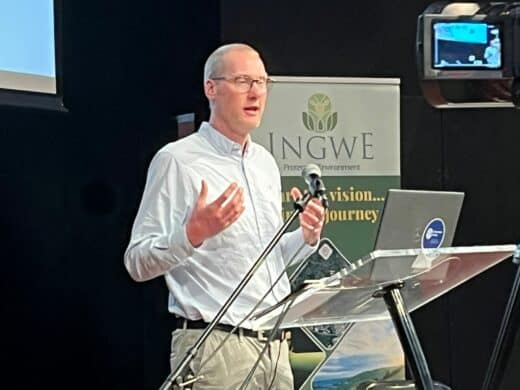
A LEADING figure in the Middle Stone Age, Associate Professor, Dr Gerrit Dusseldorp, recently gave a public presentation, ‘Revealing 70 000 Years Old Secrets’ of the greater INGWE Escarpment, to 160 members of the public.
The presentation at St Mary’s DSG was organised by the Greater Ingwe Escarpment Archaeology Group and the KZN Branch of the SA Archaeology Society.
The wider INGWE Escarpment environmental project is a community-driven private-public partnership between the Kloof Conservancy and the eThekwini Municipality. The archaeological heritage of this iconic Escarpment, adds significantly to the already incredible biodiversity richness of the area.
Also read: Kloof iconic project gets a thumbs up
Dusseldorp, the director of the Umhlatuzana Rock Shelter (URS) Unit at Leiden University in the Netherlands, has led the work – both the excavations and laboratory work – at URS since 2018/2019. The URS was first excavated in 1985 by South African archaeologist Jonathan Kaplan (discovered in 1983 at the time of the building of the N3 toll road).
Archeological evidence shows Homo Erectus and Homo Sapiens inhabiting the Highway region as far back as one million years ago.
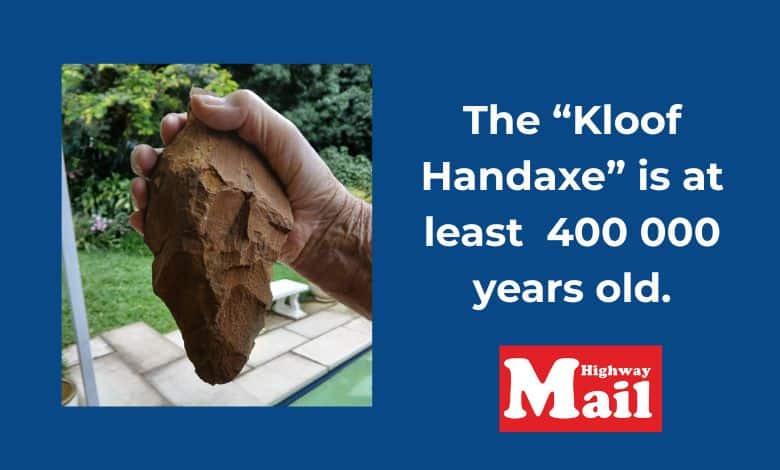
In his introduction of Dusseldorp’s presentation, Steve Hobbs, convenor of the INGWE Escarpment Archaeology Group, noted that two Archeulean Handaxes had been found in Mariannhill (in 1905), and in Kloof in 2022.
“These have been dated from, minimally 400 000 to 1 200 000 years ago. Evidence supports continuous human habitation of our Highway region and in the headwater areas of the Umbilo and Umhlatuzana rivers from these times,” explained Hobbs.
The Headwaters of the Umbilo and Umhlatuzana rivers are both hosted by the iconic and majestic Greater Ingwe Escarpment. These have clearly provided a highly attractive ecosystem for successful human habitation over the ages.
The INGWE Escarpment stretches from Fields Hill in the east, above Westmead, to the N3 tollgate, the Stockville basin and escarpment, south westward to the Giba Gorge, and up toward Assagay, adjacent to the N3.
Stone Age lithics (stone flakes and tools) have also been found in Glenholm Gorge (Umbilo river headwater) dating 55 000 to 65 000 years ago. Local archaeologist Len van Schalkwyk noted that our early predecessors were the ancestors of the Khoi San. The southerly migration of the pastoral herders and early Bantu tribes has only been in the last 2000 years (evidenced in the later Iron Age), according to Van Schalkwyk.

Dusseldorp’s work is based on a deep sequence of 70 000 years, and 29 levels of human habitation at the URS, and together with the Unit in Leiden, is shedding new light and insight into the latter part of the Middle Stone Age (MSA) in the period 30 000 to 45 000 years ago.
Dusseldorp in his presentation noted that between 50 000 and 30 000 years ago South Africa witnessed a technological re-organisation.
“Homo Sapiens having lived in the region for more than 200 000 years already, suddenly began to focus on miniaturised (or micro) stone tools. New excavations at the site of the Umhlatuzana Rock Shelter yield new understandings of these adaptive changes, not just a pure technological shift, but the establishment of a socio-economic system with innovative ways of stone tool manufacture. This provides new perspectives on the behaviours we recognise as fundamentally characterising all later human hunter-gatherer societies.”
More archaeological material recovered
In the presentation, there was also a mention of the poisoned arrows dating back 66 000 years at the URS.
According to Dusseldorp, this is a stunning finding, published in January 2026 by Professor Maralize Lombard.
“This pushes back the use of poison arrow technology and science by more than 30 000 years. This has a significant impact on our understanding of early human cognition. Much is currently being written on this subject, with this landmark discovery.”
Another recent discovery on The Greater INGWE Escarpment is that of Iron Age Pottery (or ceramics) found in 2024 on the Motala-Peace Road Grasslands dating to 750-900 AD, some 1 200 years ago. This again is indicative of early habitation of pastoralist and hunter-gathering communities in the Highway region.
“More recent Bantu Pottery sherds (1500-1850) have been found on the INGWE Escarpment at Nkonka Trust, Glenholm Gorge, Crowned Eagle conservancy, and in Winston Park. Some of this pottery has been found high up in ravines adjacent to waterfalls and is attributed to Sangomas’ religious activities and rituals.”
The Greater Ingwe Escarpment Archaeology Group called on the public who have found and uplifted any archaeological material, to please come forward, so that these may be formally recorded. They are important in helping detail a fuller picture.
Hobbs can be contacted on 082 558 3070 or at steve@rgaconsulting.com. Members of the public who wish to join the online INGWE Escarpment Archaeology Group should also use these contact details.
Hobbs cautioned that archaeological material should be left in situ. It should be photographed and reported. Heritage legislation disallows the uplifting of archaeological material.
For more from the Highway Mail, follow us on Facebook , X and Instagram. You can also check out our videos on our YouTube channel or follow us on TikTok.
Click to subscribe to our newsletter here