
Krugersdorp’s lost Carnegie Library: A century-old story of knowledge and community
Echoes of Krugersdorp: Though demolished in the 1970s, Krugersdorp’s Carnegie Library laid the foundation for the town’s thriving modern library network.
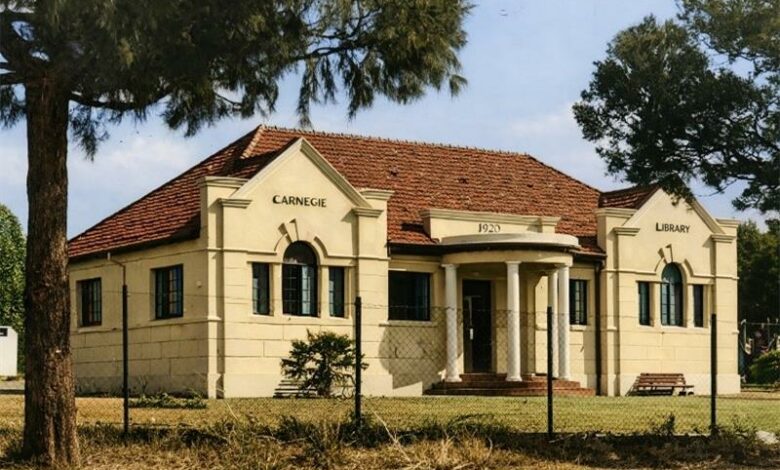
In the 20th edition of Echoes of Krugersdorp, produced in partnership with the Krugersdorp Heritage Association (KHA), we explore the history of how the Krugersdorp library was established.
Co-founder of the KHA, Jaco Mattheyse, said the story begins in the United States. In 2021, the Carnegie Corporation of New York celebrated its 110th anniversary – an opportune moment to reflect on the remarkable philanthropic legacy initiated by Andrew Carnegie and continued by the Carnegie Corporation, particularly its impact on public libraries in South Africa during the early 20th century.
In 1906, Vryheid became the first South African town to receive a financial grant from Andrew Carnegie for the establishment of a public library. By 1917, when the final endowment was made to Krugersdorp, twelve towns across the country had benefited from Carnegie funding. Jaco said that, in total, an amount of $123 855 (R245 026 727.96 in today’s money) – considerable at the time – was donated to establish free public library services for local communities.
“These 12 libraries served their communities faithfully for more than three decades. However, the promulgation of the Separate Amenities Act in 1953 restricted their use to the White population only. By the early 1970s, a combination of demographic shifts and technological changes rendered several of these early library buildings obsolete. Five of the original Carnegie libraries, including Krugersdorp’s, were ultimately demolished,” he said.
• Also read: Echoes of Krugersdorp: The hotels that built a town
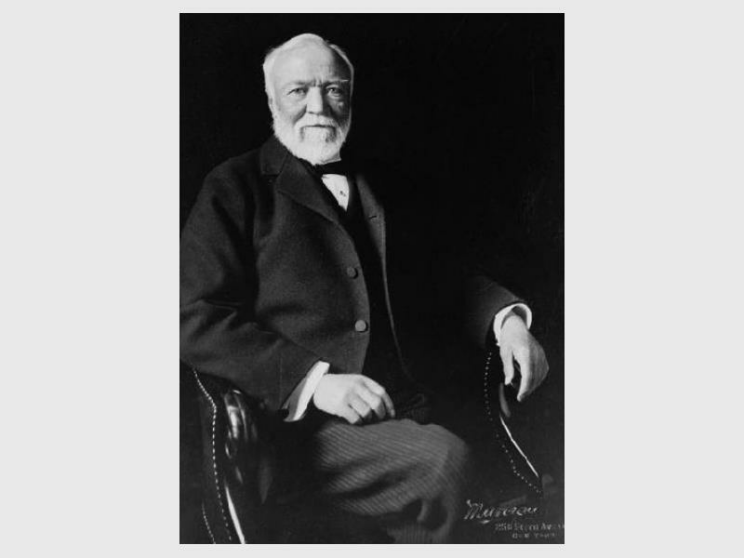
Andrew Carnegie and his vision
Jaco explained that Andrew Carnegie had a deeply personal connection to libraries.
“A self-made man who amassed his fortune in the American steel and railway industries, his formal education ended at the age of twelve. He nevertheless remained profoundly grateful for the opportunity, as a boy, to use the private library of Colonel James Anderson in Allegheny, Pittsburgh, Pennsylvania. In recognition of this formative influence, Carnegie commissioned a statue of Colonel Anderson, unveiled in 1904 outside the Carnegie Free Library of Allegheny,” Jaco said.
From his own experience, Carnegie concluded that there was no better use of wealth than the establishment of public libraries for the benefit of boys and girls, provided the community was willing to support the institution municipally. Jaco added his philanthropic efforts began in 1881 with the donation of a library to his birthplace, Dunfermline, Scotland. As his fortune grew, so too did the scope of his generosity, ultimately resulting in grants totalling some $56 million for the construction of 2 509 public libraries worldwide.
“Typically, Carnegie funding covered the construction of the library building, on the condition that the recipient municipality provided a suitable site and committed to the ongoing costs of maintaining a free public library. Of the 2 509 Carnegie libraries – fewer than one-third of which bear Carnegie’s name – 1 681 were built in the United States, 660 in the United Kingdom, 116 in Canada, 18 in New Zealand, 12 in South Africa, six in the Caribbean, four in Australia, and one each in Mauritius, Fiji and the Seychelles,” Jaco listed.
• Also read: Echoes of Krugersdorp: The untold story of Coronation Park
Design principles and architectural legacy
During the first 29 years of Carnegie grants, Jaco said the design of library buildings was left largely to the discretion of the recipients.
“Early examples, particularly in the United States and the United Kingdom, were often ornate two-storey structures with basements. Many included club rooms and auditoriums intended to generate rental income to offset operating costs. This approach later changed. The Carnegie Corporation refused to approve plans that incorporated non-library spaces. In 1910, James Bertram, Andrew Carnegie’s private secretary, issued general architectural guidelines for Carnegie libraries. Bertram argued that domes, marble, and elaborate ornamentation increased costs without enhancing library functionality, and that buildings should instead prioritise efficient and accessible library spaces,” he added.
The Carnegie Libraries in South Africa
The 12 Carnegie libraries in South Africa were constructed in towns scattered across the country, with grant amounts ranging from $4 385 in Barberton to $26 470 in Germiston.
• Also read: Die Herberg Hotel: A legacy that died in flames?
The recipient towns, in chronological order, were:
• Vryheid (1906) – $7 300. The building still exists on Market Street, now the Information Bureau.
• Harrismith (1907) – $9 825. The Town Hall still exists, but no longer houses the library.
• Hopetown (1908) – $4 850. The building still exists at the corner of Van Riebeeck Street and Van Riebeeck Avenue; currently vacant and dilapidated.
• Muizenberg (1909) – $7 800. The building still exists on Main Street, now a Police Museum.
• Barberton (1911) – $4 385. Only the façade remains.
• Standerton (1911) – $7 300. Status unknown; likely erected on the former Market Square.
• Moorreesburg (1911) – $7 290. The building still exists; now the Tourism Bureau.
• Potchefstroom (1912) – $12 175. The building still exists on Walter Sisulu Street, now the office of the Municipal Speaker.
• Benoni (1913) – $13 330. Building demolished in the 1970s.
• Newcastle (1913) – $7 290. The building still exists; until recently, an art gallery.
• Germiston (1915) – $26 470. Façade incorporated into the Dumisani Masilela City Theatre.
• Krugersdorp (1917) – $15 840. Building demolished in the 1970s and replaced by a new library on the same site in Luipaard Street.
“It is noteworthy that two libraries erected before 1910 – Vryheid and Muizenberg – feature decorative but non-functional cupolas, elements absent from later buildings. This change is likely attributable to the stricter design principles introduced by James Bertram,” Jaco continued.
• Also read: Forgotten war memorial remembered
The Krugersdorp Carnegie Library
The Carnegie endowment of $15 840, awarded in 1917, enabled the Krugersdorp Town Council to construct a purpose-built library. Jaco stated that, until then, the library had been housed in the Town Hall. The new building was designed by the Town Engineer’s Department under Mr Dobson, with David Yanghau as the builder.
According to a report in The Standard newspaper, probably dating from late 1921, Mr H. C. Reeve, chairman of the Library Advisory Committee, recalled at the official opening that the library movement in Krugersdorp had begun many years earlier at a small meeting in Keet’s Buildings. The driving force behind this initiative was Miss Helena Martin, then principal of the Secondary School and a forerunner of today’s Krugersdorp High School.
The original Carnegie Library was demolished during the 1970s, and a new library building was opened on the same site in 1976. One long-time resident recalled: “The original Carnegie Library was at the top of Monument Street, on the corner of Von Brandis. Monument Street became truncated when the library was rebuilt in the 1970s. Librarians are generally funny people – you don’t easily go rebuilding their protective space. During construction, the entire collection, along with staff and services, was relocated to the former Market Hall behind the Town Hall.”
By 1987, the new library boasted 12 400 adult members, 9 700 child members, a collection of 134 068 books, and a staff of 23, serving the main library, three branch libraries, and various depots at retirement homes and nursery schools.
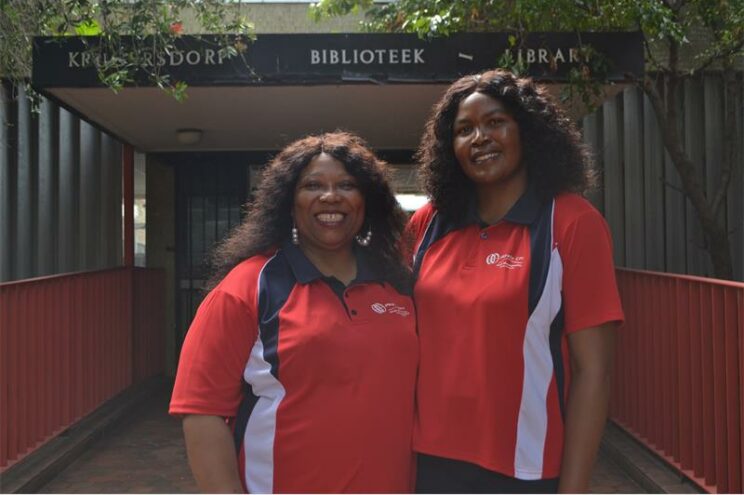
Today, the library service has expanded to include branches in numerous areas and serves the greater Mogale City area.
“Although the original Carnegie Library building in Krugersdorp no longer stands, its legacy endures. From its modest beginnings in a shared municipal space to its role as the cornerstone of an extensive modern library network, the spirit that inspired its founding remains very much alive. In keeping with Andrew Carnegie’s belief that free access to knowledge is one of the greatest gifts a community can offer its citizens, the Krugersdorp Public Library continues to serve as a place of learning, inclusion, and civic pride – faithfully reflecting the vision of both our town’s early leaders and one of the world’s great philanthropists,” Jaco concluded.