
Just energy kicks off
Key energy stakeholders, local government representatives and partners gathered in Pullenshope, to kick off the wind industry’s inaugural experiential renewable energy conversation across local schools in the province.
In support of the country’s transition to clean energy, Eskom has come alongside as a partner of this initiative, standing beside the South African Wind Energy Association in acknowledgement of its shared interest in the Just Energy Transition.
“Given our common interest in supporting the Just Energy Transition and its particular focus on the Mpumalanga Province, Eskom has joined as an official campaign partner.
“In fact, the majority of the schools that are being visited were recommended by Eskom, in line with their Socio-Economic Development strategic objectives,” said Niveshen Govender, CEO of SAWEA, who headed the delegation that included the Project Administrator of the Mpumalanga Green Cluster Agency, Celeste Dias; the Danish Ambassador, Mr Tobias Elling Rehfeld; together with Anari van Greuning, acting General Manager at Eskom’s Hendrina Power Station.
“Whilst this region is yet to build its first wind farm, it plays a critical role in the country’s energy generation as the current hub for change. As the region prepares for its continued role in electricity generation, now poised as a green energy producer, the Just Energy Transition is critical to ensure all stakeholders are engaged in this process, to ensure that the many benefits are brought to the citizens of Mpumalanga,” added Govender.
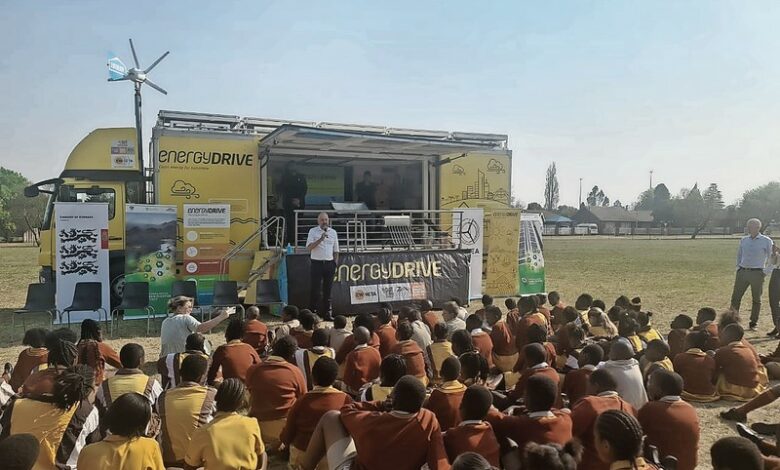
The much-loved yellow edutainer was welcomed at Laerskool Kragveld in the morning, before journeying on to Kwazamokuhle Secondary School in Hendrina.
During the course of the week, over 3 000 school learners will be visited by the Mpumalanga EnergyDRIVE, which has been funded by two key wind industry players, namely Enertrag and Windlab. It will travel across eight different communities to teach and demonstrate the benefits of renewable energy technologies.
The EnergyDRIVE is designed to be interactive, enticing and educational. It features a solar roof structure, a biogas digester, a photovoltaic panel display unit, as well as a solar hot water display unit.
The walls of the container are made up of a battery bank, photovoltaic components, and a TV and display cupboard, making it an inspirational and experiential teaching aid.