
Outgunned and outnumbered, iLembe District needs its own public order police
The iLembe cluster currently relies on a public order police unit from Empangeni which is more than an hour's drive from KwaDukuza.
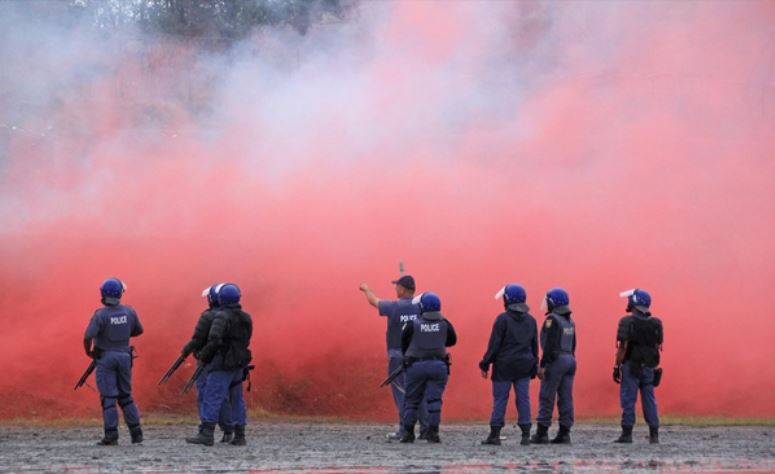
The iLembe district needs a public order policing (POP) unit of its own to deal with civil unrest, as in last month’s looting and in service delivery protests.
This is the view of a number of police officers who are called out to respond to public violence, but are not trained and are ill-equipped to deal with it.
The iLembe cluster currently relies on a public order police unit from Empangeni which is more than an hour’s drive from KwaDukuza.
One policeman told the Courier, “For instance during the recent unrest, people did not care about the local police and some were throwing stones at us and even firing shots at us. We were carrying guns but we could not use them to protect ourselves when we were attacked.”
“There was a time when there were just 5 of us facing a crowd of more than 1 000 people. If we at least had the equipment to disperse the crowd, we could have saved several businesses that were being looted in KwaDukuza. But we had to call the POP which was nowhere to be found at that time, not that they did not want to come, there were just too many protests,” said the officer, who asked to be unnamed as he is not authroised to speak to the media.
Another said he wasted at least 15 bullets, firing live rounds just to scare people off, but they knew he was not going to shoot at them and did not stop looting.
Security companies and residents had to step in and help because police were outnumbered.
As it was, a number of looters were shot and killed in Shaka’s Head and Shakaskraal and if the POP had been there to disperse the crowd the local police believe this might have been prevented.
The Courier was in Etete when hundreds of residents looted and destroyed a bottle store.
POP never arrived and they were forced to concentrate on saving the owner, leaving the store to be looted.
Ballito Neighbourhood Watch chairman Morne Steffens agreed that the cluster needed its own POP unit.
“All main stations should have their own POP. To drive a Casspir or Nyala vehicle from Empangeni takes 90 minutes, which is way too long. Worst-case scenario, we should fall under Durban which is a 30 – 40 minute drive away, ensuring a much faster response time. However, the Durban POP has a massive area to cover, so it is uncertain whether they would they be able to assist,” said Steffens.
Aresh Singh of the Crime Stop Ukukusiza group in KwaDukuza believes a local POP unit would resolve a lot of problems locally.
“Police always complain that when we call for help with protests that they do not have enough manpower. We have been hearing that song for too many years now. The quick response of POP will deter future protesters and rioters in our area,” said Singh.
The POP is the unit equipped with body armour and helmets, shields, batons, water cannons, armoured vehicles, specified calibre firearms and ammunition, communication and video equipment.
The use of video equipment helps the police secure prosecutions where criminal acts occur and when convenors of protests fail to control gatherings.
After the 2012 Marikana massacre in which 44 people were killed – most at the hands of police – Saps promised to expand public order policing units.
The 2014 proposal anticipated that by 2018, the POP personnel would more than double from 4,721 to 9,522, and the number of units would increase from 28 to 54.
While there has been some growth it has not been at the rate envisioned.
According to Police Minister Bheki Cele, in March 2021 the number stood at 6,324, a rise of 34% from 2014.
Units have been increased to 49.
Despite the increases, police were still overwhelmed when responding to the recent unrest.
The KZN Saps had not responded to our request for comment at the time of publication.
Read original story on northcoastcourier.co.za

