
[Watch] Homo naledi child’s skull of 250 000+ years old revealed
Researcher reveals the Homo naledi child's skull found in Cradle of Humankind.
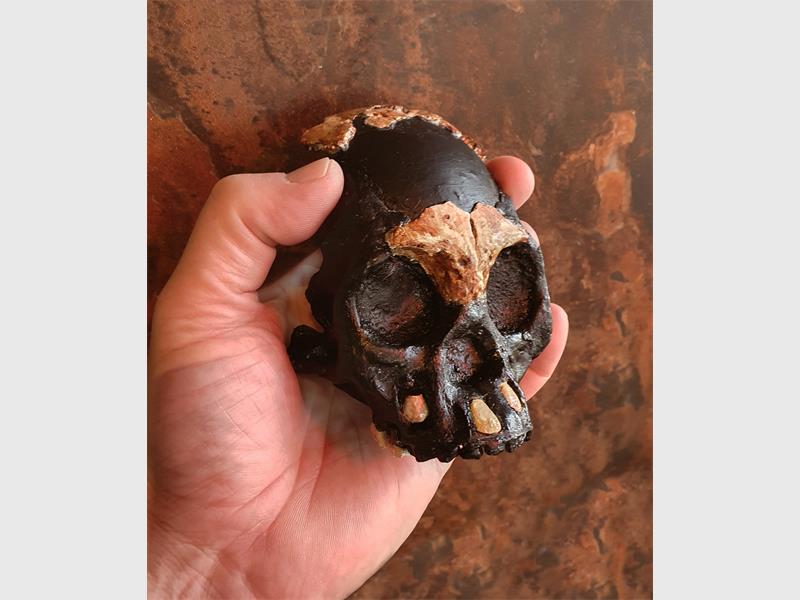
A team of international researchers revealed the first partial skull of a Homo naledi child during a special event on November 4.
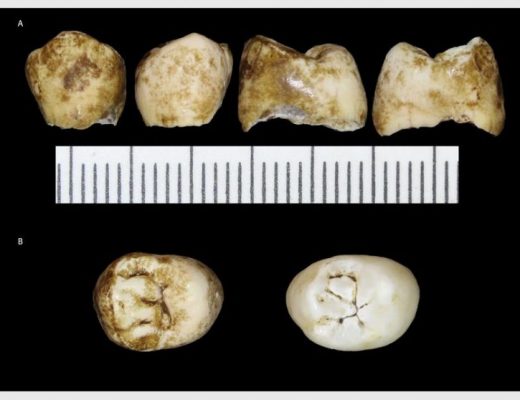
Project leader Professor Lee Berger, Director of the Centre for Exploration of the Deep Human Journey at Wits University and his team named the child ‘Leti’ after the Setswana word ‘letimela’ meaning ‘the lost one’. Leti’s skull consists of 28 fragments and six teeth, and when reconstructed shows the frontal orbits and top of the skull with some dentition.
“There were no replicating parts as we pieced the skull back together and many of the fragments refit, indicating they all came from one individual child,” said Darryl de Ruiter, a palaeoanthropologist who previously led a study of the adult skull of Homo naledi.
A statement from Wits University said the fragments that were found in the depths of the Rising Star Cave in the Cradle of Humankind in 2017 were those of a child of approximately six years old. It has yet to be established how old Leti’s remains are but since other fossils found dated between 335 000 and 241 000 years ago it is likely that Leti is from a similar period. No remains of the body have been recovered.
The fragments were discovered in a very remote passage of the Rising Star Cave System, 12 metres beyond the Dinaledi Chamber and adjacent to the Chaos Chamber, which is the site of the discovery of the first Homo naledi remains that were revealed to the world in 2015. The passage measured only 15cm wide and 80cm long.
“Homo naledi is one of the most enigmatic ancient human relatives ever discovered,” said Professor Berger, who is also an Explorer at Large for the National Geographic Society.
“It is clearly a primitive species, existing at a time when we first thought only modern humans were in Africa. Its very presence at that time and in this place complexifies our understanding of who did what first concerning the invention of complex stone tool cultures and even ritual practices.”
Since the cave system was discovered in 2013 researchers have found almost 2 000 individual fragments of more than two dozen individual Homo naledi at all stages of life.
“Since its discovery the Rising Star Cave System has become one of the most prolific sites of discovery for hominin fossils in the world. Prof Berger says that work is continuing throughout the cave system and that soon new discoveries are likely to shed further light on whether these chambers and passages are in fact a burial ground of Homo naledi, as the team originally hypothesised,” read the statement.
Because there are no signs of carnivore damage or damage caused by scavenging, and also no evidence of the skull having been washed into the narrow passage, the team does not know how Leti’s skulls came to rest alone, especially in such a remote and inaccessible part of the system.

“The discovery of a single skull of a child, in such a remote location within the cave system adds mystery as to how these many remains came to be in these remote, dark spaces of the Rising Star Cave system. It is just another riddle among many that surround this fascinating extinct human relative,” Berger said in the statement.
• Information and images provided by Wits University.
Read original story on krugersdorpnews.co.za

