
Social media 101: The power of your thumbs
What you type, tweet, share or post is protected by law and, if transgressed, can result in hefty fines or even time in jail.
One, two, three, four – don’t let your thumbs create a social media war.
The thumb, as little as it is, can cause big problems for you if you are not careful. The mighty thumb is, according to data, most often used to type on mobile devices.
Just as your mouth can land you in hot water, so too can your thumb. To create awareness of responsible online behaviour, the South African Human Rights Commission has launched the Social Media Charter.
There are many things you can – and cannot – say on social media platforms. Harmful expression, defamation, privacy, crimen injuria, harassment, and bullying will be summarised in this article.
Harmful expression
Inequality and discrimination are terms that are synonymous with South Africa’s past. To this day, these are some of the biggest challenges society faces, and unfortunately, they are still part and parcel of what people say on social media platforms.
“The Constitutional Court has explained that at ‘the heart of the prohibition of unfair discrimination is the recognition that under our Constitution all human beings, regardless of their position in society, must be accorded equal dignity. That dignity is impaired when a person is unfairly discriminated against.” – Hofmann v South African Airways 2001 (1) SA 1.
The Promotion of Equality and Prevention of Unfair Discrimination Amendment Act 52 of 2002 and Section 9(3) of the Constitution list various aspects of a person that should not be used as a basis for discrimination against them.
The charter refers to these as ‘protected traits’. They include, among others, race and gender.
View this post on Instagram
Our Constitution protects the right to freedom of expression, but takes into account the tension that can exist between freedom of expression and conflicting interests in society.
“It is for this reason that Section 16(2) of the Constitution makes it clear that certain types of expression are not protected by the right to freedom of expression. The excluded types of expression are: Propaganda for war (encouraging, calling for, or trying to influence people to start a war), incitement of imminent violence (encouraging, calling for, or trying to influence people to commit acts of violence), and advocacy of hatred that is based on race, ethnicity, gender or religion, and that constitutes incitement to cause harm (this is generally known as hate speech).”
Hate speech is not the only form of expression that is discouraged by the charter as ‘there are many types of expression that do not meet the definition of hate speech but are, nonetheless, severely harmful’.
Defamation
The commission notes that the law of defamation protects a person from ‘unjustified attacks’ on their reputation. “The right to protect your reputation is part of your right to human dignity, which is guaranteed by Section 10 of the Constitution,” the charter explains.
The charter, therefore, warns that content that will negatively affect the reputation of another person or organisation should not be posted unless:
- the facts you are posting are true and sharing them benefits the public, or
- you are sharing a comment that is your honestly-held opinion, based on facts that you clearly state or indicate, or are matters of public knowledge. The comment must also relate to a matter of public interest. The law recognises companies’ and organisations’ right to reputation because ‘they can suffer harm to their personality and have legitimate interests in the protection of their reputations’.
Use this as a rule of thumb: Will the content I am about to post about this person or organisation cause the audience to think less of them?
If the answer is yes, the content is probably defamatory.
Privacy
Photos, videos, screenshots, and audio recordings are all protected by a person’s right to privacy. As such, they should not be shared unless they reveal illegal dealings or you have the consent of those involved.
Personal and private information such as cellphone numbers, addresses and health information should not be shared unless consent is obtained from the relevant persons.
The charter says that given social media’s nature of sharing, it can sometimes be easy to cross the line when it comes to privacy without realising it.
Before posting, ask these questions:
- Would the sharing of the information intrude into a person’s private life or affairs?
- Is this the kind of content that an ordinary person would usually keep to themselves or share only with their circle of trusted people?
- Would the other person be uncomfortable sharing this information with the people who I am about to share it with (whether that is a closed group or a public platform), or would they potentially be upset about it?
If the answer to any of these questions is yes, the content may be private. If the content is private, then you should not share it unless you have permission to do so.
Crimen injuria
The Oxford Dictionary defines crimen injuria as: A wilful injury to someone’s dignity, caused by the use of obscene or racially offensive language or gestures.
This is a criminal offence in South Africa and does not require publication to a third party.
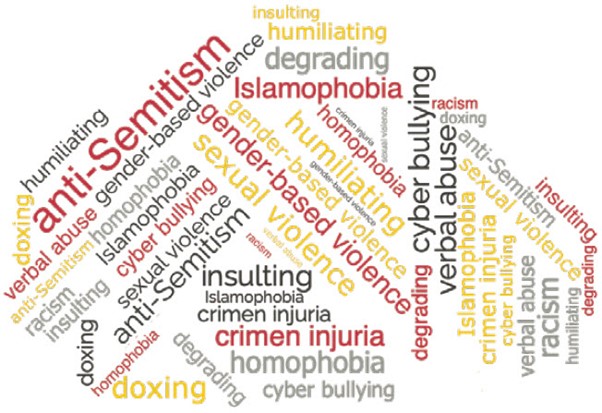
Harassment and bullying
Content that could cause a person mental, psychological, physical or economic harm (or a fear of that harm), as well as content that could cause a hostile environment based on a protected trait, should not be posted.
“Cyberbullying involves targeting a social media user…[and] is repeated behaviour, aimed at scaring, angering or shaming those who are targeted. Cyberbullying often overlaps with harassment. Harassment occurs when a person acts in a way that they know, or ought to know, causes harm or inspires the reasonable belief that harm may be caused to a person,” the charter explains.
View this post on Instagram
Read original story on benonicitytimes.co.za