
Rabobi returns: Why Spider-Man remains Mzansi’s ultimate cinematic hero
As the highly anticipated fourth Spidey film prepares to hit the big screen, industry experts explain why the web-slinger captures hearts like no other superhero.
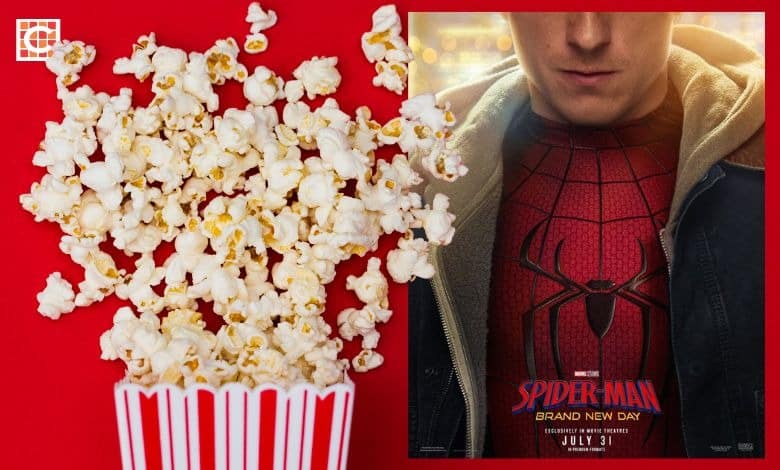
With the official global launch of the fourth Spider-Man film, featuring Tom Holland, just a few weeks away, Filmfinity (formerly known as Ster-Kinekor Entertainment) is predicting an overwhelming, chart-topping opening weekend.
“We are confident that the film will rival the biggest post-pandemic theatrical debuts,” says Thobashan Govindarajulu, head of sales and marketing at Filmfinity.
According to Govindarajulu, the blockbuster remains one of the crown jewels of modern cinema because of the sheer stakes established at the climax of No Way Home, with audiences desperate to see an isolated Peter Parker starting from scratch.
A trailer that broke the internet
Sony Pictures Entertainment officially released the trailer for Spider-Man: Brand New Day around three months ago. Since then, it has garnered over 38 million unique views globally. In South Africa, it has been sitting comfortably in the top 20 trending videos on YouTube for weeks.
“The record-breaking debut of the trailer easily broke through the noise because it promises a fundamentally raw, grounded and transformative chapter for the character, featuring highly anticipated crossovers including the Punisher and the Hulk,” says Govindarajulu.
For decades, superhero fans have locked horns in heated debates over who reigns supreme as the definitive hero: Batman, Spider-Man or Superman.
While Batman relies on being a wealthy, handsome billionaire – brought to life by the undeniable Hollywood attractiveness of actors like Ben Affleck, George Clooney and Robert Pattinson – and Superman is an invulnerable alien, Spider-Man stands apart.
The local Spidey obsession
According to Chris Broodryk, an associate professor at the University of Pretoria’s School of the Arts, the web-slinger’s true power lies in his humanity: He is ordinary, deeply fallible and yet entirely capable of impressive, extraordinary feats.
“Spider-Man definitely resonates with South African audiences, but that resonance extends globally,” notes Broodryk. “In my view, the superhero that South African audiences were historically most invested in and receptive to was Black Panther.”
However, hardcore South African Spider-Man fans would strongly disagree with Broodryk’s assessment. In fact, local costume hire shops report that both children and adults overwhelmingly prefer renting a Spidey-suit over a Superman costume.
This local obsession goes back a long time. In 2016, South African athlete and property agent Eric Nefdt began training for marathons in a full-blown Spider-Man suit, eventually completing the taxing Comrades Marathon in it in 2017. While he could have easily chosen Superman, it was Spider-Man’s iconic motto – ‘With great power comes great responsibility’ – that resonated with him.
In 2018, he walked from Pretoria to Lüderitz in Namibia, entirely in his Spider-Man suit, to raise awareness for organ and tissue donation.
This enduring appeal mirrors a global trend. Pop culture platform Comicbook.com notes that Spider-Man has been Marvel’s most popular hero almost since his inception, connecting with young readers instantly and completely overshadowing his stablemates.
Ultimately, Superman – despite his decades-long head start – can take his signature line, ‘Up, up, and away!’ and launch himself into the sky. When it comes to global impact, Spider-Man wins hands down.
He remains the world’s most recognisable superhero, with over 2.5 billion people connecting not just with his web-slinging, but with his deeply relatable humanity and his many flaws.
Billionaires, aliens and the ultimate human
According to Broodryk, Superman represents the ultimate American immigrant, heavily associated with traditional American values and an appreciation of brute strength and near invincibility.
“Another key difference is Spider-Man’s sense of humour, which Superman mostly lacked until James Gunn’s version in 2025,” says Broodryk. “Spider-Man shone when audiences grew fatigued with ‘dark’ superhero movies such as Man of Steel and The Dark Knight trilogy.”
In contrast to the Man of Steel, Peter Parker is the ultimate human.
“He pursues romantic relationships, tries to find time to study, makes friends and disappoints the people he cares about,” Broodryk adds. “He is a lower-middle-class young man trying to make his mark in the world beyond his preternatural gifts. His identity and existence do not depend on his superpowers. Also, unlike Tony Stark (Iron Man), who had his life figured out, Peter amiably fumbles from one pivotal moment to the next, as most of us do.”
Govindarajulu agrees: “The enduring power of Spider-Man lies in his profound, universal relatability. Peter Parker is a deeply human, everyday character. He is someone who struggles to pay rent, navigates complex relationships, makes mistakes and faces the same daily anxieties that the audience does.”
From TV1 to Gen Z: The story of Rabobi
Govindarajulu adds that the local connection runs incredibly deep across South Africa. “For generations of South Africans, he isn’t just a global icon; he is fondly remembered as ‘Rabobi’, a character who became a cultural phenomenon through local language television dubs. Whether you grew up singing the Xhosa theme song on TV1 or you are a Gen Z fan watching Tom Holland today, Spider-Man’s heroism has always felt accessible.
“When he puts on the mask, he doesn’t become flawless; he carries his vulnerabilities with him,” Govindarajulu continues. “His heroism is defined not by his superpowers but by his resilience. No matter how many times life knocks him down, he always finds a way to get back up, creating an emotional bond that spans across generations of Mzansi moviegoers.”
This cross-generational appeal has been carefully maintained by Hollywood.
By comparison, the modern Spider-Man movie craze established that every generation gets its own iteration of Peter Parker.
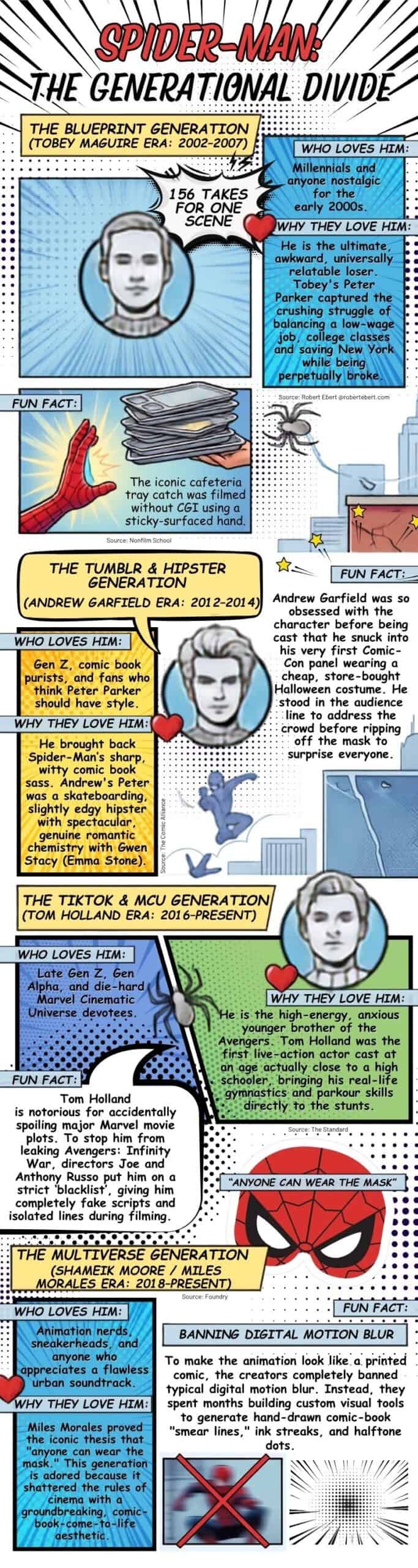
The phenomenon started in the early 2000s with Sam Raimi’s trilogy. Tobey Maguire played Peter Parker as a quiet, ordinary guy who struggled but never gave up. He featured in Spider-Man (2002), Spider-Man 2 (2004) and Spider-Man 3 (2007).
A few years later, the series was restarted by director Marc Webb, with Andrew Garfield taking over the role to deliver a cooler, tech-savvy Peter Parker who cracked jokes in The Amazing Spider-Man (2012) and The Amazing Spider-Man 2 (2014).
Next, Tom Holland brought the character into the massive Marvel Cinematic Universe, playing Peter as an enthusiastic high school student mentored by Iron Man in Spider-Man: Homecoming (2017), Spider-Man: Far From Home (2019) and the monumental Spider-Man: No Way Home (2021).
Broodryk points out that global and local awareness of the character is currently at an all-time high.
“The Tom Holland films already have a huge following, but there’s more,” says Broodryk. “Prime Video’s Nicolas Cage-starring Spider-Noir series recently launched to positive reviews and is proving very popular. Set in the 1940s, the series shows that the basic template can work in completely different visual styles without losing the character’s essence.
“Furthermore, the animated adventures in Into the Spider-Verse and Across the Spider-Verse not only introduced film audiences to an Afro-Latino Spider-Man, Miles Morales, but also demonstrated the immense range and depth of the franchise.”
Beyond the silver screen, the two Marvel Spider-Man video games released in 2018 and 2023 were critically acclaimed for their storytelling, setting global sales records. Off-screen, the star power of real-life Hollywood couple Tom Holland and Zendaya – who boast a combined Instagram following of nearly 240 million – provides an unparalleled promotional engine that keeps audiences continuously engaged.
While historically most Spider-Man films have shattered box office records, it was Tom Holland’s No Way Home that truly rocked the industry, grossing roughly $1.92 billion globally (approximately R31.16 billion).
Coming to a big screen soon
The fact remains that the latest chapter, releasing on July 31, is guaranteed to once again fill theatre seats across the country.
As Beverley Govender, senior marketing manager of Nu Metro, notes: “Major franchise releases like Spider-Man continue to be among the biggest drivers of cinema attendance. These are true event films made for the big screen, with spectacular visuals, immersive sound and action sequences that audiences want to experience together. They remind us that some stories are simply best experienced in the dark of a cinema.”
Ultimately, this cinematic pull might just make Spidey the world’s most democratic superhero.
As Broodryk concludes, while a character like Captain America fights fascism to champion a grand democratic vision, Spider-Man’s democracy is far more down-to-earth.
“He proves that even a struggling freelance photographer and occasional science researcher like mild-mannered Peter Parker can temporarily possess great power – provided they are willing to carry the great responsibility that comes with it.”
Breaking news at your fingertips… Follow Caxton Network News on Facebook and join our WhatsApp channel.
Nuus wat saakmaak. Volg Caxton Netwerk-nuus op Facebook en sluit aan by ons WhatsApp-kanaal.
Read original story on www.citizen.co.za

