
Diamond in America: Former Mbombela municipal manager helps SA businesses in ‘land of plenty’
After seven years in the US, Neil Diamond is helping South African entrepreneurs find their footing while staying closely connected to the country he still calls home.

As hundreds of South Africans build new lives in America, Neil Diamond is among those who have made the journey across the Atlantic, taking with him a long career in South Africa and a deep connection to home.
The former city manager turned businessman now lives in Atlanta, Georgia, where he serves as president of the South African Chamber of Commerce in the USA (SACCUSA), helping to promote South African business interests in the USA while building a new life of his own.
But leaving South Africa was not an easy decision.
Diamond followed his wife and children to America after they had moved ahead of him, leaving behind a life and career he had built in the Lowveld. He says he was quite happy in South Africa, but his wife wanted to move, primarily because she wanted to give their children a future in America.
Familiar name in Mpumalanga
Before moving to America, Diamond had established himself as a prominent figure in South African local government, particularly in Mpumalanga.
He was a local government expert and is credited with delivering two clean audits for the City of Ekurhuleni in 2014 and 2015, before serving as the city manager of the City of Mbombela, formerly Nelspruit.
He also headed Mbombela’s financial recovery and turnaround, taking the municipality from red to green within two years.
But all those achievements and accolades aside, Diamond is clear that he has no political affiliations and focuses on promoting bi-national business between the US and South Africa.
Referring to South Africans as a ‘herd that walks together’, he says his aim is to help them flourish in America by guiding them through a new culture and economic landscape.
“South Africans understand one another and the way we do business. We must also remember that other South Africans do not care how you get to America, whether it was through immigration or the refugee programme.
“We are all equal and have the same journey. We all have to start from the bottom and work ourselves to the top again.”
He says SACCUSA helps both refugees and immigrants find their footing in America.
Different view of home
“In South Africa, we each had our own identities, but moving to the US meant starting afresh as immigrants.
“This is not the land of milk and honey. It is a land of opportunity and hard work. You start from the bottom, not where you left off in South Africa, but you can climb the ladder very quickly.”
He says America has given him a different perspective. In his view, success is determined by hard work, problem-solving, critical thinking, innovation and creativity.
Even though he speaks English with an American twang, drinks Southern sweet tea and eats shrimp grits, there is little about Diamond that suggests he has turned his back on home.
He still speaks Afrikaans with fellow South Africans and, if the opportunity arises, still sokkies (dances) to the beat of the Campbell Brothers, who have been living in America since 2022.
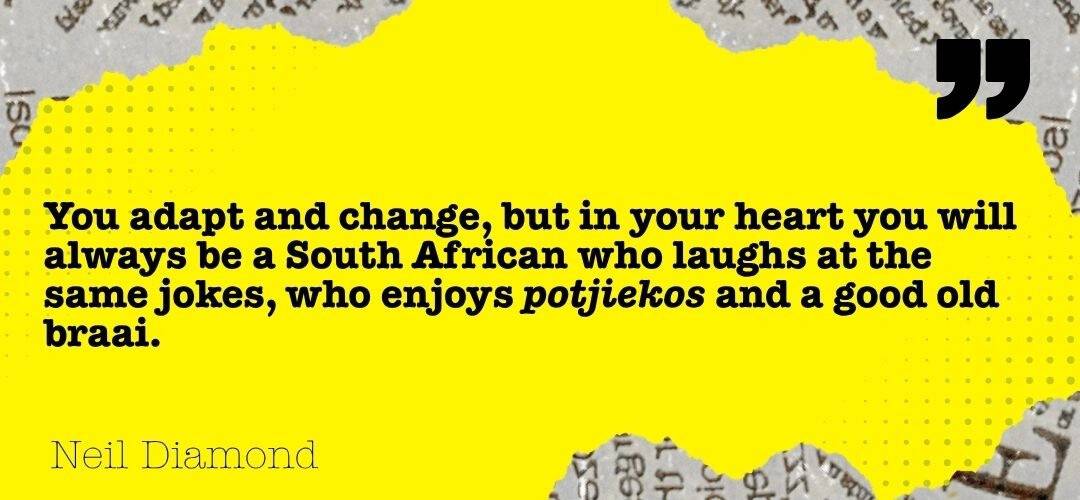
“You adapt and change, but in your heart you will always be a South African who laughs at the same jokes, who enjoys potjiekos and a good old braai. You still miss Table Mountain, the Kruger National Park and your family.”
Now in his 50s, Diamond has silver-grey hair and a solid build. With his distinguished looks, it is easy to see why some women might call him a silver fox.
South Africans in America
For Diamond, staying connected to South Africans in America is not only about community – it also represents a significant business opportunity for the expat community.
The latest available estimate puts the number of South Africa-born people living in the United States at about 156 000, based on 2024 US Census Bureau American Community Survey data.
Diamond suspects the actual number may be higher, as people who later become American citizens may no longer be counted in the same way.
For him, that also means a sizeable market for South African businesses to introduce proudly South African products to American consumers.
He says the chamber currently has around 1 000 active members.
“But I regularly meet South African business people from all over the USA that could become potential members of SACCUSA.”
Veldskoene and beskuit in America
Diamond is modest about his role in helping South African companies and products become established in what he calls the ‘land of plenty’.
People who know his work say he was the thread holding the chamber together, the man who pulled the strings at an organisation that was once ‘neither fish nor fowl’.
Today, the South African presence in America is a little more visible.
Americans eat biltong, with the ‘o’ stretched to make the vowel longer.
They wear veldskoene (traditional South African leather shoes), and it is not strange to find Diamond’s favourite wine, Hermanuspietersfontein – with labels such as ‘Kleinboet’ (little brother) and ‘Kaalvoet Meisie’ (barefoot girl) – on American shelves.
His cousin was a pharmacist in South Africa. Now, Diamond says, she bakes beskuit (rusks) for fellow South Africans and Americans.
“Yes, the Americans have mastered the art of dipping that piece of beskuit into their coffee.”
Braaivleis in place of grilling is becoming a regular thing, and even Donkey Long Tong (a South African brand of braai tongs and fire tools) has found its way into American homes.
Starting over
Building a new life in America wasn’t as simple as boarding a plane and starting again.
“Maybe certain things were easier for me than for many other people, but I certainly didn’t just arrive here and suddenly everything was sunshine and roses. It was a long process.”
Despite having an MBA and a three-year BCom degree, Diamond found that his South African qualifications were not fully recognised in the US. His BCom was regarded as an incomplete university education because American degrees typically take four years.
“You have to do a bridging course in almost any speciality, even in medical science.”
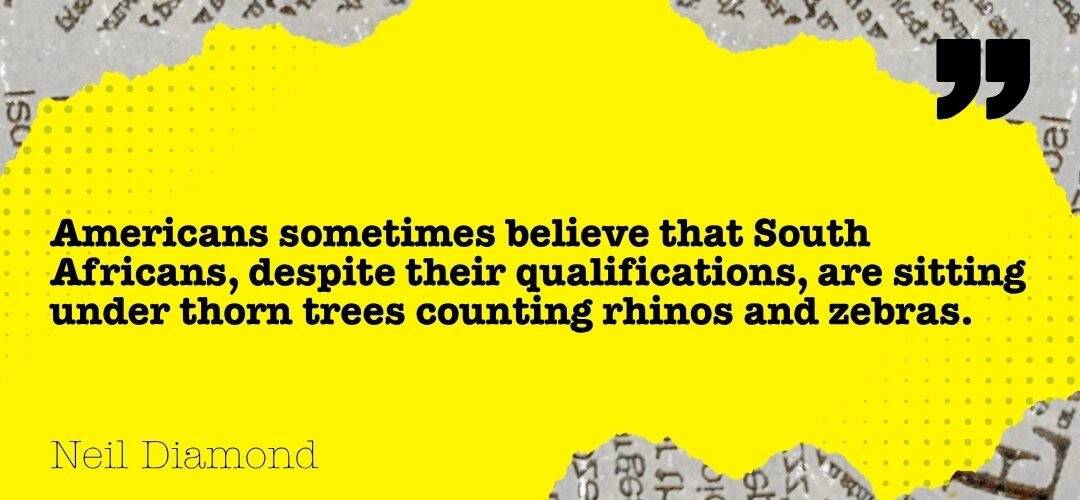
“Americans sometimes believe that South Africans, despite their qualifications, are sitting under thorn trees counting rhinos and zebras.”
“I know of doctors and dentists who have had to reinvent themselves, doing something completely different from what they did in South Africa.”
Diamond says some South Africans may struggle with the idea of taking jobs they would have considered beneath them at home.
“That is the problem,” he says. “I think South Africans are a bit snobbish when it comes to work opportunities. In America you can earn a living salary at McDonald’s, flipping and selling burgers.”
Diamond has also had to reinvent himself, moving into a field he had not worked in before. “If your experience and degree mean nothing, you have to make a plan.”
Before leaving South Africa, Diamond was offered a job at the World Bank. Then Covid-19 struck and the position was no longer available.
He found himself in a foreign country with no work and no connections. But as he states, ‘’n boer maak ’n plan – and South Africans look after one another’.
From setback to opportunity
Through a South African connection, Diamond was introduced to Nomaindiya Mfeketo, the former South African ambassador to the United States.
She asked him if he would be willing to get involved and revive the South African business chamber.
“At that stage, the business chamber was touch and go. South African expats and big companies would only be a member for a year or two and then go back to South Africa. There was no sustainability or proper structure.”
The chamber is a volunteer organisation and neither Diamond nor anyone else receives any compensation.
More and more, South African businesses are looking towards America, and Diamond says the chamber works to present South Africa in a positive light while helping companies navigate their entry and expansion in the US market.
“You must understand something; America has a big economy, the biggest in the world, in fact, and while your business might have limitations in South Africa, Americans have a huge demand for everything and your South African product could become the next big success, even vetkoek and mince with Mrs Balls Chutney.”
The chamber also works through the appropriate channels on trade issues, including the African Growth and Opportunity Act.
Afrikaans on an international level
Diamond’s daughter, Mickey, is a fourth-year psychology student at the University of Georgia and wants to continue with postgraduate medical studies.
He says she was the first pupil in the Georgia school system to receive bilingual certification in Afrikaans as a third language. She also graduated high school with Spanish as a second language.
Thanks to her home language, she later received an exemption from a foreign-language module at the University of Georgia, another first for the state and something the Diamond family is proud of.
He says Afrikaans is intertwined with his culture, faith, values and identity. “It remains part of who Afrikaners are as people, regardless of where in the world they live.”
He points out that Afrikaans is among the African languages that can be studied at Harvard University.
For all the distance between Atlanta and the Lowveld, language remains one of the things that keeps home close.
“I planted my roots in a new garden and even though I miss the soil that will always be part of my African roots, I carry new fruits in my transplanted American garden.”
Despite building a new life in America, Diamond misses his birth country, his family and friends, and the people of the Lowveld.
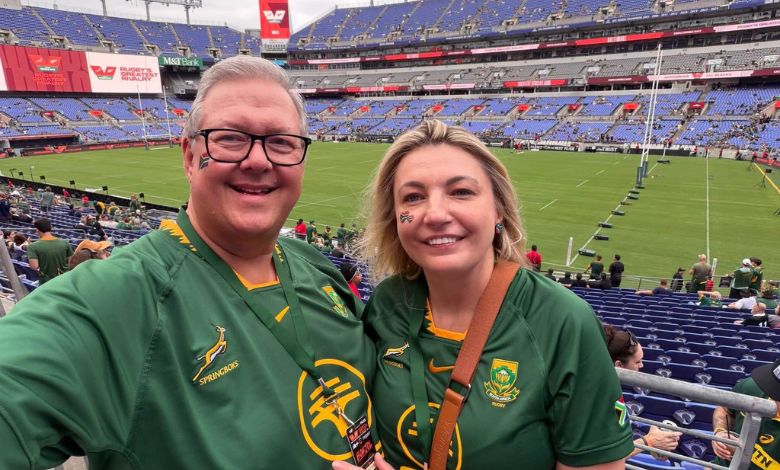
On Saturday (September 12), he was in Baltimore for the game between South Africa and New Zealand. He enjoyed Nando’s, complete with spicy peri-peri, with the Springbok team.
He sat in the stands wearing a Springbok jersey and waving a South African flag.
And he cried when the first notes of South Africa’s anthem rippled through the stadium.
Sometimes, a song can take you thousands of kilometres back home.
His life, however, is now in America.
Watch the video here:
* This is the third in a Caxton Network News series about the experiences of South Africans in America. Don’t miss the next chapter.
Read the previous stories here:
- 10 000 South African refugees and counting: The American who became their voice
- South African refugee’s hopes for a new life end in tragedy
- Onwillige vlugteling: Boervrou vind haar lot in Fate, Amerika
Breaking news at your fingertips… Follow Caxton Network News on Facebook and join our WhatsApp channel.
Nuus wat saakmaak. Volg Caxton Netwerk-nuus op Facebook en sluit aan by ons WhatsApp-kanaal.
Read original story on www.citizen.co.za

