Refreshing container roses
June is the best month for repotting container-grown roses that are not flourishing.
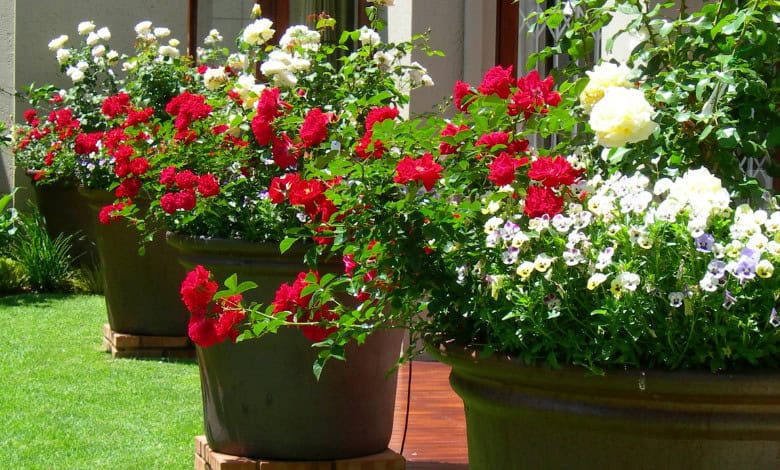
More and more gardeners are growing their roses in containers, especially in small gardens. Containers happily accommodate any impulse buy and they can be moved to follow the sun.
Roses grow very well in large-enough containers and they can stay in those containers for many years before the potting soil needs to be completely changed. All goes well until one day you look at the roses and realise that they are not looking as good as they used to.
Repotting is a big job and the good news is that there are other ways to rejuvenate poorly performing pot roses.
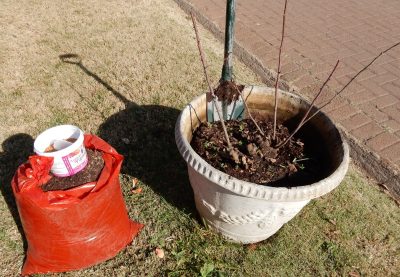
One of the most common reasons for the under-performance of roses is that over the years, the rose has sunk deeper and deeper into the pot. Some can be 10 to 15 cm below the rim of the pot.
With watering or lots of rain in summer, the potting soil compacts with less growing space and oxygen for the roots. The micro-organisms in the soil cannot function without oxygen to convert various nutrients in the soil for absorption by the roots. The roses lose their lower leaves and no longer look healthy.
Here is the solution:
Cut back or trim the rose by a third, to reduce the stress on the leaves.
Push the blade of spade down all around the plant so that it can be lifted. Then put new potting soil underneath the root ball making sure that it is filled high enough so that original root ball is now level with the edge of the container. Fill in with the new potting soil if necessary and firm down.
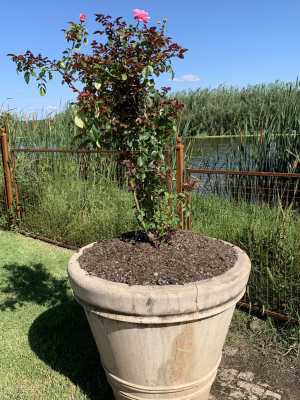
The reason for this is that as the soil settles and is watered it naturally sinks so that the rose is just below the edge.
Being much higher in the pot there is ample room for the water to run down through the pot, which suits the rose because its roots like water in motion. Pots with the holes at the bottom need to be raised a little for the water to drain out and flow away.
There is no need to fertilise. Let the rose settle in and give it a light prune in July.
Solution 2:
Another way to regenerate container roses (those that have not sunk too deeply below the rim) is to make holes in the potting soil. This method is particularly helpful for roses in very large containers that are difficult to repot.
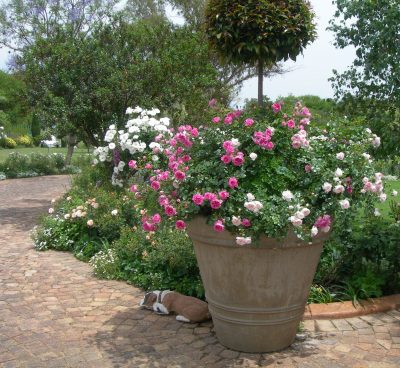
Push a wooden or metal stake into the pot and wiggle it around so that it makes a deep hole. Make a number of holes like this. Pour new potting soil into the holes and shake the container so that it settles in. Water in well. The new potting soil feeds the rose at root level, and this method also aerates the potting mix.
Alternatively, remove the top 15 to 20cm of soil from around the rose and refill with fresh potting soil. Loosening the potting soil further down will help to improve aeration and drainage.
One more tip for container roses. If you are moving a rose from a container into the garden, make sure to loosen the root ball and open up the roots so that water can reach to the centre of the root ball. Container roses can develop a very dense root ball that stays dry in the centre, no matter how much water is given. To ensure this doesn’t happen, soak the root ball in water until it is completely wet through, then plant.
Content by www.ludwigsroses.co.za.
For more on gardening, visit Get It Magazine.