Q3 data points to a housing market recalibrating, not retreating
Positive news for the property market, despite higher interest rates and continued pressure on household budgets.

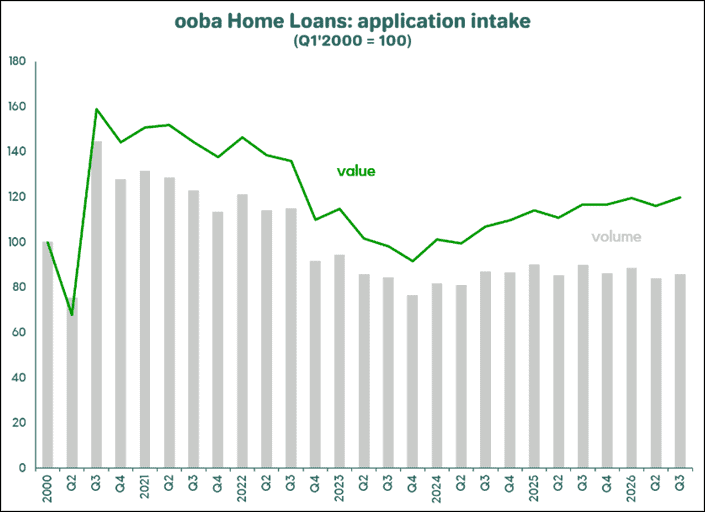
Higher interest rates and renewed pressure on household budgets tested homebuyer affordability in Q3 2026 (Q3 ‘26), yet ooba Home Loans’ data shows a housing market that’s holding its ground.
Both the volume and value of home loan applications edged higher from the previous quarter, increasing by 2.1% and 3.2%, respectively. Granted home loans followed a similar pattern, with volumes up 1.7% and values rising by 2.4% from Q2 2026.
“While home loan activity remains below year-earlier levels, the data points to a market recalibrating rather than retreating despite the effects of higher fuel prices and recent interest rates hikes which continue to weigh on household budgets,” says Rhys Dyer, CEO of the ooba Group. “Against this backdrop even modest quarterly growth is encouraging, supported by above-inflation house price growth and an ongoing appetite among banks to lend, with our customers currently benefiting from the best interest rate discounts since 2009.”
SOURCE: ooba Home Loans
House price inflation holds firm as homebuyers spend more cautiously
In Q3 ‘26, South African property values held firm with ooba Home Loans reporting a national average purchase price increase of a robust 5% year-on-year to R1 758 491, outpacing consumer inflation (at 4.4%). Quarter-on-quarter, however, it edged 0.5% lower, suggesting that homebuyers are becoming more measured in what they are prepared to spend.
A similar pattern emerged among first-time homebuyers with the Q3 ‘26 average purchase price increasing by 5.1% year-on-year to R1 292 263, but declining by 1.8% from Q2 ‘26. Average approved bond sizes also recorded healthy annual growth, rising by 7.7% overall and 5.7% among first-time homebuyers.
“What is particularly telling is that homebuyers are contributing less upfront,” says Dyer, pointing a reduced average deposit size of 12.3% in Q3 ‘26, down from 13.4% in Q2 ‘26. “The average deposit size among first-time homebuyers also dipped from 8.9% to 8.4% indicating a greater reliance on home loan finance at a time when household affordability remains under pressure.”
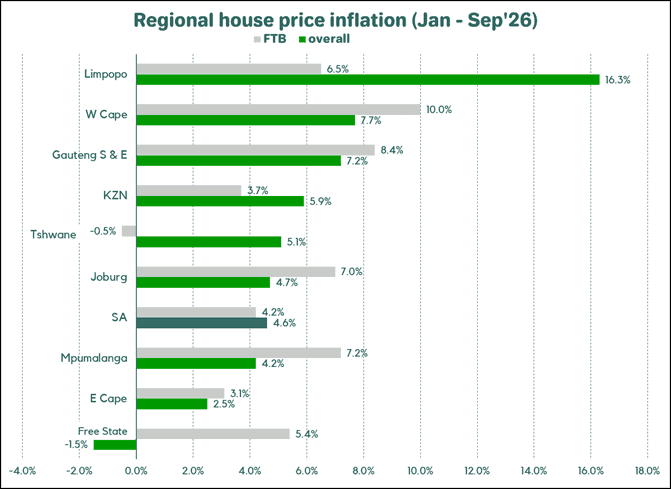
National averages, however, tell only part of the story with regional house price inflation (HPI) moving in very different directions over the first nine months of 2026.
SOURCE: ooba Home Loans
Seven of the nine regions monitored by ooba Home Loans recorded overall price growth above the average consumer inflation rate of 4%, but the spread was wide – from a 16.3% spike in Limpopo to a decline of 1.5% in the Free State.
An analysis of the first-time homebuyer segment indicates even greater regional variation, as Dyer explains, “The Western Cape, Gauteng South & East and Mpumalanga recorded particularly strong HPI, while Limpopo’s first-time homebuyer growth was far more muted than its broader market performance. Tshwane showed the clearest disconnect, with overall prices still rising while first-time homebuyer prices slipped into negative territory.”
Financing options keep the door open for first-time homebuyers
South Africa’s current affordability pressures are most evident among first-time homebuyers, who, being typically less financially established than their repeat buyer counterparts, are understandably more sensitive to higher borrowing costs. In Q3 ‘26, this segment accounted for 46.5% of home loan applications, down from 48.1% in the previous quarter and 47.8% a year earlier.
“The moderation is somewhat inevitable given the strain on household finances, but first-time buyers still represent almost half of all applications received – signalling that the appetite for homeownership remains,” says Dyer.
Importantly, homebuyers with limited savings continue to have financing options available to them. Zero-deposit home loans accounted for 56.6% of all ooba Home Loans applications received in Q3 ’26, broadly unchanged from Q2 and above year-earlier levels. Demand for cost-inclusive loans – which can also cover costs such as transfer duty and bond registration – rose more sharply, accounting for 9.8% of applications, up from 8.4% in Q2 and 6.6% in Q3 ‘25.
“Approval rates for zero-deposit home loans have softened slightly but remain at a healthy level of 82.4% overall and at 79.5% for first-time homebuyers,” says Dyer, adding that for those struggling to accumulate a large deposit alongside other upfront costs, the continued availability of these financing options remain an important route to homeownership.
Bank competition gives buyers an edge
One of the clearest positives observed in Q3 ’26 is the noticeably improved interest rate discounts from the banks, cushioning the effect of the recent rate hikes and easing borrowing costs. In Q3 ’26, ooba Home Loans customers received an average interest rate discount of prime -0.76% – a 10-basis points improvement on Q2 ‘26. In September alone, the company achieved an average rate interest rate discount of prime -0.83% for its customers – the most competitive level recorded since Q1 ‘09.
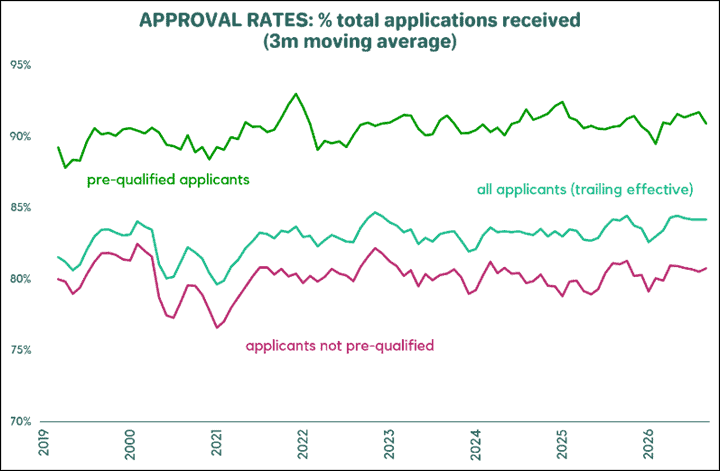
“The competition for quality borrowers remains strong and is translating into attractive interest rate discounts and consistently high approval rates,” says Dyer.
ooba Home Loans’ effective approval rate for Q3 ’26 remained steady at 84.3%, virtually unchanged from a year earlier. The benefit of being financially prepared is even clearer among pre-qualified buyers, who achieved an approval rate of 91.1%, compared with 80.9% for those who were not pre-qualified.
SOURCE: ooba Home Loans
Investor demand adds another layer of resilience
Investor activity continued to edge higher in Q3 ’26, accounting for 13.1% of all home loan applications received during the quarter, up 1.6 percentage points (ppt) year-on-year. The Western Cape remains by far the country’s most investor-heavy market, with 33.7% of applications in the province coming from investors. The strongest quarter-on-quarter increases in investor share, however, were recorded in Mpumalanga (+3.4 ppt), Limpopo (+3.2 ppt) and Gauteng South & East (+3.0 ppt).
“While investors remain a relatively small part of the overall market, the growth we’re seeing suggests that they are identifying selective opportunities even as owner-occupier buyers become more cautious,” says Dyer.
Moving into a more selective market, rather than a stalled one
Looking ahead to the final months of 2026, Dyer expects affordability to remain the defining pressure as households contend with inflationary pressures and an uncertain interest-rate outlook.
However, Dyer believes that Q3 26’s modest quarter-on-quarter improvement in both applications and instructed bonds suggests that demand has not disappeared – it is becoming more selective.
“This is likely to favour pockets of activity that are less sensitive to prevailing conditions, including investors and those moving because of life-stage changes from growing families needing more space to empty-nesters adjusting their housing needs.”
Furthermore, Dyer shares that sustained competition between the banks will also provide further support for buyers. “Opportunities still abound for prepared buyers as evidenced by high approval rates for pre-qualified applicants and ooba Home Loan’s record low interest rate discounts, once again highlighting the importance of shopping around for a home loan” concludes Dyer.
Issued by Jess Gois