Rose pruning without fear!
It's July, which means it's time to prune your roses – and – Ludwig Taschner answers some of the most frequently asked questions.

If there is one fear that unites rose gardeners it is the question, ‘What if I cut down my roses too much and kill them?’
It’s a concern that rose grower Ludwig Taschner hears every year, and he is always quick to reassure the anxious gardener that a rose can’t be killed by over pruning or under pruning it.
He gives the example of a gardener who cuts her roses down to ground level and the rose grows back in September with strong new shoots. That might sound extreme but Ludwig says that even if you make a mistake the rose will correct itself.
By July, the roses are past their best and pruning serves to neaten them, as well as rejuvenate them for the coming season. In most areas the roses can be pruned from mid-July until early August.
Ludwig’s pruning tips
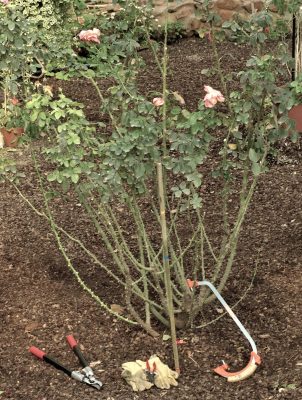
Hybrid tea, floribunda, Fairytale and Antico Moderno roses benefit most from being pruned.
This entails cutting out older stems at the base and retaining younger woody branches. The age of the wood is usually clear to see from the grey bark and prickles.
Once the older wood is removed, cut the remaining stems down to the desired height which may be at hip height, 70 to 90 cm or knee height 50cm to 60 cm.
This depends on the variety (some grow tall, others to medium height) as well as the desire for fewer long stems a rather than lots of shorter flowering stems.
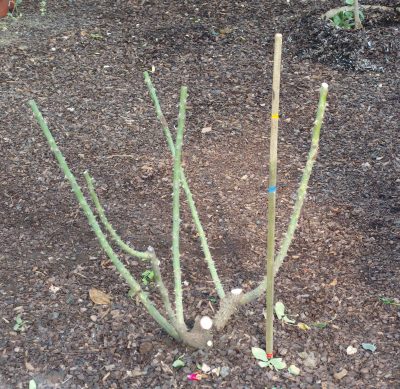
‘Iceberg’ roses
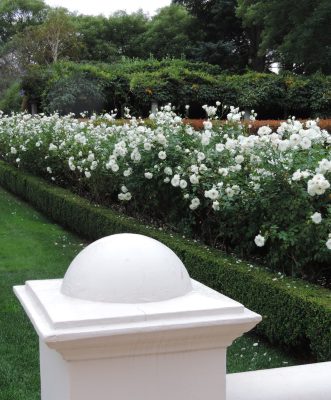
‘Iceberg’ and roses like ‘Clocolan,’ ‘Duet,’ ‘Gold Reef,’ ‘Springs 75’, and ‘Addo Heritage’ are capable of producing new stems from the old wood so it is not essential to cut out the thick older stems.
Rather use your own judgment and reduce or remove criss-crossing stems to allow for good new growth at the required height. That means if the rose is two metres high when cut back to 1 metre it will soon have grown back to 2 metres.
It is risky to cut back too severely into older mature stems. That’s because the eyes have retracted into a deep dormancy and it takes longer for these to be activated and to sprout. The resultant shoots are very sappy and easily break and bend when the spring storms arrive or the heavy flower clusters are produced.
Standard roses
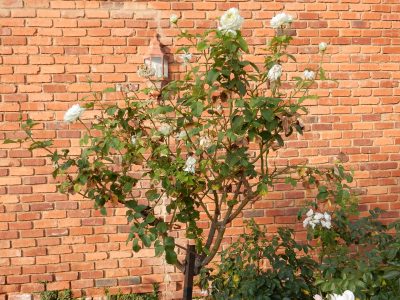
Standard roses are bush roses that have been budded onto the top of a long stem. Cut back all stems and branches to a maximum of about 50 cm from the crown or bud union and then remove all the older wood from its centre.
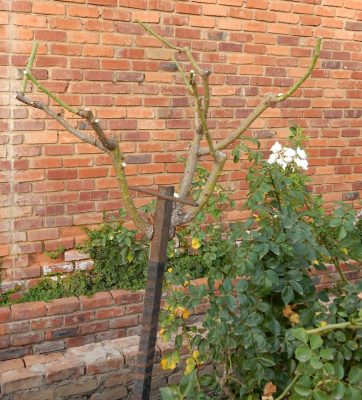
It is also a good time to check the stakes and ties that support the rose.
Remove old ties that might be cutting into the stem. Don’t use wire or ties that could damage the stem. Rather use strips of shade cloth wound around the stake and the stem right up to the crown of the rose. Pushing Styrofoam blocks between the stem and the stake also protests the stem.
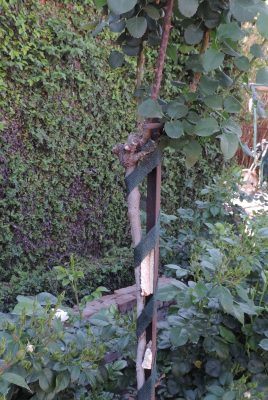
Groundcover roses

Roses like ‘My Granny’ and the other ‘Grannies,’ ‘Deloitte and Touche’ and the ‘Sunsation’ roses as well as other low growing, spreading roses are the simplest to prune.
Trim their spreading side stems back to about 30 cm from the centre or 60 cm in diameter. Small growth may be cut out as well but it can also be left and will dry out.

Aftercare
Pruning is only half the story. For the roses to really flourish the soil around the roses also needs to be regenerated. By the end of summer, the nutrients are used up and heat or heavy rain may have compacted the soil.
Dig deeply around each rose, to a depth of 30cm, working in the past season’s mulch, adding fresh compost and other organic material as well as a slow release fertiliser like Vigolonger. In the process the soil is aerated so that water reaches the roots and there are nutrients to kick start the new growth from August.
Water well, followed by watering once a week until the temperatures rise when watering can be increased to twice a week.
Content by www.ludwigsroses.co.za
For more on gardening, visit Get It Magazine.