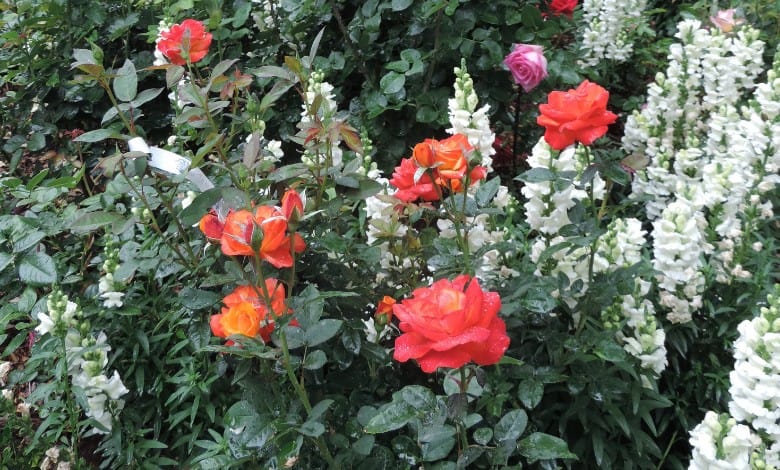
Setting a good foundation for roses in September and following a regular care routine will produce resilient roses, especially if El Niño begins to influence the weather with the possibility of higher than normal temperatures and probably less rainfall.
Tip 1: Watering
The roses grow faster in September than in any other month so it’s important that they receive all the water they need to take up nutrients and fertiliser from the soil to feed the plant. They will establish a stronger root system, with plenty of new shoots to produce a leafy bush that shades the stems, especially the hottest months of January and February.
During this period of fast growth water deeply at least twice a week. If you have an irrigation system set it to water for longer for two or maybe three days rather than just 10 minutes a day. That’s because the water needs to go down deep to the roots and a 10 minutes watering doesn’t achieve that. A single watering needs to be the equivalent of 15mm on a rain gauge. With mini sprinklers check how long it takes to fill a bucket with10 or 15 litres of water.
Tip 2: Use cooling mulch
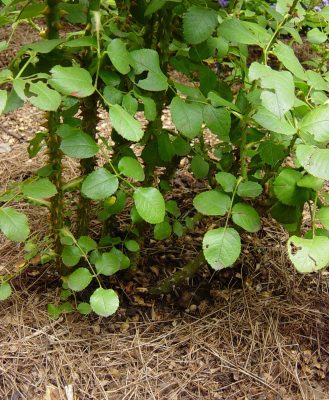
To shade the soil, reduce evaporation and keep the surface moist for longer, put down a 2 to 3 cm layer of organic material such as leaves, bark chips or pine needles. Do not push it up against the stems but leave an open area around the base of the rose so that water and fertilizer can penetrate. Renew the mulch during the season.
If the soil is compact or was not improved after pruning, dig in organics (including compost) to a depth of 30cm. Alternatively push holes into the soil with a fork and wiggle the fork to open up the holes and fill the holes with compost. This allows water to easily reach the roots. Drench after digging.
Tip 3: How to make the water go further
For roses in sandy or well-draining soil and especially in pots incorporate a water absorbing and holding product such as Terra Sorb or Swell Gel. In pots and even with garden plants it is best to make holes the size of a broom handle around the bush about 30cm deep. Mix the product with water in a bucket until it becomes a fluid jelly and pour this into the holes, pouring water over it weekly. The roots will find their way to this source of water and make good use of it.
In the event of water restrictions, use grey water from the shower or bath to water the roses. Once a week, switch over to tap water to wash away salts or other residues.
Tip 4: Feeding

Starting in September, a monthly application of rose fertiliser like Vigorosa powers the growth of new flowering stems. Sprinkle the granules over the rooting area and water in well. Don’t be tempted to over-fertilise.
The advantage of the Vigorosa fertiliser is that the inorganic component is compressed into an organic source – humic acid – which enables the plants to absorb the fertiliser quickly with no toxic residue build up in the soil. It includes chlorophyll building Epsom salts (magnesium sulphate), as well as lime and micronutrients.
Monthly fertilising continues until April, but should there be a shortage of water reduce fertilising to once every two months or reduce the amount of fertiliser to a half dose once a month. Water well after application .
Tip 5: Pest control
Sucking insects like aphids, thrips, red spider and scale can weaken a rose and if the plant loses its leaves the sun burn will kill it.
For a long-acting insect solution, particularly aphids, use Kohinor as a drench around the roses. This systemic pesticide is effective for up to five months and a reapplication may only be necessary in December. Because it is a soil drench, it is safer for bees because it goes into the plant but not the pollen. The easiest way to apply Koinor is to dilute 20ml in 10 litres water and then scoop out one litre at a time and pour it on the soil around each rose.
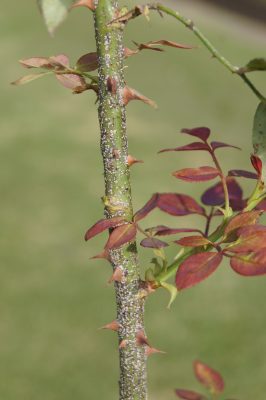
Be aware that red spider and scale suck on the downflow of the sap from leaves to roots and this is a sign with of not enough water. Increase watering and remove an existing red spider infestation spray with Ludwig’s Insect Spray Plus once a week. Make sure to spray underneath the leaves where the red spider lay their eggs.
Scale tends to colonise the stems. If you see scale use a soft nail brush, or toothbrush, and brush off the scale. Then follow up with Ludwig’s Insect Spray which contains canola oil that will smother any remaining eggs of scale. Also increase watering.
Tip 6: Finger pruning

This spring task and also only applies to hybrid tea roses. Pinch back a third of the new flowering shoots and leave the rest. This breaks the flowering cycle because the pinched stems will only come into flower two or three weeks later which has the effect of a longer flowering period.
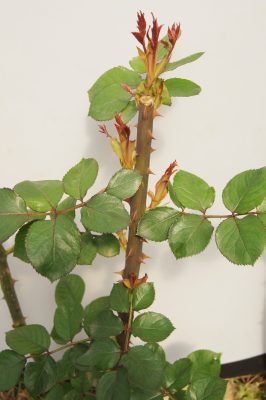
This cycle continues throughout the summer and a bush is hardly ever without a bloom. It also results in leafy plants that shade and keep the plant cool on very hot days.
Content by www.ludwigsroses.co.za
For more on gardening, visit Get It Magazine