
Covid-19: President Ramaphosa warns that the war against Covid-19 is only beginning
President Cyril Ramaphosa said that the Covid-19 pandemic is one that the country will face for at least a year to come.
The Western Cape remains the epicentre of Covid-19 in the country – of the 40 000 people who have tested positive, 27 000 of them are in the Western Cape. The province also accounts for 77 per cent of deaths.
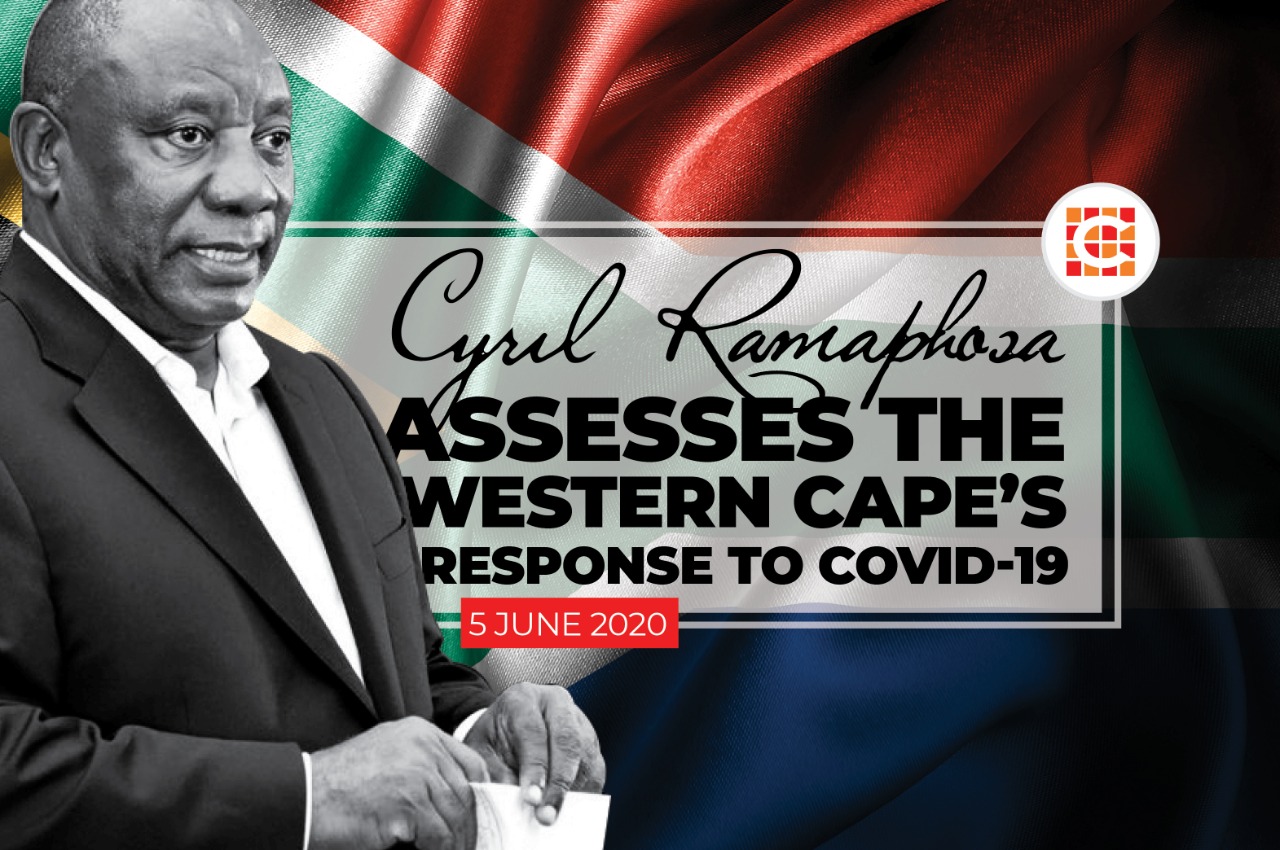
Minister of Health Zweli Mkhize spoke at a press conference 5 June, where President Cyril Ramaphosa assessed the Western Cape’s response to Covid-19. “We are concerned that these numbers will obviously be rising in the coming weeks in other provinces and the indications are that the numbers are going to be rising,” Mkhize said.
Mkhize said that there are doctors from Cuba who will be travelling to the Western Cape to assist with the high number of cases. He said that they have identified that quarantine and isolation must be focused on in order to ensure that they can break the cycle of the infection.
He added that various departments such as public works, tourism and environmental affairs, have offered additional beds so that they can ensure people are properly quarantined or isolated. “I do think we need more beds… we really need to push up close to 30 000 beds.”
He added that a surge in cases has moved more quickly than initially thought, so they thought there might be a shortfall on beds. However, he said that there is an agreement with the private sector to assist the province.
With regards to the backlog of tests, Mkhize hopes that this is a temporary problem. He said that additional testing kits from Russia have just been released from customs. He added that while a significant amount of people have been tested, they still want to test more.
Over 820 000 tests have been conducted and 23 per cent of tests have been done in the Western Cape. “We are working closely on this issue of containment. What I’ve found be important is how the multi-sectoral teams have to be activated everywhere.”
Mkhize said that they are working with standardised protocols when a patient is referred so that the government can decide when someone needs to be treated in a private healthcare facility. He emphasised, however, that there would be no difference in the standard of treatment.
The number of healthcare workers who have been infected is a matter of concern. Mkhize said that as of 28 May, there were 2 084 healthcare workers who were infected with the virus. Of this, 80 per cent, were in the Western Cape. He said that there is a need for additional support and a number of health care workers are now coming from other provinces to assist.
President Ramaphosa praised all those involved in helping curb the spread of the virus and treating those who have contracted it. He also thanks police officers, soldiers and the media for their respective roles.
He said that they are deeply concerned about the Western Cape and he is pleased to see that the provincial government is cooperating well at a national level to help curb the spread of the virus.
“As we face Covid-19 it is very important that the cooperation is at a deep level with the Ministry of Health as well as all other departments in our government.” He added that he is pleased to see Premier Alan Winde working so well with the government on a national level.
He said Western Cape has been leading the development of the district development model and through this model, they will be able to more effectively manage the virus.
“Covid-19 has also given us an opportunity which has clearly demonstrated here in the Western Cape, to work with other role players such as NGOs, religious-based organisations and all manner of other entities that have an interest in ensuring that we address Covid-19 properly.”
He that he has been made aware of some key challenges, such as staffing, which need to be solved. “We are at war, we are fighting a life and death war and staffing challenges must be solved. We must identify and headhunt all those staff members that we need to bring in.”
The President highlighted that cost is not the issue, but saving lives is. He added that when he travelled to the Eastern Cape, they also did not have enough staff members and they immediately said that more healthcare workers must be employed so that the virus can be managed properly.
“Not having enough staff is not going to be an excuse that I will accept. We have got to find them, money is not going to be the issue, we must pull out all stops to save lives. This is a war that we must win, we cannot sit back and be defeated by Covid-19 on the basis that we didn’t have enough staff members.”
He said that the province does need more beds. “I am not satisfied with the limit that you think you are going to have, we must increase the beds. It is better to over provide rather than under provide because the worst is yet to come.”
He said that when he visited KwaZulu-Natal, there were not enough beds available and at that point and he said they need to increase the number of beds, to which they responded positively.
He highlighted that while it is beneficial to work with models, which work on the basis of probability, he believes that they always need to be ahead of the curve and over provide. “If we don’t do that and we have an increase in people who need beds, we should never be found wanting.”
President Ramaphosa said he is pleased with how the Covid-19 hotspots have been identified in the Western Cape and of the great results shown. “This is precisely what we want to see in all our hotspots where our interventions and solutions are focused on each of the hotspots because it already shows, going by the Witzenberg [local municipality] case that our hotspot strategy is the correct one. Let us intensify it and begin to apply it in many other areas that are hotspots.”
He added that flattening the curve is an ongoing process and they need to identify which areas are hotspots and use all the tools available.
Ramaphosa also said that they need to up their contact tracing in order to isolate or quarantine them to help flatten the curve.
He said that social distancing is still a concern and they need to embark on a massive communication campaign so that the level of awareness among people is raised exponentially.
He added that he is aware that more funding is needed in the province and he is allocating R20 billion to Covid-19 which will be allocated through various budgetary prioritisation process and also obtaining funding from various sources. “We are going to allocate the resources necessary. We note that you need up to R3 billion or so and funding will be made available because you are the epicentre.”
With this funding, Ramaphosa hopes to see more staff brought in and more beds made available. He added that they need to ensure they care for people on a social level.
“We need to ensure that it happens at a community level and that we are responsive to the needs of our people at the community level.”
Ramaphosa said that they need to ensure that they don’t politicise the distribution of food and ensure there’s no corruption. “We do it on the basis of addressing the needs of our people, that is critically important.”
The president concluded, “This is a long-term war, it will probably take us a year and a half to two years of living with Covid, so therefore we must not lose any stamina. It is a marathon that we are running.”
Read original story on fourwaysreview.co.za