
Covid-19: Ramaphosa urges the public to maintain safety measures
President Cyril Ramaphosa urged the public to remain vigilant as they enter the festive season and announced that some Level 1 restrictions will be eased.
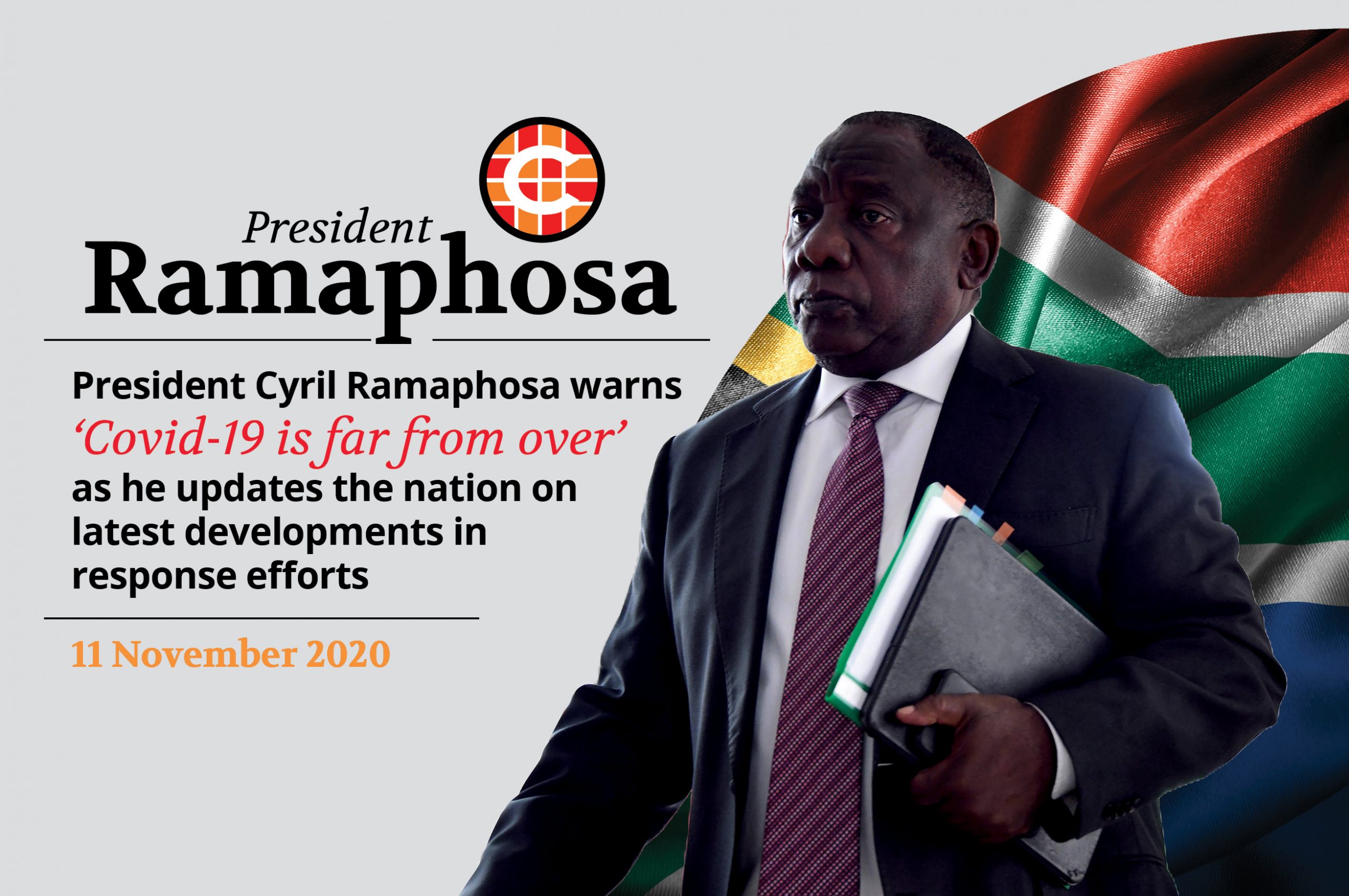
President Cyril Ramaphosa delivered an address to the nation on 11 November to update the public on South Africa’s response to the coronavirus pandemic.
The address follows a special sitting of Cabinet that considered recommendations of the National Coronavirus Command Council (NCCC).
Pandemic is far from over
Ramaphosa said that many people have suffered hardships due to the pandemic and people are beginning to feel ‘coronavirus fatigue’ but it is important to remember that the virus is still very much present. He said that the highest number of weekly cases and deaths have been recorded around the world, with at least 1.2 million deaths caused by the virus.
He highlighted that the pandemic is ‘far from over’ and will likely remain for some time to come. During South Africa’s peak, there were about 12 000 cases recorded a day.
Over the past two months, the number of infections has been relatively stable with fewer than 2 000 cases a day. “The number of hospital admissions has declined for the fourteenth consecutive week, we owe this to the decisive measures we took early in the pandemic and the contribution that every South African has made in fighting this virus.”
Ramaphosa said that the number of cases has continued to decrease and the country’s response to the pandemic has been praised around the world. “While this is welcome progress, we must acknowledge that this pandemic has taken a great toll on the health and well-being of our people. South Africa has recorded more than 742 000 cases, of these people, over 92 per cent have recovered.”
He said that the goal since the beginning of the crisis has been to save lives and protect livelihoods. “Although infections have stabilised, many people are still getting infected and we remain vulnerable. We have now seen how quickly and dramatically infections can rise in a number of countries.”
The rise of coronavirus cases has led to a number of countries imposing tough restrictions. “We have seen how a resurgence can dash the hopes of a swift economic recovery.
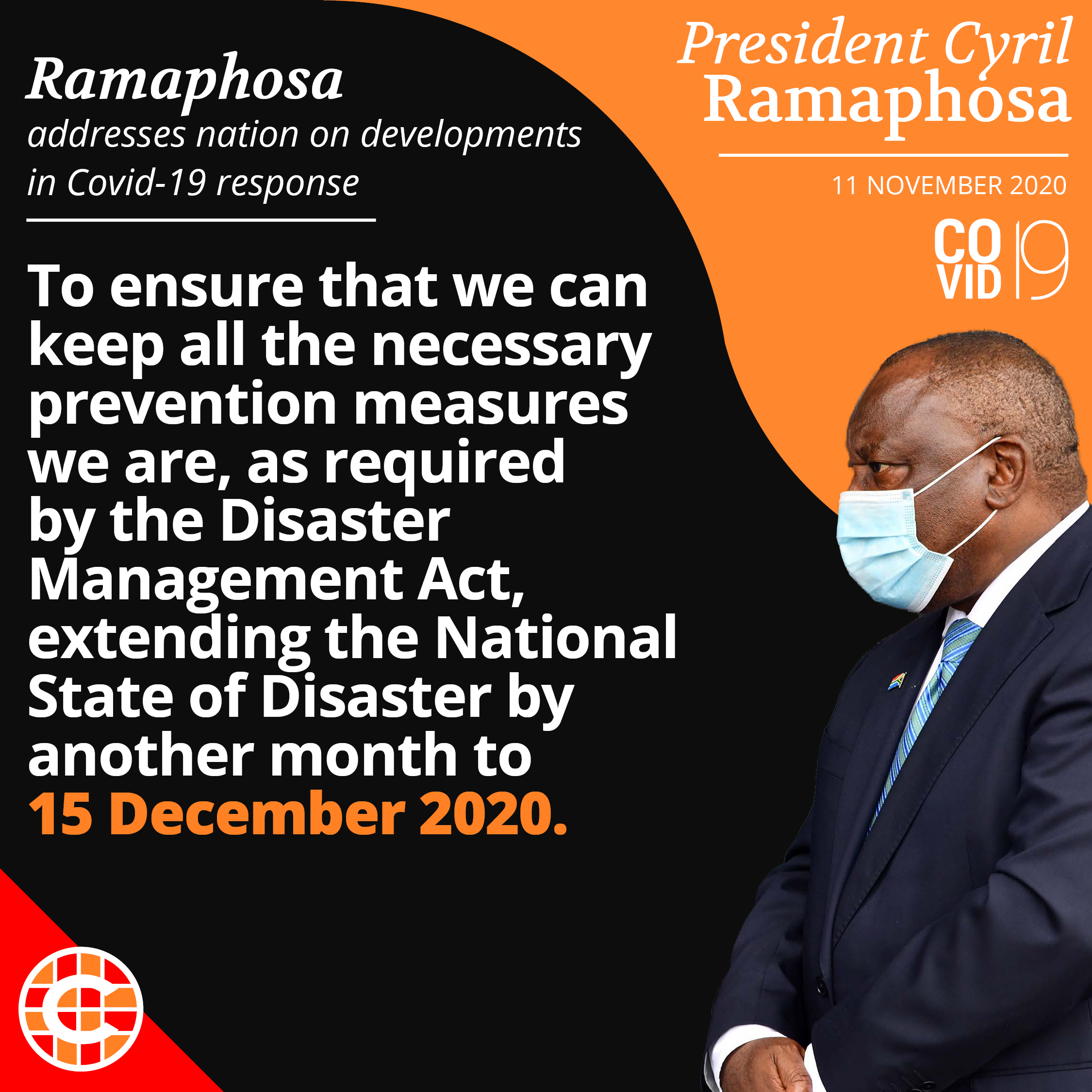
“We must do everything we can to prevent this from happening in South Africa. If we are to prevent a resurgence in South Africa, there are a few areas we must pay attention to. The first is the situation in the Eastern Cape which is showing a resurgence. In the past week, the number of new cases was 50 per cent higher than the week before.”
He added that this spike in numbers in the Eastern Cape has primarily been in the Sarah Baartman District in Nelson Mandela Bay. He said that this spike could have been triggered by outbreaks in universities, schools and social gatherings.
He said that it is a matter of time before this surge spreads to other provinces.
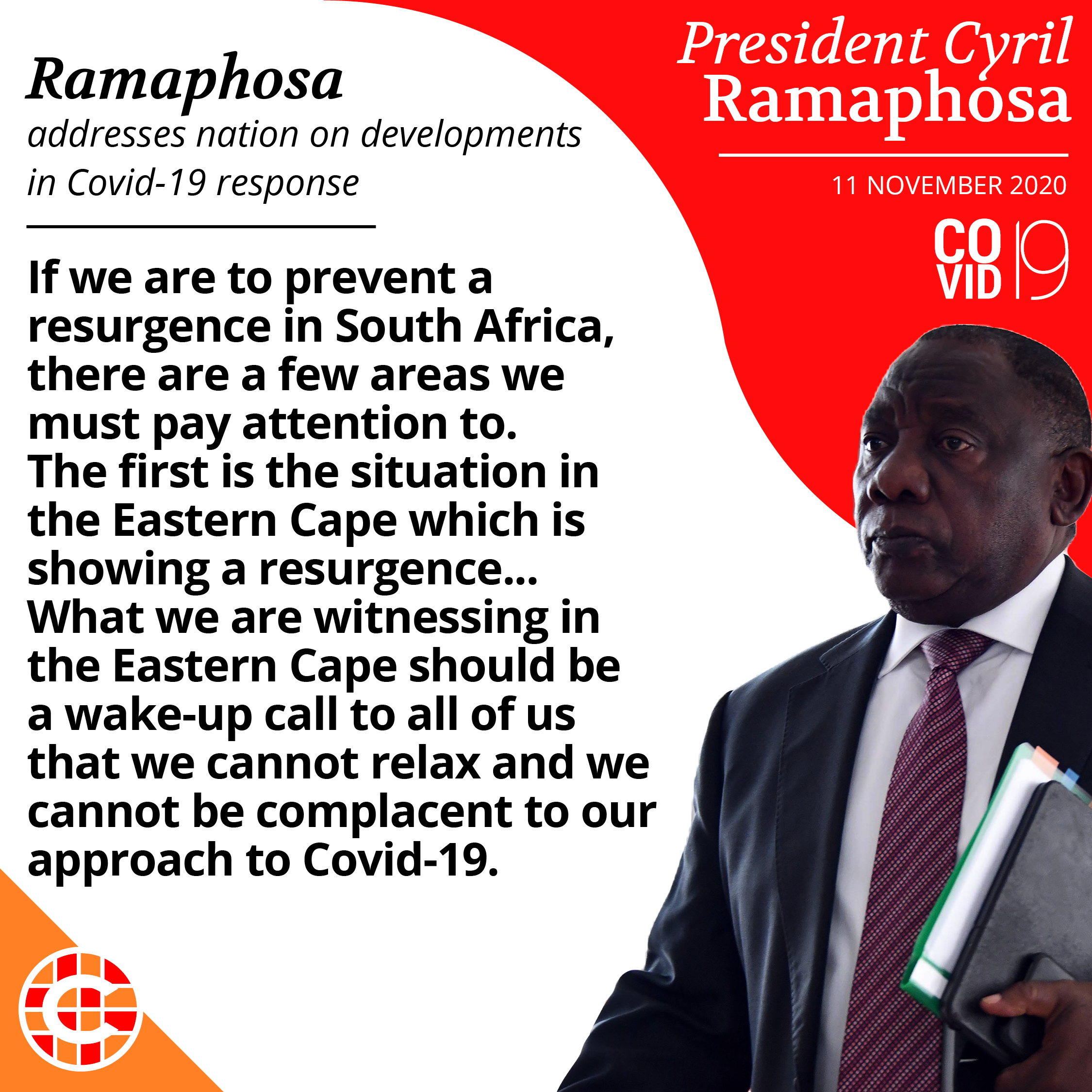
“We are implementing the resurgence plan that has been developed together with the surge team that was deployed to our country by the World Health Organisation. Interventions that we have come up with include primary healthcare outreach teams to intensify contact tracing, daily community mobilisation, ensuring the readiness of health facilities in the province and being ready to respond to cluster outbreaks.”
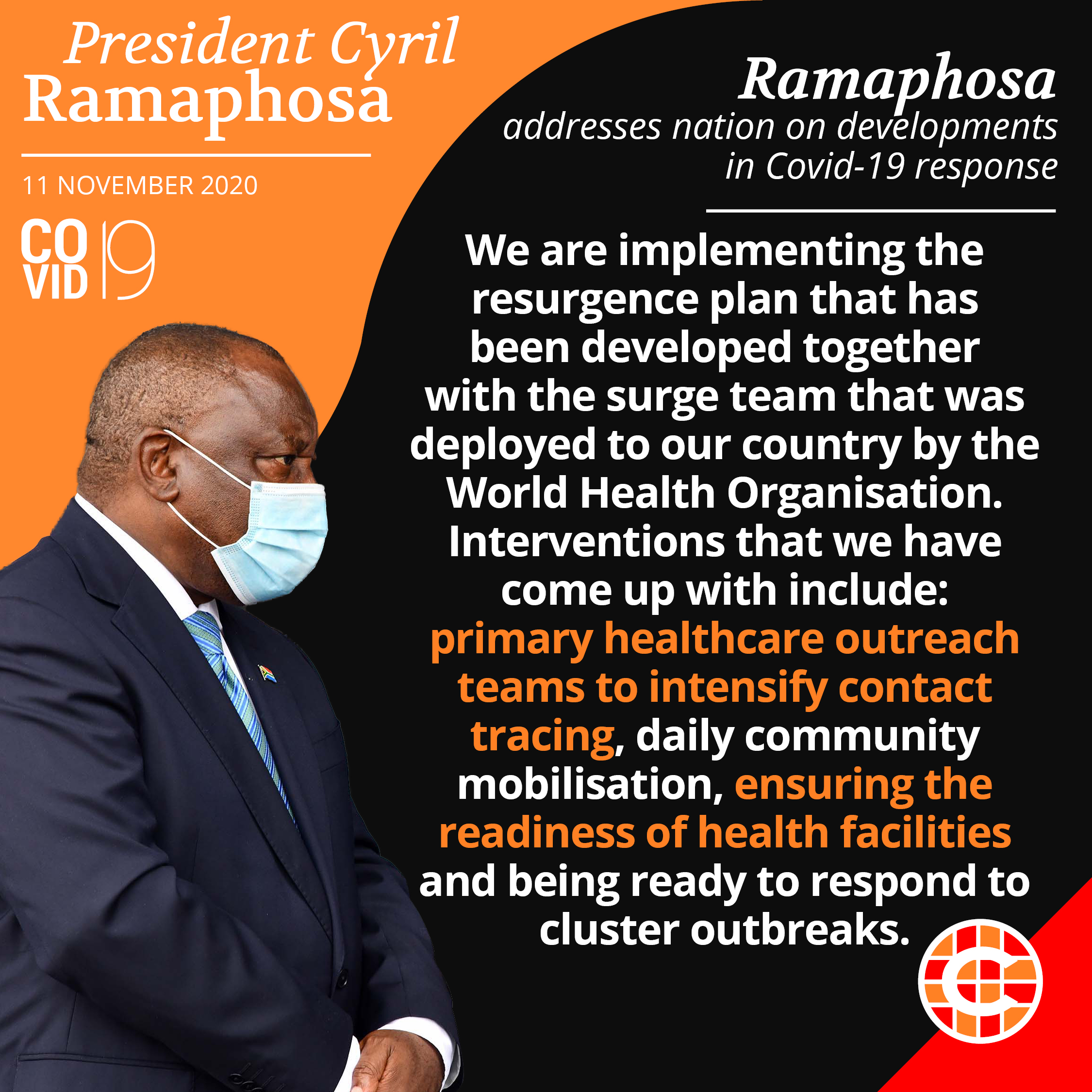
Ramaphosa said that the National State of Disaster has been extended to 15 December. He added that the second area of concern is the upcoming festive season. “During this time [the festive season], many South Africans travel to other parts of the country and tend to relax and gather socially. These activities, if not undertaken responsibly, pose the greatest immediate threat to our management of the pandemic.
“We can all play our part if we remember what we need to do to keep ourselves and others safe.”
Ramaphosa said that he is asking South Africans to do what they all know needs to be done. “We know that we need to wear a mask. A cloth mask worn over the mouth and nose is one of the best defences against the spread of coronavirus. I know this can be a hassle, they can be hot, cumbersome and uncomfortable… they also make it difficult to recognise someone or hear what they are saying… but the inconvenience of wearing one is far better than getting infected or infecting others.”
He highlighted that this inconvenience is far better than having to endure another lockdown.
“I have been increasingly getting concerned and alarmed by what I’ve been seeing on social media and television, where people are holding big parties, where they are going to big gatherings and social events as though the virus does not exist. Where they go to shebeens and taverns and dance the whole night as though the virus does not exist.
“I’ve been seeing images of indoor venues crowded with people who are not wearing masks and with no evidence of social distancing. These are super spreader events that must be avoided because this is dangerous behaviour.”
Ramaphosa encouraged South Africans to download the Covid Alert app which can notify people if they have been exposed to the virus. “It does so without sharing your location or any of your personal data. It is also zero-rated.
“We are strengthening our public interventions with regard to health. Testing is essential if we are to successfully prevent a resurgence. Without the severe capacity constraints, we had a few months ago, we are now working to significantly increase the number of tests that are done each day.”
Progress made on an effective vaccine
He added that a vaccine will be the greatest defence against Covid-19. “Equitable access to an effective vaccine is vital to the containment of the pandemic. Earlier this week, the world witnessed a game-changer in the world of science regarding the development of a vaccine. This is the first evidence that an effective vaccine against coronavirus is possible.”
South Africa is collaborating a number of multinational companies in order to obtain a safe vaccine.
“In recognition of our country’s manufacturing capability one of the leading pharmaceutical companies in the world, Johnson and Johnson, has entered into an agreement with a local company, Aspen Pharmacare, to manufacture and package its candidate vaccine.
“Aspen has the capacity to manufacture 300 million doses of the candidate vaccine at its Nelson Mandela Bay plant. This is a life-saving medical product that will be needed across the world, which will be manufactured by South African workers. Obviously, we are bidding hard to have an uptake of the product that we are producing.”
Benefits to be extended
Ramaphosa said that as restrictions are being limited, they have begun their ambitious plan for economic reconstruction. “As the economy starts to recover, many of the measures in the relief package are steadily being wound down. We are trying, with our limited resources, to do this in a gradual manner.”
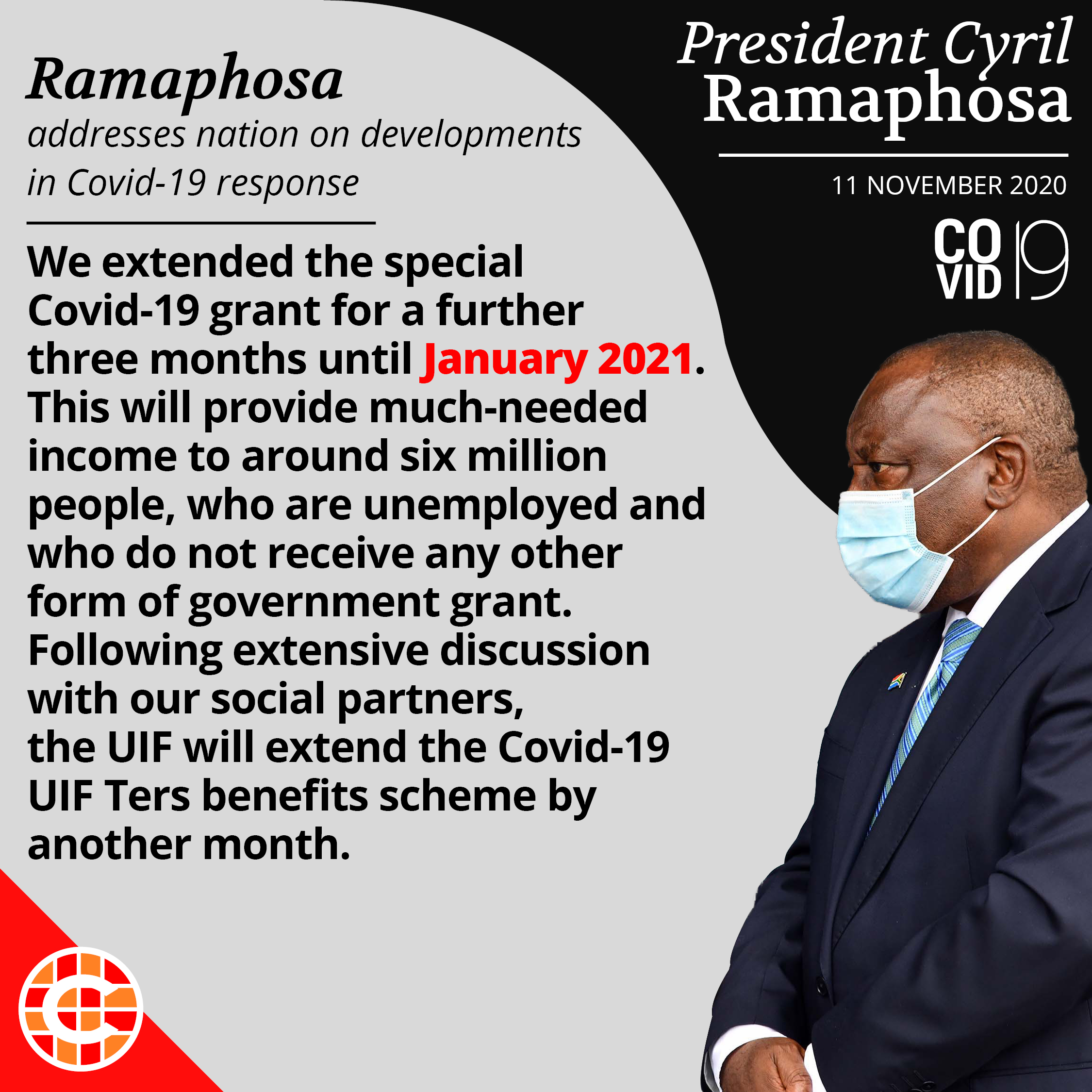
The special Covid-19 grant has been extended to January next year. “Following extensive discussions with our social partners, the Covid UIF Ters benefit scheme will be extended by another month, to 15 October.”
He highlighted that while these benefits have assisted people in a time of dire need, they will need to come to an end as the government does not have sufficient resources to continue.
Some restrictions to be lifted
Ramaphosa said that they are amending Alert Level 1 regulations to enable all parts of the economy to return to full operation as quickly and safely as possible. Trading hours for the sale of alcohol will return to normal and international travel will be allowed, subject to all health protocols.
“We expect that those measures that we are going to take will greatly assist businesses, particularly in the tourism and hospitality sectors. We are focusing relentlessly on the implementation of our plan, pursuing a few priorities with the highest impact and ensuring that we deliver on these.”
Nation to enter a period of mourning
“As we look back on a year of much pain and sorrow, it is important as a nation that we should honour and remember all those who have succumbed to this disease.
“It will be appropriate that during the 16 Days of Activism for No Violence Against Women and Children, which is the second pandemic we are confronting, we demonstrate remembrance of all those who have departed due to the pandemic and gender-based violence. Cabinet has decided that from 25 to 29 of November, the nation should embark on five days of mourning for the victims of Covid-19.”
The president called on South Africans to wear a black armband or another sign of mourning for all the people who have lost their lives to the virus.
Ramaphosa also expressed his sadness over the passing of outgoing Auditor-General Kimi Makwetu.
“We call upon all South Africans to demonstrate their solidarity and do this in remembrance of our countrymen and women, in recognition of the grief that we share as a nation, and as an affirmation of our determination to overcome this devastating disease.”
Read original story on midrandreporter.co.za

