
Economy loses up to R1b a day due to load-shedding – minister
Electricity Minister Dr Kgosientsho Ramokgopa briefed Parliament and said the power crisis needs urgent intervention.
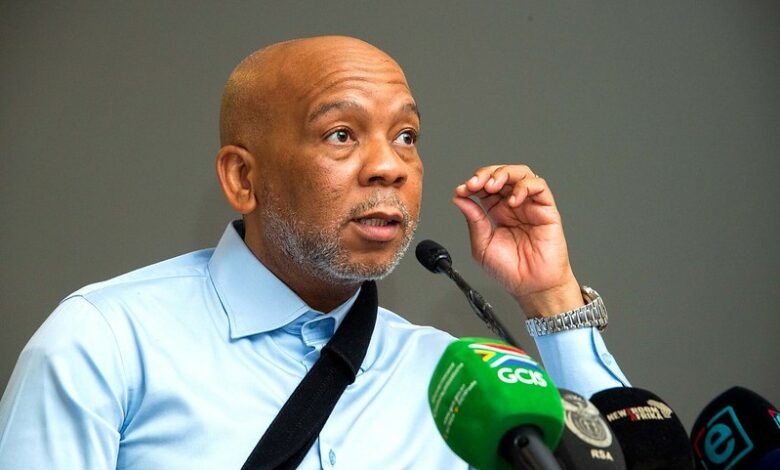
Minister in the Presidency responsible for Electricity Dr Kgosientsho Ramokgopa has told the Portfolio Committee on Public Enterprises that load-shedding is an existential problem, both in economic and social terms, which requires urgent intervention.
The minister said the South African economy could be losing up to R1b a day, depending on the intensity of load-shedding.
“This is severe. The amount of jobs that have been lost as a result of load-shedding is projected to be upwards of 800 000 just for the current year, if you were to go by the modelling that has been done by some of the reputable institutions.
“I’m trying to convey the message that we are dealing with a major problem that undermines the overall growth of the South African economy,” he said yesterday.
Ramokgopa added that as a result of this, President Cyril Ramaphosa found it appropriate to provide a comprehensive and compelling response to the crisis by unveiling the Energy Action Plan, which has about five outcomes.
The five priority outcomes, Ramokgopa said, are to fix Eskom and improve the availability of existing supply; enable private investment in new generation capacity; accelerate procurement of new capacity from renewables, gas and battery storage; unleash investment in rooftop solar PV for businesses and households, and to ‘undermine the political interest calculation, ensuring that there’s transparency in how costs are located and how tariffs are determined’.
Expanding on the first priority, the minister said they have to improve the availability of existing suppliers.
“So the focus will be on the existing fleet of Eskom coal-fired power stations, a focus on Koeberg Nuclear Power Station and also the importation of hydro that we are getting from Mozambique, ensuring that first we address the reliability of this unit… [and reduce] the rate of abrupt failure of these units, and address their efficiency as they run, then approximate their design capacity,” he said.
Turning to the second priority, Ramokgopa said that it exists to ensure that significant private sector investment is attracted, and this is supported by the reforms that were introduced on the generation side.
He explained there is a significant amount of project pipeline as a result of the reforms that have been introduced on the generation side, which focuses on the private sector and new generation capacity.
Generation performance
On the overall performance of units, Ramokgopa told the portfolio committee that the trendline has essentially been going up.
“If you look at the available capacity, you can see that it is beginning to pick up from what the situation was in May, which was used as a baseline.”
The minister said they were addressing factors that have contributed to increased load-shedding over the past week.
“… There is the good and there’s also the bad. The good is that the trendline is going up and the bad is that there are things that we admit that we can improve on, especially better planning, returning the units on time, and ensuring that gradually, we continue to reduce the intensity of load-shedding,” the minister remarked.
He said they are taking advantage of the warmer period the country is in.
“We have been ramping up planned maintenance… [We need to] make sure that we fix [the units] and when they come back, they’re healthier and they’re able to perform,” he said.
As part of improving the issues at Eskom, Ramokgopa explained they have returned two of the three units that failed at Eskom last year in October as a result of challenges related to the flue-gas desulfurisation unit, which is a mechanical component that houses a chemical process meant to reduce the amount of sulphur content that is emitted into the environment.
“We asked for a special dispensation to bypass that flue-gas desulfurisation unit and then we accepted that there are environmental costs, and that’s why we put together a comprehensive health plan to… mitigate the environmental costs, and those were approved by the minister of environment.
“Of course, we are going to return to normality, essentially to go back to the original design of going through the flue-gas desulfurisation by the end of the year 2024.
“But now we’ve got that relief and two of those three units are back. Unit 1 and 3 are back, and we anticipate to bring Unit 2 by end of the month, and then we’ll be firing Unit 5 at Kusile by the third week of December. So we project to get another 1 600MW,” the minister added.
The minister told the portfolio committee that they are currently focusing on four broad areas, which include the facilitation of renewables.
“It’s important to not just over rely on Eskom, which is aging. We have committed to a decarbonisation agenda. We’re committed to the nationally determined contribution: The net zero path. Of course, we have extended the life of these power stations as a result of the challenges that we’re currently facing.
“So we [have] delayed the decommissioning. It will happen but it’s delayed. The key is facilitating renewables, and transmission is a big part of that.” – SAnews.gov.za
Read original story on www.citizen.co.za

