
KZN on high alert after ‘extreme’ weather warnings
The weather service warns that flooding may be caused by disruptive rainfall that is predicted over the next two days.

The KwaZulu-Natal Department of Co-operative Governance and Traditional Affairs (Cogta) says disaster management teams around the province have been put on high alert as weather warnings ‘spell disaster’.
This after the South African Weather Service warned that disruptive rainfall, which may lead to flooding, is expected over KZN today and tomorrow.
The weather service issued an orange level 5 weather warning over the whole of KZN and an orange level 9 warning along the KZN coast, with the possibility of localised flooding in low-lying areas, susceptible settlements, roads, and bridges.
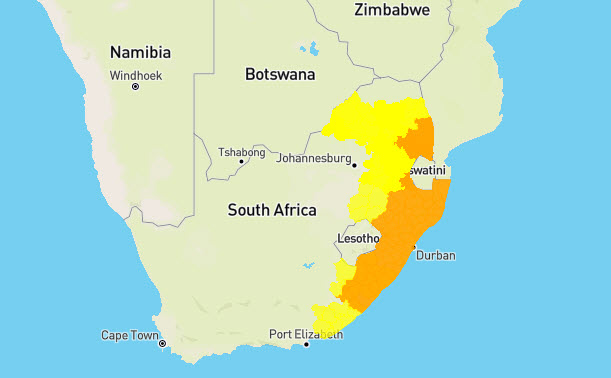
Areas that will be affected by the level 9 warning are:
Big Five, Hlabisa, Hluhluwe, Jozini, KwaDukuza, Mandeni, Maphumulo, Mkhambathini, Mthonjaneni, Mtubatuba, Ndwedwe, Richmond, Msunduzi, uMhlabayalingane, uMhlathuze, uMlalazi and uMshwathi.
Level 5 weather warning for disruptive rain was issued for:
Abaqulusi, Alfred Duma Indaka, Alfred Duma – Ladysmith, Dannhauser, Dr N. Dlamini-Zuma-Underberg, eDumbe, eMadlangeni, Endumeni, Greater Kokstad, Impendle, Ingwe, Inkosi Langalibalele Escourt, Inkosi Langalibalele Sobabili, Mpofana Giants Castle, Mpofana- Mooi River, Msinga, Newcastle, Nkandla, Nongoma, Nquthu, Okhahlamba, Ray Nkonyeni, Ubuhlebezwe. Ulundi, Umdoni, uMngeni, UMuziwabantu, Umvoti, Umzimkhulu and Umzumbe.
Cogta says these weather warnings, which have been placed on level 9 and 5 respectively in terms of the scale of impact and likelihood, could spell disaster for communities living in low-lying areas.
Cogta spokesperson Senzo Mzila says: “The provincial disaster management centre has activated the Joint Operations Committee (JOC), which will meet daily with all disaster management teams from municipalities to take stock of the situation.
“Residents in the affected areas are requested to restrict unnecessary travelling as this might place them in danger.”
Mzila adds that parents must be vigilant and guard children so that they do not swim in rivers or go near large bodies of water.
“The province of KZN has not fully recovered from the floods that took place last year and residents are urged to heed these warnings and to not take unnecessary risks,” says Mzila.
The department offered the following safety tips:
- People living in low-lying areas must take special care during storms, as flash-floods might affect them.
- They should monitor nearby water levels and evacuate the areas to a safer place or higher spot when the water level rises.
- Do not cross through flooded roads or bridges – use other routes.
- Avoid crossing low-lying bridges, streams and rivers.
- Never try to walk, swim or drive in swift-flowing water. Even if the water is 15 cm deep, it can sweep you off your feet.
- Motorists must be very careful and avoid driving through flooded areas.
- Drive to and park at safer areas.
- The public must monitor weather alerts on radio and television.
- The public should contact their ward councillor or nearest municipal disaster management centres if they need more information.
- Do not try to drive over a low-water bridge if water is flowing strongly across it and the ground is not visible.
“Where possible, communities are encouraged to try to avoid contact with any flood waters. The water may be contaminated with raw sewage, oil or other dangerous substances, and may also be charged with electricity from fallen powerlines.”
uMhlathize municipality in northern KZN urged residents to remain indoors.
“Our disaster management teams will also be on standby to monitor the situation. We also plead with people who have houses near water banks and rivers to be on high alert,” said municipal spokesperson Bongani Gina.
Read original story on www.citizen.co.za

