
Large shining object spotted in sky likely to be a rocket
On Tuesday evening, many Pretoria residents shared photos of what seemed like a large shooting star - but experts say this was likely to have been a deorbiting rocket.
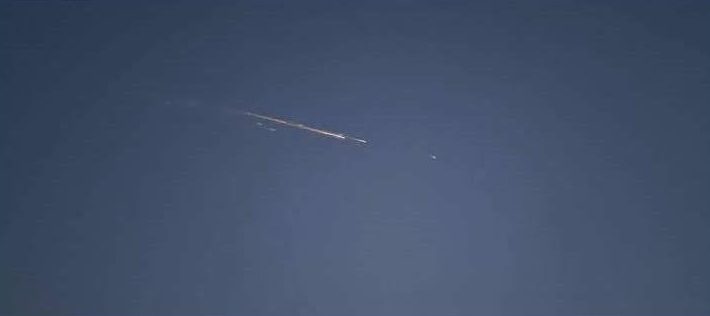
Was it a meteor? Was it a shooting star? Or could it have been a rocket?
What initially was thought to be a large shooting star broken in different parts spotted in Pretoria and Polokwane night skies on Tuesday evening, could actually have been a crashing rocket.
Within a few hours of being spotted, many residents shared on social media visuals of an object what seemed like a large shooting star on Tuesday evening.
But now the South African Astronomical Observatory has shared more information.
Astronomer Daniel Cunnama said what he initially thought was a large shooting star, also known as bolides a couple of minutes after videos went viral, was most likely to have been a de-orbiting rocket launched by the China Aerospace Science and Technology (CAST) on Tuesday.
“It was not a meteor nor a rock. We are confident that it was an upper stage of a Chinese rocket that was launched yesterday (Tuesday) and that rocket was deorbiting meaning coming back on Earth and burning up in the atmosphere,” he said.
According to the CAST website , a rocket named the Long March 2C carrier rocket Yuanzheng-1S, was launched at the Jiuquan Satellite Launch Centre in China at 19:15 on August 24.
China is about six hours ahead of South African time.
At the time it was launched it was 13:15 in SA, and residents spotted it around 18:20 – five hours after its launch in China.
ALSO READ: What Pretorians spotted in the night sky was a shooting star, not a meteor shower
Explaining the time difference of five hours after the rocket was launched to when it was seen, Cunnama said the rocket would have orbited the earth just over three times. Each orbit takes approximately 90 minutes.
“It was launched and orbited just over three times and just after the third time it came crashing down,” he said.
“We calculated where the launch happened, where the rocket body was going and we can track where it could have been and I must say the correlation (in terms of time) is very close.”
Cunnama said for the rocket to have been seen over land as it deorbited it was not usual as they usually plan for deorbiting to happen over the ocean to minimise risks.
“We normally plan to deorbit over the ocean so that there is no risk to anyone. But sometimes it is hard to predict where it will hit and I think that this is what happened with this one,” he said.
“We are deorbiting rockets all the time and they are burning up in the atmosphere quite regularly. It is common experience but to actually see it is quite special.”
Cunnama said there was a small chance that pieces of a rocket could hit the ground and they had not received any reports of anything hitting the ground yet.
Rocket launch phases explained: “The rocket has a first stage which will get the rocket up in space and second the second which will take the satellite or whatever the payload would be. That second stage will do another burn, it will fire its motors and this will slow itself down so that it can fall back to earth.”
Cunnama said a large rock was initially assumed was likely to look like the crashing rocket but a rock would have travelled much faster.
He said there was not much information on the payload of the rocket.
A resident who managed to capture the shooting star, Nicole Verwey, said she saw the object for about 30 seconds when driving in Botha Avenue, Centurion around 18:20.
Link to confirmation of launch by the China Aerospace Science and Technology (CAST).
Read original story on rekord.co.za