
Mboweni says tax revenue for the year expected to drop by over R300 billion
Government plans to borrow R121 billion to help fund its Covid-19 response.
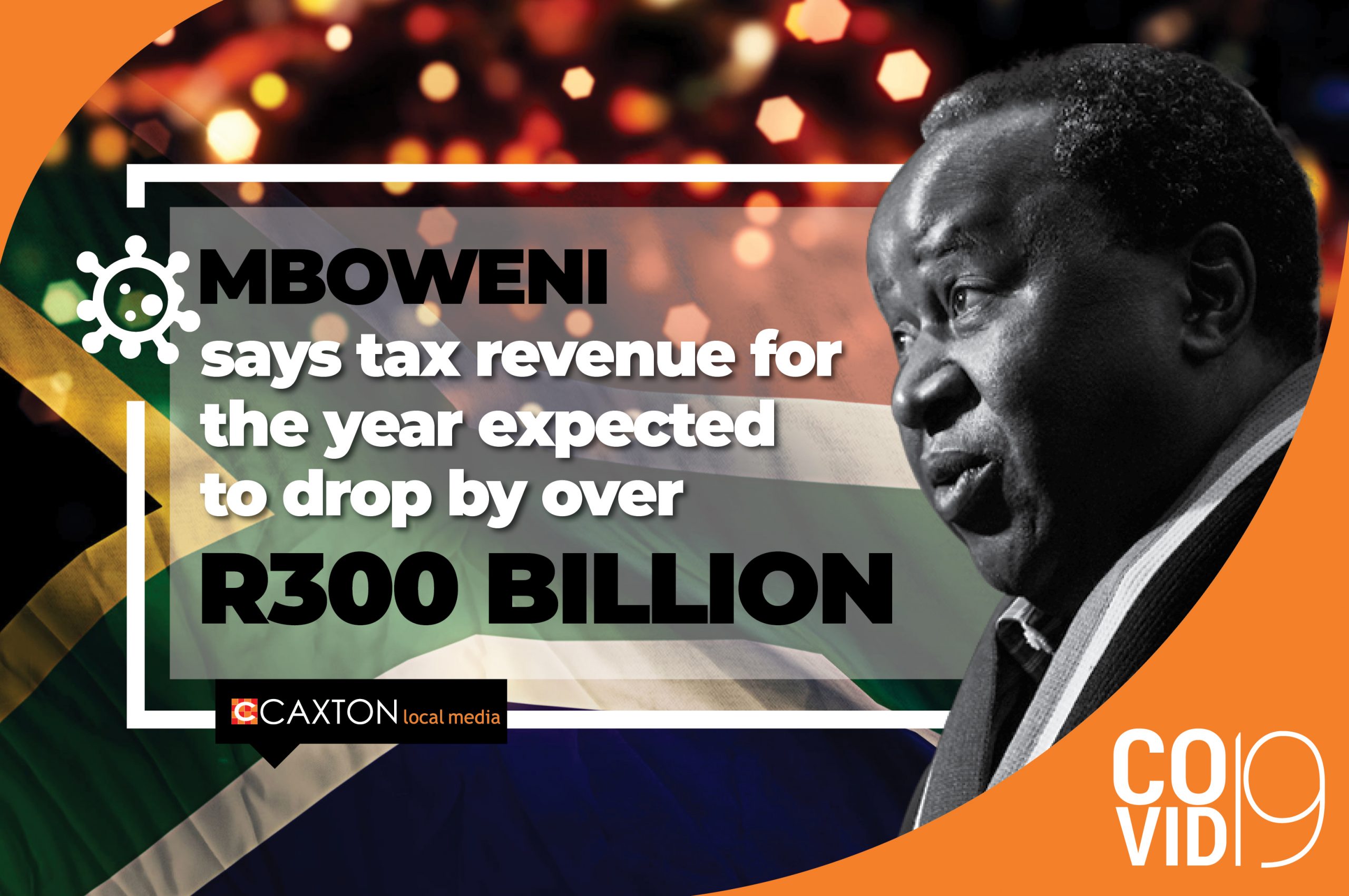
Finance Minister Tito Mboweni in his emergency budget speech laid out his proposed roadmap to stabilise debt, by improving the country’s spending patterns in order to create a foundation for economic revival post-Covid-19.
This will be a tough ask though, as projected total consolidated budget spending, including the cost to service the country’s massive debt bill, will exceed R2 trillion for the first time ever.
Meanwhile, gross tax revenue collected during the first two months of 2020/21 was R142 billion, falling R35,3 billion short of the projected R177.3 billion. As a consequence, gross tax revenue for the 2020/21 fiscal year is revised down from R1.43 trillion to R1.12 trillion.
This will lead to a tax shortfall of over R300 billion.
Mboweni, said public finances are “widely overstretched”, as if to warn of the biblical proportions of the challenges lying ahead, comparing the two possible paths lying ahead to the narrow and wide gates described from Matthew 7:13-14.
“If we remain passive, economic growth will stagnate. Our debt will spiral inexorably upwards and debt‐service costs will crowd out public spending on education and other policy priorities. We already spend as much on debt‐service cost as we do on Health in this financial year. Eventually the gains of the democratic era would be lost,” the finance minister warned.
“The wide gate opens to a path of bankruptcy.”
He warned of a possible sovereign debt crisis, saying though still far from being unable to pay back the interest or principals on the country’s debt, “if we do not act now, we will shortly
get there.”
Harking back to other countries which ad face this situation in the past, such as Germany in the 1920s, and Argentina and Zimbabwe in the early 2000s, and the apartheid government which had to declare a debt standstill, Mboweni said: “We firmly reject this gate!”
His preferred path, or as he referred to it, the narrow gate, leads to a “path of prosperity”, the minister said.
“Through this gate, we reduce our reliance on borrowing. We feed the hungry. We look after the sick. We educate our people. We build for the future. We spend with wisdom, and we jail those who loot.
“The narrow gate is an active approach – a nation that takes active steps to rapidly stabilise debt and grow the economy. By doing this we will create jobs, reduce the cost of doing business and build a competitive economy.”
He announced plans to borrow about US$7 billion to support the pandemic response, but warned that these loans are not a source of revenue and will add to the debt that must be paid back.
Notice: Coronavirus reporting at Caxton Local Media aims to combat fake news
Dear reader,
As your local news provider, we have the duty of keeping you factually informed on Covid-19 developments. As you may have noticed, mis- and disinformation (also known as “fake news”) is circulating online. Caxton Local Media is determined to filter through the masses of information doing the rounds and to separate truth from untruth in order to keep you adequately informed. Local newsrooms follow a strict pre-publication fact-checking protocol. A national task team has been established to assist in bringing you credible news reports on Covid-19.
Readers with any comments or queries may contact National Group Editor Irma Green (irma@caxton.co.za) or Legal Adviser Helene Eloff (helene@caxton.co.za).
Read original story on citizen.co.za

