
Minister Thoko Didiza outlines how public can acquire state land
The Minister of Agriculture, Land Reform and Rural Development, Thoko Didiza said about 896 farms on state land will be released to the public.
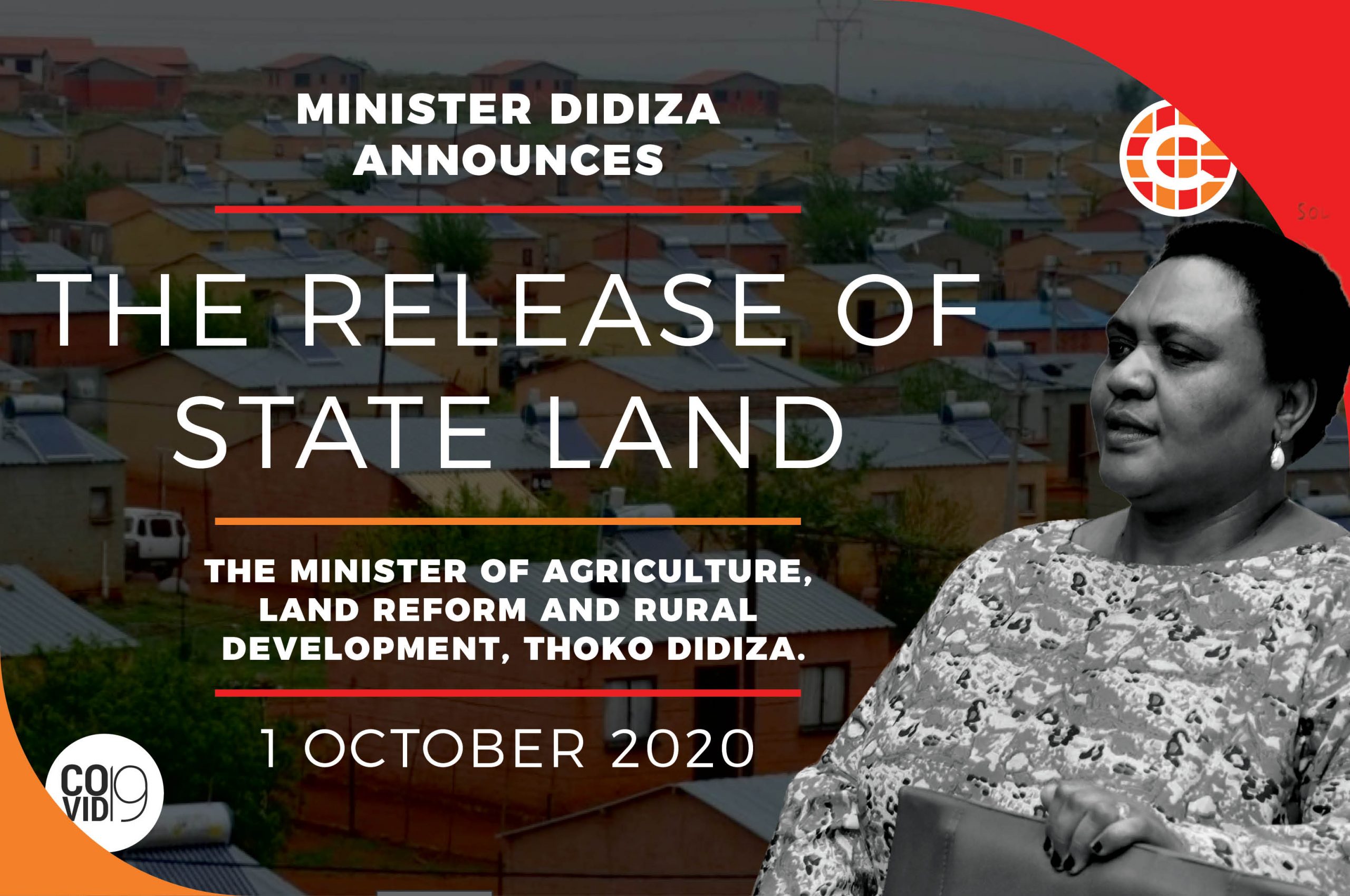
The Minister of Agriculture, Land Reform and Rural Development, Thoko Didiza hosted a briefing on 1 October on the release of state land.
Didiza extended her appreciation to farmers for their tireless efforts to keep their operations running during the lockdown. She also thanked farmers’ associations for their food parcel contributions to those in need.
In February this year, President Cyril Ramaphosa announced that they would release government-owned land to the public. Didiza said that since then, the department has released about 135 000 hectares of land to 275 farmers. The majority of this land was released in Mpumalanga. She said that 160 of the 275 farmers that received land were women and 14 of them are young people.
In the next two weeks, the government will issue advertisement notices of 896 farms available to farmers.
This land will be divided as follows:
- Eastern Cape will have 43 000 hectares available
- Free State will have about 8 333 hectares available
- KwaZulu-Natal with have about 3 684 hectares available
- Limpopo will have 121 567 hectares available
- Mpumalanga will have 40 206 hectares available
- Northern Cape will have about 12 224 hectares available
- North West will have about 300 000 hectares available.
Didiza said that the notices will be advertised in local, provincial and district newspapers and will be available on the department’s website. Application forms will be available in the district and provincial offices. She said that applicants must be South African citizens and at least 18 years old and added that priority will be given to women, youth and people with disabilities.
Applicants will need to indicate their current farming area and the successful applicant will need to work the land full time for the duration of the lease contract. The lease will be valid for 30 years with the option to buy the land.
“We will ensure that the Land Administration Unit, both at a national and provincial level, do work to ensure that such leases are maintained appropriately, particularly the obligations to the state as a lessor and the beneficiaries as the lessees.”
Didiza said that applicants are required to have the capacity and resources to farm the land but the government will be able to provide post-settlement assistance. She said that those with three to five years of farming experience will be given priority.
“We are not saying those who are first-time [farmers] will not be considered,” said Didiza.
Following the application process, the applicants will be screened and recommendations will be made by the district offices. The Provincial Technical Committee will then screen these recommendations and consult with the national department to approve suitable applications.
“The land allocation process does always have challenges. If people want to appeal, we have set up an appeals committee to consider those applicants who ask for an appeal.”
She said that in some instances, people might be occupying state land already. She said that they would undertake a land enquiry process for land that is occupied without state approval.
“The land enquiry processes how individuals and communities currently occupying the land got access to it. It will also look at how the land is being utilised and whether site use is in accordance with agricultural practices for that area.”
She said that those who are already occupying land are encouraged to apply for the land release process. The beneficiaries will have to undergo a compulsory training programme which will include entry-level training on the commodity of choice, basic record-keeping, basic financial management and enterprise development.
“Farming, regardless of scale, is a business enterprise. Yes, it is multi-faceted because we need to deal with food security but at the same time you must make an income out of agriculture.” Beneficiaries will pay a monthly or yearly fee in line with property values in the area.
Requirements of lessees
- The lease agreement signed between the state and the beneficiary will be a legally binding contractual agreement.
- The lease agreement will not be transferable under any circumstances.
- The beneficiary will not be allowed to sub-lease or sublet a portion of land or the whole of the farm under the leasehold between him/her and the state.
- The beneficiary has an obligation to maintain all the infrastructure and upkeep of the land allocated to him/her.
- The beneficiary will have to manage, maintain and keep the record of assets received from the state.
- Any investment made by the beneficiary must be recorded, valued and reported to the state.
- Beneficiaries will pay a monthly or annual rental fee per hectare determined by the state, consistent with the value of the land in line with area valuation.
- A credit management system will be put in place to manage debt recovery and management.
Failure to comply with any of the contractual obligations listed above, the state will consider the option of terminating the lease.
Government responsibilities:
- Enter into a lease agreement with the beneficiary, 30 days after approval of the application.
- Ensure that basic infrastructure is in good shape and register the infrastructure and assets on the farm.
- Issue monthly invoices to the beneficiary with payment due date.
- Undertake quarterly inspection visits by the Land Administration Unit to ensure that state infrastructure and assets are well kept.
- Table annual reports on the performance of the lease and productivity of the land to the minister.
Notice: Coronavirus reporting at Caxton Local Media aims to combat fake news
Dear reader,
As your local news provider, we have the duty of keeping you factually informed on Covid-19 developments. As you may have noticed, mis- and disinformation (also known as “fake news”) is circulating online. Caxton Local Media is determined to filter through the masses of information doing the rounds and to separate truth from untruth in order to keep you adequately informed. Local newsrooms follow a strict pre-publication fact-checking protocol. A national task team has been established to assist in bringing you credible news reports on Covid-19.
Readers with any comments or queries may contact National Group Editor Irma Green (irma@caxton.co.za) or Legal Adviser Helene Eloff (helene@caxton.co.za).
Read original story on midrandreporter.co.za

