
Opinion: Are an independent press and free expression at risk in the US?
Known as ‘the land of the free and the home of the brave’, the US is facing questions over media independence.
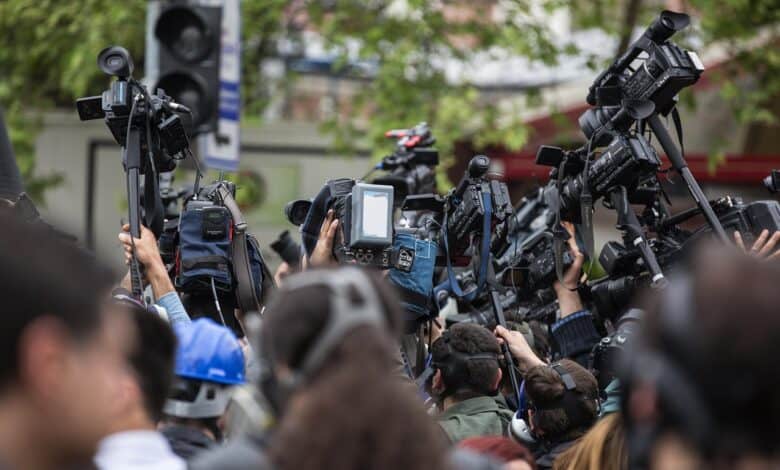
In every year of my nearly half-century journalistic career, I have known only a free and independent press in the United States.
My professional start was in the 1970s. Those were years when Americans could see clearly how the press served democracy:
- With the publication of the Pentagon Papers, first by The New York Times, the American public learnt of the failures its government had covered up during a long war in Vietnam that cost so many lives.
- And then there was Watergate, an investigation spearheaded by The Washington Post. US citizens learnt how their president had weaponised the government against his political adversaries, abusing his powers and sabotaging the Constitution of the United States.
The eroding pillars of press freedom
In the decades since those revelations, I took for granted that my country would always enjoy press freedom – and that the First Amendment of the US Constitution would guarantee it.
I no longer take any of that for granted. I no longer assume that the constitutional order will hold in the United States. Or that the rule of law will prevail. Or that free expression – not just for the press, but for all Americans – will endure.
That is because we have a president who has demonstrated disdain for traditional restraints on his power. Because a majority in the American congress remains servile. Because a majority of the Supreme Court of the United States has handed this president extraordinary authority and immunity. Because the president appears determined to lay siege to institutional pillars of democracy, with the press as a high-priority target.
Fragile institutions and the truth divide
And it is because those institutions are proving to be more fragile and faint-hearted than I imagined possible.
And perhaps most concerning to me is that we now live in a time when people are unable, or unwilling, to distinguish between what is true and what is false. It is only natural – and, in a democracy, expected – that we will disagree about which policies are best.
Yet today, we cannot agree on how to determine a fact. All of the elements we have historically relied upon to establish facts – education, expertise, experience and, above all, evidence – have been denigrated, dismissed and denied.
Democracy’s dependence on a free press
How can democracy flourish, or even survive, when we can’t determine the most basic facts? If democracy is in danger, a free press is, too. An independent press cannot survive without a democracy. And there is a corollary to that. A democracy cannot survive without a free press.There has never been a democracy without a media that is free and independent.
The playbook of aspiring authoritarians is well-established. High on their to-do list is crushing the press, an institution that can shed light on what political leaders are up to and that might hold them to account.
Beyond the press: The threat to free expression
Their repressive practices extend well beyond the press, however: They seek to abolish free expression altogether:
- The right of musicians, authors, artists, playwrights and screenwriters to express themselves as they wish.
- The right of the public to listen to, see and read what they feel they should. The right of business executives, academics, activists and political leaders to advocate for the policies they believe in.
- The right of every one of us to speak freely with family, friends, neighbours and colleagues without fear of surveillance and reprisal.
The true target: Extinguishing truth
The rights that the press strives to safeguard are no different from the rights most people want for themselves:
- The freedom to inquire into facts,
- to share what they’ve learnt,
- to communicate what they believe.
Much more is at risk than the freedom to express opinions. The real target of autocrats is truth itself. They aim to extinguish all independent arbiters of fact, whether they happen to be judges, scholars, scientists, statisticians or journalists.
In nations tilting toward authoritarianism, heads of state claim sole ownership of the truth. And they rig, suppress or erase data to advance their lies.
That is what is happening now in the United States. Facts are under attack while government demands that its fictions be unquestioningly repeated.
America’s fading model of freedom
For decades, the United States was a bastion of free expression of all types, with constitutional protections seemingly secured. That is no longer the case.
Americans were a model for citizens in other nations who yearned for similar liberty. We no longer are. We were a forceful champion for these freedoms elsewhere. Civil rights activists, democracy advocates and independent journalists worldwide often counted on our support when faced with repression. They can no longer expect it.
In a famous 1941 speech about four essential human freedoms, then-American president Franklin Delano Roosevelt listed ‘freedom of speech and expression’ as the very first. And he pointedly added the words: ‘everywhere in the world’.
The president’s role in global jeopardy
Today, with an aspiring autocrat as president, the United States is failing to embrace the freedoms that Roosevelt considered indispensable for a better world. Independent media was already in peril globally, a casualty of diminished confidence in democracy and the rise of a new generation of authoritarians. Our president has placed the press worldwide – and freedom of expression generally – in even greater jeopardy.
What US president Donald Trump and his allies contemptuously disregard is why the founders of the United States drafted the first amendment. James Madison was the principal author. And in describing the role of the press and of free expression, he spoke of the ‘right of freely examining public characters and measures’.
Journalism’s core purpose: Beyond stenography
The word ‘examining’ deserves special attention. Here is how the dictionary defines its meaning: ‘To inspect closely’, ‘to inquire into carefully/investigate’, ‘to test by questioning to determine progress, fitness, or knowledge’.
Apply that to journalists, and it means we are not stenographers. Nor should we be. We go behind the curtain and beneath the surface – to learn who did what and why, who will be affected and how, who influenced those decisions and with what intent.
The purpose of journalism, in my view, is to provide the public with the information it needs and deserves to know so that people might govern themselves. Embedded within that mission is a particularly high calling: Holding powerful individuals and institutions to account.
Accountability and the cost of silence
Those with power have the capacity to do enormous good. When they do, and when ordinary individuals do, we in the press should make that known.
Praiseworthy efforts to improve society should be shared with others. At the same time, some wrongs can be committed on an extraordinary scale.
Often, the fault lies with those who possess disproportionate power, including the means to cover up their misdeeds. Immoral or unlawful conduct can go undetected for years or decades. Ordinary people can suffer severe harm. Victims are often ignored or muzzled.
The public’s stake in free expression
So, the public has much at stake in the struggle for free expression and an independent press. People must have the right to voice their grievances. The media should be prepared to listen and investigate.
When there is grave wrongdoing, often no one but journalists will explore the facts. When there are no journalists to report on corruption, inevitably, there is more of it, with ordinary citizens paying the greatest price. When no independent media exists to draw attention, those who possess immense power seize the opportunity to acquire more. Their interests are served, but the public’s needs are not.
A global call to action for freedom
As the US government abandons the cause of freedom worldwide, my hope is that citizens in other countries will now become a model for Americans who took their own freedoms for granted. They can show us how best to struggle against a repressive government.
And in the difficult fight to uphold the fundamental democratic principles of free expression and an independent press, they can provide inspiration.

