
Ramaphosa promises to blow life into ailing economy in ‘flat’ SONA 2021
Ramaphosa himself made the point that his speech was more of a report on the progress of the economic recovery plan he delivered in October last year, than a traditional state of the nation address.
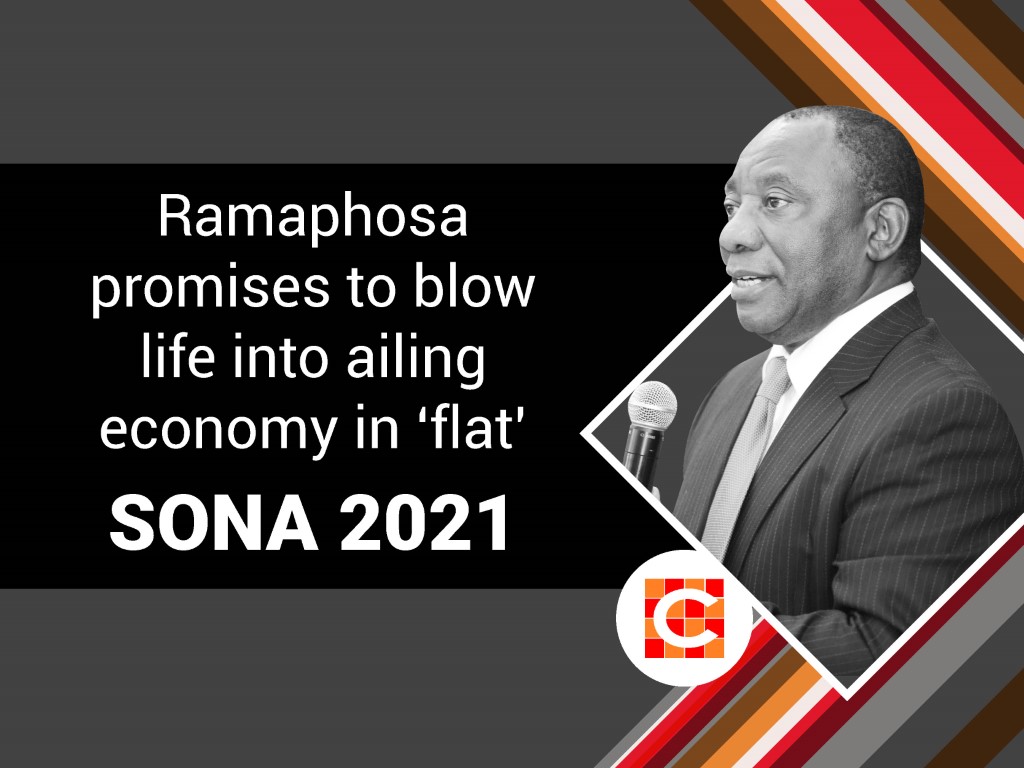
President Cyril Ramaphosa’s fifth state of the nation address (SONA 2021) was a stripped-down ceremony with no red carpet, very little pomp and ceremony and a vastly reduced guestlist.
Only 50 people, including Ramaphosa, were allowed inside parliament.
But if you can believe the comments on social media from commentators, analysts and South Africans in general, the president’s speech was as stripped down as the event itself.
Ramaphosa himself made the point that his speech was more of a report on the progress of the economic recovery plan he delivered in October last year than a traditional state of the nation address.
He, however, stipulated the overriding priorities of 2021.
He said it was first, necessary to defeat the coronavirus pandemic and accelerate South Africa’s economic recovery then emphasised the implementation of economic reforms to create sustainable jobs and drive inclusive growth, as well as the need to fight corruption and strengthen the state.
Ramaphosa said the state had secured nine million doses of the Johnson & Johnson vaccine as replacement for the AstraZeneca vaccine which was found to be ineffective against the South African strain of the coronavirus.
“The first batch of 80 000 doses will arrive in the country next week,” Ramaphosa said, adding that further consignments would arrive in the next four weeks, totalling 500 000 Johnson & Johnson vaccines.
“In addition, we have secured 12-million vaccine doses from the global Covax facility,” Ramaphosa said.
This will be complemented by other vaccines that are available to South Africa through the AU’s African Vaccine Acquisition Task Team facility as well.
Pfizer has also committed 20-million vaccine doses commencing with deliveries at the end of the first quarter.
Unemployment was also on Ramaphosa’s agenda as South Africa has experienced a sharp decline in growth and a significant increase in unemployment over the past year.
He said unemployment was now at just over 30%, as a result of the Covid-19 pandemic.
Ramaphosa announced that the R350 special grants have been extended to the middle of April. The Unemployment Insurance Fund’s temporary employer-employee relief scheme money will also be extended until 15 March. This, however, will only be available to businesses that were not able to open at all.
Ramaphosa then turned to what is his dream of smart cities in a post-apartheid South Africa. According to him, people laughed at his dream, “but it is becoming a reality”.
One of the most important aspects of Ramaphosa’s speech was his focus on the rapid expansion of energy generation capacity.
“Restoring Eskom to operational and financial health and accelerating its restructuring process is central to this objective,” Ramaphosa said.
“The Department of Mineral Resources and Energy will soon be announcing the successful bids for 2 000 megawatts of emergency power.
“The necessary regulations have been amended and the requirements clarified for municipalities to buy power from independent power producers. Systems are being put in place to support qualifying municipalities,” Ramaphosa said.
He also said that government will soon initiate the procurement of an additional 11 800 megawatts of power from renewable energy, natural gas, battery storage and coal in line with the integrated resource plan from 2019.
Land redistribution was also on the table. To date, government has redistributed over 5-million hectares of land, totalling around 5 500 farms, to more than 300 000 beneficiaries.
This was in addition to the land restitution process, which has benefited over two million land claimants and resulted in the transfer of around 2.7 million hectares.
“We are also pursuing programmes to assist smallholder and emerging farmers with market access, to develop skills across the entire agricultural value chain and increase the number of commercial black farmers.”
On corruption, Ramaphosa said: “Corruption is one of the greatest impediments to the country’s growth and development.
“The government has started the implementation of the national anti-corruption strategy, which lays the basis for a comprehensive and integrated society-wide response to corruption.”
Read original story on rekordeast.co.za

