
SAWS confirms damage to farms was caused by a tornado
Photos and videos from Middelburg Observer’s website solve the mystery of whether two tornadoes hit the area.
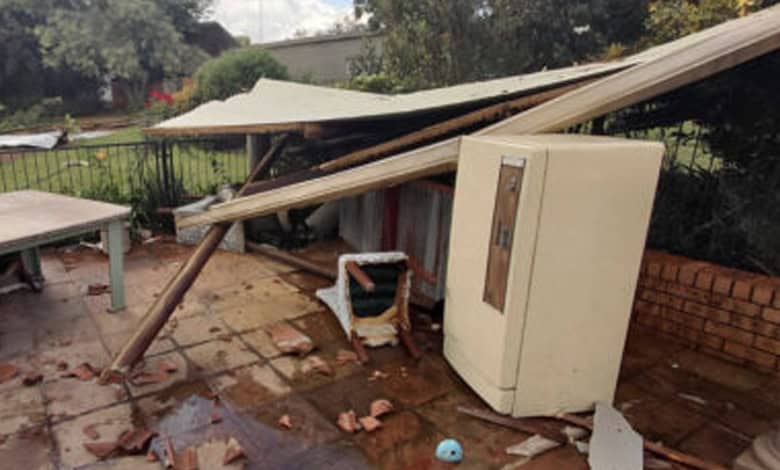
The South African Weather Service (SAWS) confirmed in a statement issued this morning that two tornadoes raged in the Middelburg and Carolina area over the past week.
Middelburg Observer reports that there was initially doubt as to whether the damage caused to the Van Wyk farm was indeed caused by a tornado.
After SAWS studied photos and videos posted on Middelburg Observer’s website, it confirmed that a tornado hit the area.
In a statement, SAWS acknowledged the Middelburg Observer’s contribution to solving the mystery.
Two short-lived tornadoes were reported
According to the press statement issued on January 1, two short-lived tornadoes were reported across the eastern Highveld of Mpumalanga – one just to the north-east of Middelburg, and the other one near Carolina.
Although no loss of life was reported, damage to property was observed.
The two phenomena occurred amid widespread severe thunderstorm activity. Just as the issuing of weather forecasts and, where necessary, severe weather warnings is the responsibility of the SAWS, so is the occasional assessment of weather impacts to damaged property and infrastructure.
Damage to property assessed
“On Friday, January 2, the SAWS assessed the damage to property in the north-eastern area of Middelburg in the aftermath of the tornado. This was despite communication challenges, with internet connectivity unavailable. Locals suspected that the communication challenges were the direct result of the severe thunderstorm that hit the area the previous day, as seen in Figure 1 below.
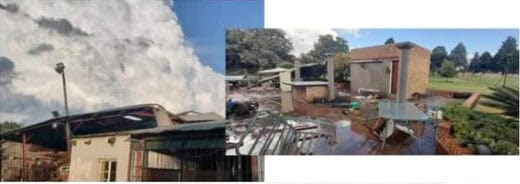
“Restricted access to several private farms in the area prevented a full survey of damage to property. However, damaged and rusted communication lines on one side of the Stoffberg road and extricated tree branches on the other side suggested that tornadoes might be underreported in the area.
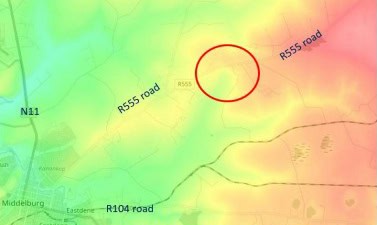
“Eyewitness accounts and limited ground observations indicated that strong winds and particularly large hail were observed just before and soon after 18:00 on the day. One eyewitness reported observing a funnel-like feature below the cloud near the Stoffberg road (circled stretch of R555 road in Figure 2).
“During their journey back home, workers from nearby farms faced severe weather, including a high frequency of thunderstorm lightning. As a result, hiding spots were sought in the nearby settlements.
“Desktop analyses of Eumetsat satellite images of the late afternoon of New Year’s Day over the northern Highveld of Mpumalanga showed signs of a rotating thunderstorm between 17:40 and 17:50, albeit with gaps of nine minutes before each subsequent image.
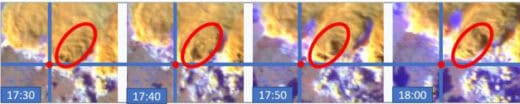
“Weather analysts accept that a thunderstorm that is rapidly neared by another has the tendency to produce at least one tornado. Tornadoes that develop in this fashion (the Middelburg tornado and Randfontein tornado of November 27, 2024) are the trickiest to detect for the purposes of warning the public in advance, in that they offer no time to upgrade warnings. Of at least two thunderstorms that approach a common geographic location, the one that reaches this location first could spawn a tornado.”
No surface damage assessment
“Regarding the Carolina tornado, which was reported under similar convective conditions, no surface damage assessment could be conducted in this area due to access restrictions and limited time available.
“Since New Year’s Eve, the SAWS issued Levels 2 and 4 warnings for potential severe thunderstorms for Thursday, January 1. A Level 4 warning meant that the likelihood of the occurrence of severe thunderstorms was low, but with potential significant impacts. The two warnings were for Mpumalanga and KZN, and they highlighted the risk of damaging winds, large hail, and heavy rainfall.”
People are advised to:
- Avoid travel during severe weather
- Find shelter quickly in smaller rooms like bathrooms when in the midst of two adjacent storms or more
- Move quickly out of the path of the leading storm. These interim measures could minimise the possibility of injuries or loss of lives.
“In recent years, researchers Kaitano Dube and David Chikodzi of the Vaal University of Technology conducted a focused study on tornadoes that occurred across Mpumalanga. The SAWS continues to enhance post-event verifications, particularly in regions where no numerical data is collected. Researchers are continually working with various academic institutions to categorise these events, including the development of their nowcasting techniques.”
Weather warnings are updated daily and can be accessed via the SAWS website.
Breaking news at your fingertips… Follow Caxton Network News on Facebook and join our WhatsApp channel.
Nuus wat saakmaak. Volg Caxton Netwerk-nuus op Facebook en sluit aan by ons WhatsApp-kanaal.
Read original story on www.citizen.co.za

