


The political killings task team has cost government R435 million so far.
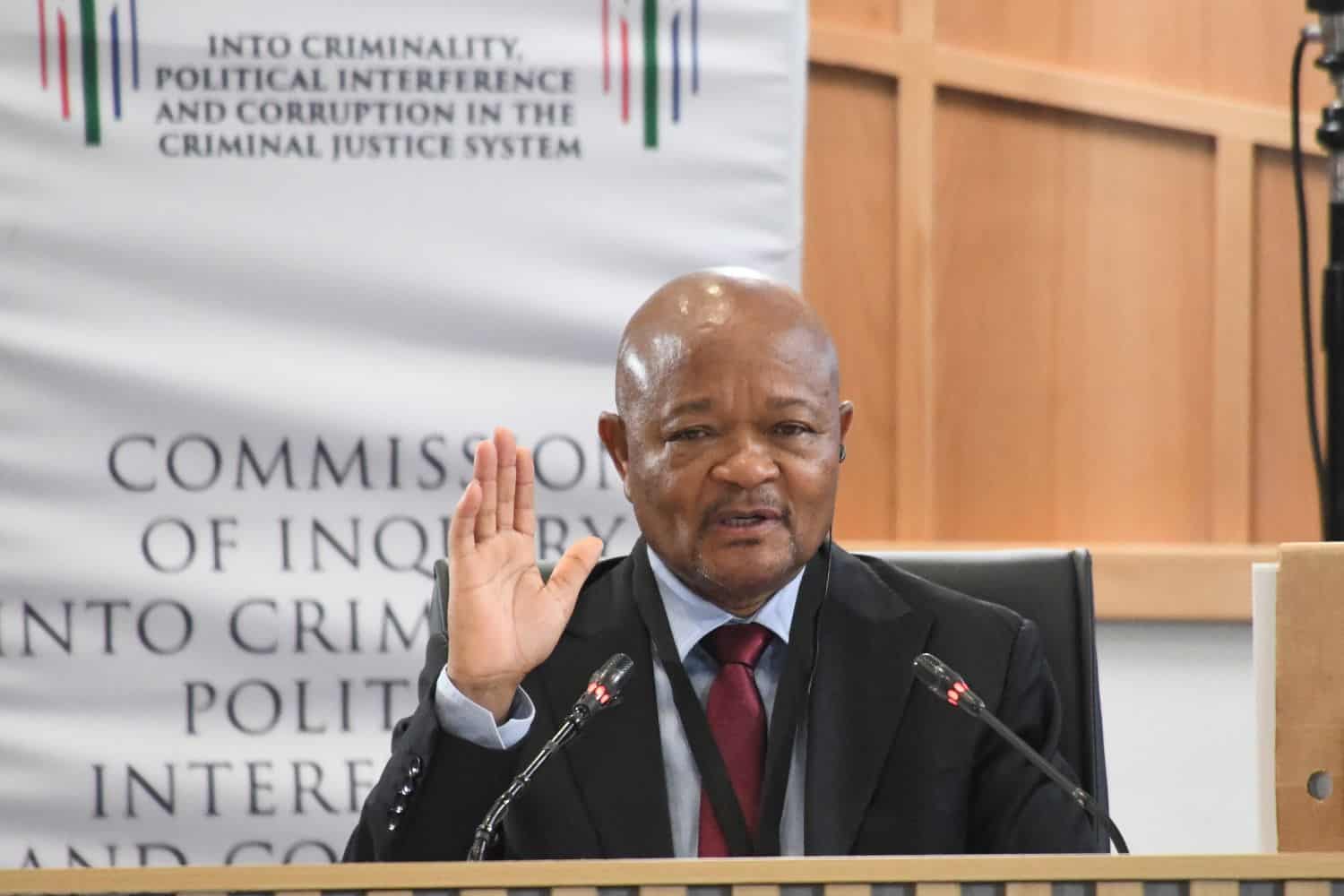
Police Minister Senzo Mchunu testifies before the Madlanga commission at Brigitte Mabandla Judicial College in Pretoria on 2 December 2025. Picture: Gallo Images / Frennie Shivambu


Police Minister Senzo Mchunu has contended that the political killings task team (PKTT) should have been shut down long ago, while also appearing to shift the blame to National Police Commissioner Fannie Masemola.
Mchunu testified on Monday in Pretoria before the Madlanga commission, which is probing allegations of political interference, corruption, and criminal misconduct.
Currently on special leave, the minister is accused of disbanding the PKTT to obstruct an investigation into a crime syndicate – a claim he denied during his appearance before parliament’s ad hoc committee in October.
Mchunu had authored a letter dated 31 December 2024 instructing Masemola to shut down the PKTT “immediately”.
He explained to parliament that his decision was influenced by concerns over the PKTT’s declining operational value, budget inefficiencies, and the need to redirect resources across the country.
The PKTT was initially formed in 2018 through an inter-ministerial committee established by President Cyril Ramaphosa to deal with political killings in KwaZulu-Natal (KZN).
The task team has cost government R435 million so far.
Mchunu testifies at Madlanga commission
On Tuesday, evidence leader advocate Mahlape Sello noted that Mchunu would only give an “uninterrupted” account regarding the PKTT and would return to the commission on Thursday.
With his legal team present – including Advocate Tembeka Ngcukaitobi – Mchunu stressed that throughout his political career he has never faced corruption accusations.
“This is the first time, I get accused of such as alleged particularly on the 6th of July,” he said, referring to a press briefing held by KZN police commissioner Nhlanhla Mkhwanazi.
He told the commission that he had no involvement in operational policing decisions undertaken by Saps officials.
“As minister, I don’t necessarily direct, approve or participate in operational policing activities,” he said, insisting that allegations that he had influenced arrests or raids were “incorrect”.
ALSO READ: ‘I couldn’t understand the reasons’: Acting police minister on PKTT disbandment
Mchunu revealed that Masemola informed him and his deputies on 1 December that the PKTT was never a formal unit, but an interim task team.
Masemola had also told parliament in a written response in December 2023 that the task team was expected to evolve into a broader murder and robbery unit.
The proposal was first outlined in a June 2019 work study signed by former commissioner Khehla Sithole.
PKTT ‘interim in nature’
The minister emphasised that the PKTT was created as a “special project” and outside the permanent Saps organisational structure.
“It was always understood that it was interim in nature,” he added, highlighting the distinction between a task team and a police unit.
“There’s no project in government that runs indefinitely.”
He further explained that the PKTT was not part of the standard budgeting process, and funds had to be reallocated to sustain it.
ALSO READ: Mathale says Mchunu’s PKTT disbandment letter ‘problematic’, saw it on social media
According to Mchunu, the team was intended to operate for only six months, “not six years”.
After the Covid-19 pandemic, the PKTT underwent a review in 2021 when it received an extension and funding for that financial year.
But after 2022, no further extension was approved, meaning the team, the minister suggested, continued without the legally required assessment for more than two years.
Mchunu said this resulted in irregular expenditure under the Public Finance Management Act.
Work study
Mchunu testified that the 2019 work study effectively dissolved the PKTT because feasibility assessments showed its functions overlapped with those of the murder and robbery unit.
A letter approving the study’s implementation was signed in November 2019.
According to the minister, police later conducted an evaluation in March 2024 to determine whether the study had been implemented.
The resulting report found that the PKTT and other task teams had “ran rampant” for years with little oversight, removing officers from station level without accounting for the operational gaps or providing proper budget controls.
“In summary, the recommendation in relation to the PKTT was that its functions be transferred to the murder and robbery unit,” Mchunu said.
The report was signed by Deputy National Commissioner Shadrack Sibiya, who expressed concern that the implementation of the 2019 work study had not progressed.
Masemola eventually approved the study on 5 June 2025, ordering that implementation be accelerated.
“It was a year-long lapse after everybody else had signed,” Mchunu remarked, suggesting that had Masemola signed earlier – in March 2024 – the PKTT would likely have been shut down then.
“You do from time to time come across lapses. Some lapses have a minor impact and consequences, but other lapses have bigger consequences depending on the case at hand.”
Mchunu added that the police’s new organisational structure had been finalised before the end of 2024, but was only officially signed off in May 2025 due to labour-related engagements with unions.
He seemingly compared the PKTT issue to the disbandment of the Saps inspectorate unit.
The minister earlier raised concern about Crime Intelligence head Dumisani Khumalo’s dual role as the PKTT’s project leader, pointing out that intelligence work is a “24/7 kind of work”.
NOW READ: ‘Ramaphosa was in agreement’: Khumalo on what Mchunu said about PKTT disbandment
Support Local Journalism
Add The Citizen as a Preferred Source on Google and follow us on Google News to see more of our trusted reporting in Google News and Top Stories.

