


Once the GNU was formed, the price the DA had paid for the new arrangement quickly became clear.
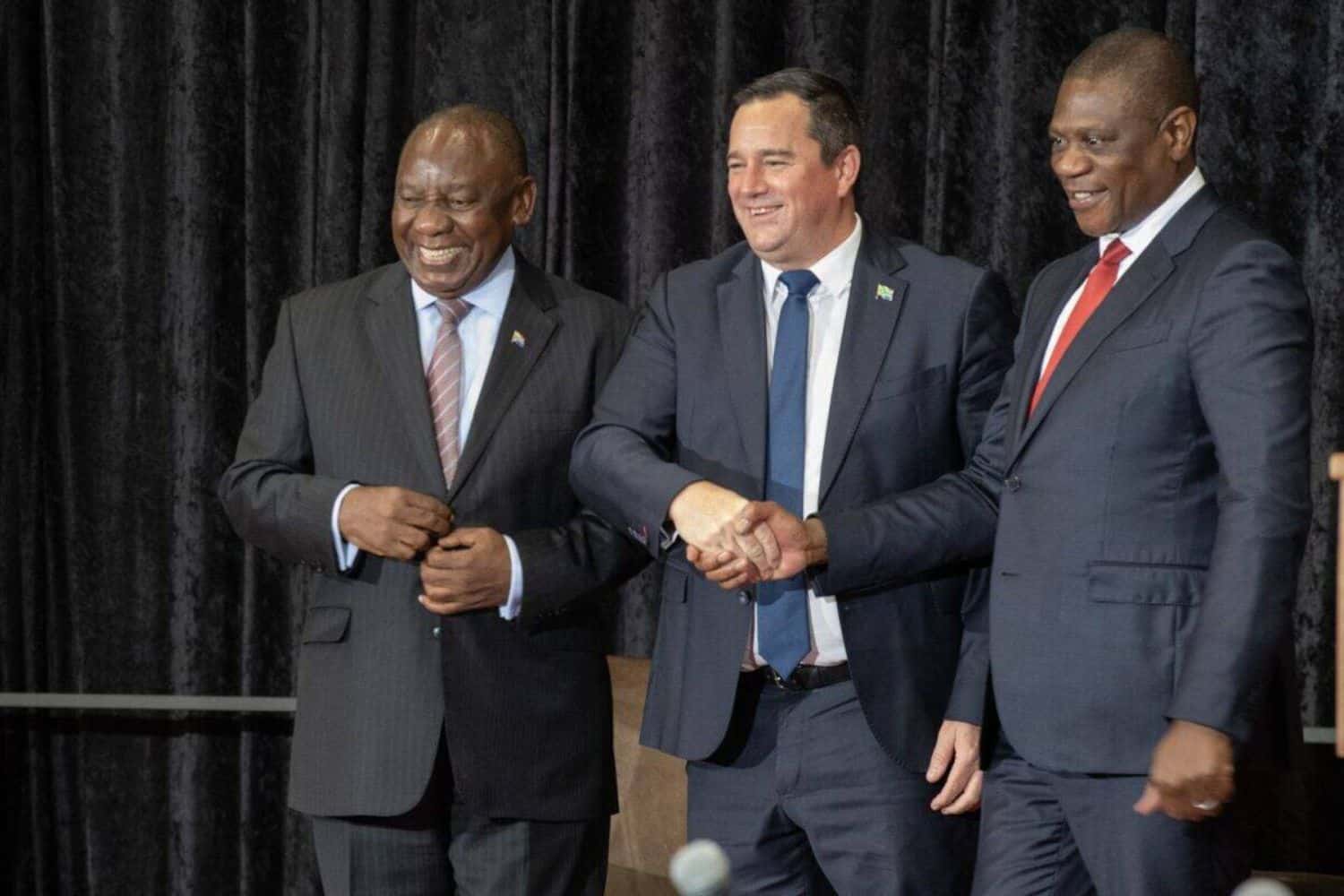
President Cyril Ramaphosa smiles as Minister of Agriculture John Steenhuisen shakes hands with Deputy President Paul Mashatile at the swearing in of ministers, on 3 July 2024, in Cape Town. Picture: RODGER BOSCH / AFP


That the judiciary is independent is perhaps the most enduring myth of the post-apartheid era.
It is the national catechism that we all recite around braai fires, dinner tables and cocktail parties: the politicians may be rotten, parliament supine, the prosecution service comatose, the police and criminals hand-in-glove, but thank God for the judges.
It is a delusion and an increasingly threadbare one at that.
There should be no doubt that the ANC’s determination to extend its hegemony over every lever of societal power has made substantial inroads into the judiciary.
Concerns over constitutional court delays
This week, in a letter to Chief Justice Mandisa Maya, EFF leader Julius Malema ripped into the Constitutional Court’s continued delay – now almost 500 days, rather than the norm of three months, and now also a full two months after her vow to “expedite” things – in delivering judgment on President Cyril Ramaphosa’s Phala Phala matter.
“It is troubling that a matter implicating so high an office should now be subject to an unprecedented delay,” Malema wrote.
This, he warned, was “creating a perception that the court is not immune to political pressures”.
Opposition parties and shifting accountability
It is ironic that it is the EFF, rather than the DA that has had to keep reminding South Africans of this.
Before the government of national unity (GNU), the DA was ferocious on Phala Phala, which DA leader John Steenhuisen called “Ramaphosa’s Nkandla”.
At that stage, the DA still behaved like an opposition party that understood the constitutional stakes: that a president credibly accused of grave misconduct had to be pursued, challenged and, if necessary, politically imperilled.
But once the GNU was formed, the price the DA had paid for the new arrangement quickly became clear.
Helen Zille said the DA would not make the government unstable by constantly backing impeachment or no-confidence manoeuvres against Ramaphosa.
Cadre deployment records and legal battles
The same retreat can be seen in the fight over the public release of the ANC’s cadre-deployment committee records.
Here, the pre-GNU DA fought valiantly in the courts and won repeatedly.
When the ANC produced only a partial and redacted paper trail, the High Court in Johannesburg found the party and secretary-general Fikile Mbalula in contempt.
In October 2024, the ANC’s attempt to appeal that contempt ruling was dismissed.
Yet after that, the DA’s fire seemed to fade. It has made no further attempt to force the missing unredacted material into the light.
ActionSA and the IPID report pressure
And then there is the Independent Police Investigative Directorate’s report on Phala Phala.
Here too, it is ActionSA that has done the pushing. After a sustained campaign, Acting Police Minister Firoz Cachalia has conceded the report should never have been classified in the first place.
The DA’s failure is part of a more serious institutional reality, that Ramaphosa specifically and the ANC, in general, are protected by the machinery through which the upper judiciary itself is shaped.
The president has the decisive appointing hand across the senior courts, albeit after “consulting” the Judicial Service Commission.
In practice, that means Ramaphosa, subject only to mild constraints of possible public outrage, appoints the chief justice and deputy chief justice, the president and deputy president of the Supreme Court of Appeal, the judges of the Constitutional Court, and the judges of the high court.
A politically curated judiciary
None of this is to claim the judiciary has been crudely “fixed”. But what we clearly do have is a judiciary selected through a political sieve and operating in an atmosphere of ideological conformity that will tend to produce the same practical result.
Ramaphosa does not need judges who behave like party hacks. He needs only a system too slow and too politically curated to move decisively against the ANC when it matters most.
That is, after all, what those other institutions of supposedly unchallengeable public virtue – the Reserve Bank, the SA Revenue Service, the Hawks and the public protector – have already done for the president. It’s time that the judiciary, too, was subject to a less instinctually reverent eye.
Support Local Journalism
Add The Citizen as a Preferred Source on Google and follow us on Google News to see more of our trusted reporting in Google News and Top Stories.

