



Farmers face devastating losses as the FMD outbreak spreads, highlighting weak state capacity and unequal access to veterinary support services.
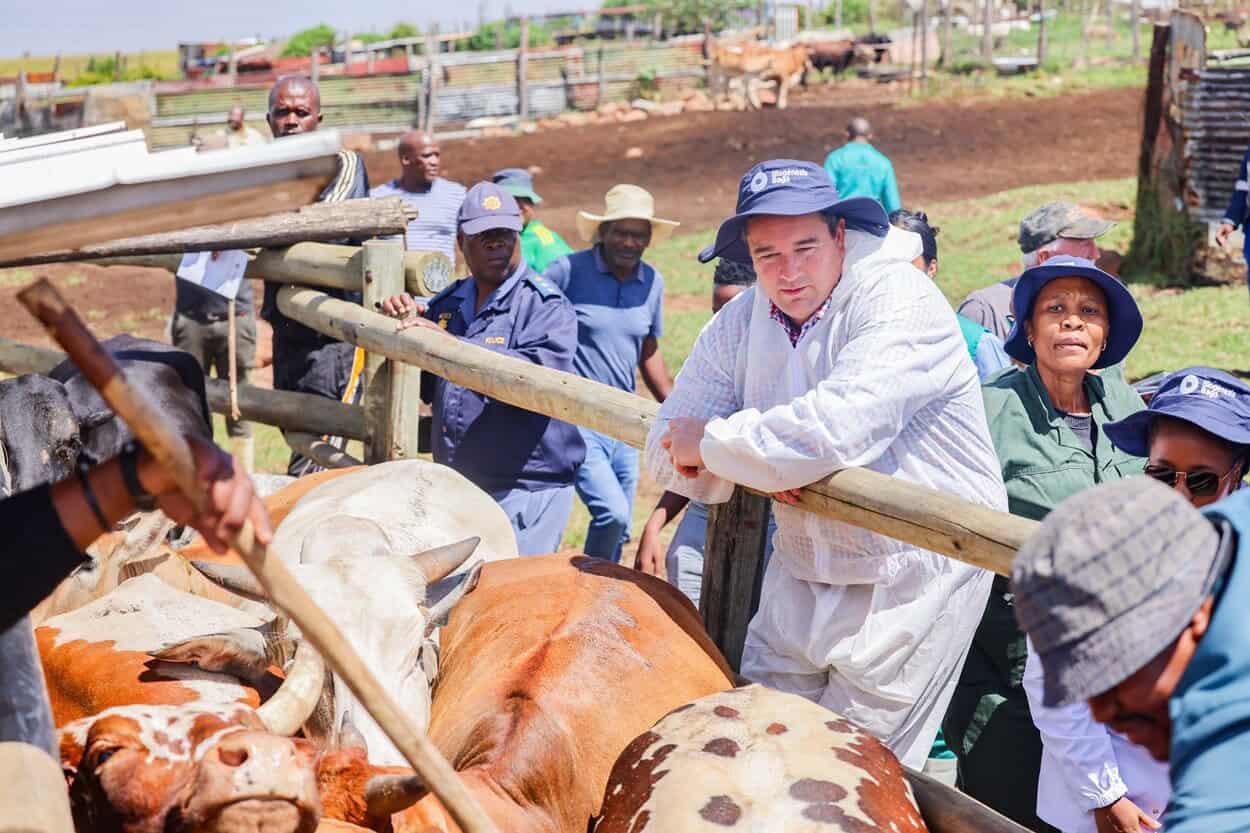
Minister John Steenhuisen at the mass vaccination against Foot-and-Mouth Disease (FMD) roll-out outreach at Magagula Heights in Katlehong on March 07, 2026 in Ekurhuleni, South Africa. This ongoing vaccination rollout forms part of the government’s urgent response to curb the spread of FMD, a highly contagious viral illness affecting cloven-hoofed animals. (Photo by Gallo Images/OJ Koloti)


South Africa’s deepening outbreak of foot-and-mouth disease (FMD) is no longer simply a matter of animal health.
It has become a stark indictment of the state’s capacity to respond to crisis and, more pointedly, of the political leadership entrusted with safeguarding a sector that underpins both food security and rural livelihoods.
The scale of the outbreak alone should have triggered urgency at the highest levels of government. With more than 900 outbreaks recorded across all nine provinces, the spread of the disease reflects a failure of early containment and coordinated response.
Livestock production constitutes a substantial portion of South Africa’s agricultural economy, with beef and dairy alone contributing tens of billions of rands annually, and the broader livestock and poultry sector accounting for roughly half of total agricultural output.
The implications of such a widespread outbreak are, therefore, systemic, extending beyond farms to processors, exporters and ultimately the national economy.
Yet, beyond the macroeconomic data lies a more intimate and devastating reality – one that emerges clearly from submissions received by the EFF from affected farmers across the country.
They speak of watching cattle deteriorate over days: animals refusing to eat; developing painful sores; limping; collapsing; and eventually dying.
Farmers describe waiting for veterinary assistance that either arrives too late or does not arrive at all.
In some cases, officials collect samples and leave, offering no treatment, no vaccine and no reassurance.
In rural communities across KwaZulu-Natal, the Eastern Cape, Limpopo, Mpumalanga and the Free State, livestock is the backbone of household survival.
The loss of cattle is the loss of income, food, school fees and dignity. The financial loss runs into millions, but the deeper impact is devastating: a once-viable farming enterprise reduced to ruin, with no clear path to recovery.
These are not isolated cases, in fact they reflect a pattern of systemic neglect, where small-scale and predominantly black farmers are left exposed to the full force of the outbreak, with minimal state support.
Farmers recount spending their last savings on feed, supplements and medication in a desperate attempt to save their livestock, often to no avail.
Pregnant animals and unborn calves are lost alongside entire herds, compounding both immediate and future losses.
The response from the department of agriculture, under John Steenhuisen, has been characterised by delay and contradiction.
ALSO READ: Legal challenges won’t derail FMD response
Public statements have projected a concerning lack of immediacy, most notably the assertion that meaningful vaccination coverage, targeting 80% of the national herd, may only be achieved by December – if at all possible.
In the context of an active and expanding outbreak, such a timeline does not inspire confidence, but signals an acceptance of prolonged disruption.
This posture has been accompanied by a tone that many farmers have experienced as dismissive.
While acknowledging regulatory constraints, the minister’s remarks have at times appeared disconnected from the desperation unfolding on the ground.
The dysfunction, however, is not merely political but, also, institutional.
The department of agriculture’s veterinary services operate with a vacancy rate of about 45%, a long-standing issue that has now materialised into a fullblown crisis of capacity.
The consequences are evident: delayed responses, inadequate containment and a failure to provide even the most basic level of coordinated support.
Meanwhile, the economic fallout continues to deepen as export restrictions have closed off key international markets, contributing to losses estimated in the billions.
At farm level, the costs are immediate and severe, with individual operations facing financial damage that could take years to recover, if recovery is possible at all.
The crisis has also exposed familiar fault lines in South Africa’s agricultural sector.
Access to vaccines and veterinary services remains uneven, with larger, historically advantaged farming operations better positioned to secure assistance, while small-scale and communal farmers are left waiting.
In this context, inequality is reproduced and reinforced through the very mechanisms of crisis response.
Perhaps most tellingly, the gravity of the crisis has necessitated the involvement of the National Treasury, signalling that the implications extend beyond agriculture into the broader fiscal and economic stability of the country.
Taken together, the evidence points to a response that has been reactive, insufficient and, at times, indifferent to the human cost.
The outbreak of FMD may have been unavoidable, but the scale of devastation now being witnessed speaks to a failure that goes beyond the disease itself.
NOW READ: ‘Premature and misdirected’: Farmers left waiting as court rules in FMD vaccine access matter
Support Local Journalism
Add The Citizen as a Preferred Source on Google and follow us on Google News to see more of our trusted reporting in Google News and Top Stories.

