


New cohesion data shows South Africans value unity, yet many doubt it can be achieved amid inequality, distrust, and political divisions.
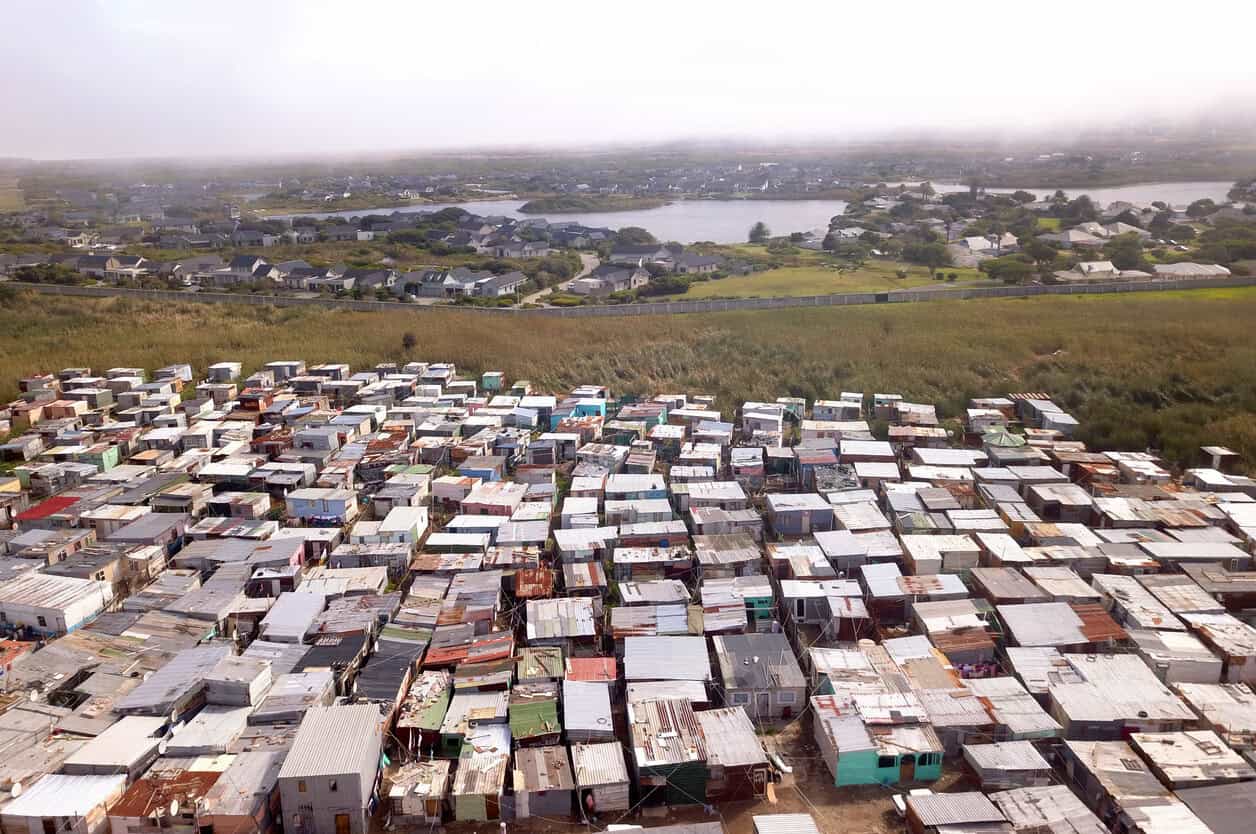
Masiphumelele township and houses belonging to wealthy people between Kommetjie and Noordhoek in Cape Town. Picture: iStock


South Africa is often described as a deeply divided society that is fractured along racial, economic and political lines, but the latest findings of the South African Social Cohesion Index (2025 update) paint a more nuanced picture.
It reveals a country where cohesion is certainly under strain, but also one whose social fabric is more resilient than many assume.
The latest update of the index records an overall social cohesion score of 56 out of 100, which places South Africa slightly above the midpoint of the scale.
This suggests that cohesion in the country is neither strong nor collapsed, but rather moderate and fragile.
Importantly, the figure for 2025 also represents a modest improvement when compared with the earlier measurements of cohesion, with the overall index now reflecting an improvement of 2.5 points since 2021.
In other words, despite persistent social and economic challenges, the foundations of cohesion in South African society have not eroded in the way that many commentators would suggest.
ALSO READ: Polls reporting ANC’s downfall are misleading
The index measures cohesion across nine dimensions, grouped into three broader domains that capture how people relate to one another, to society and to the state.
These dimensions include: social network; trust in people; acceptance of diversity; identification with the country; trust in institutions; perceptions of fairness; solidarity and helpfulness; respect for social rules; and civic participation.
The strongest dimension of cohesion in South Africa remains South Africans identification with the country.
It recorded a score of 76.7 in the latest update; a significant finding in that it shows that a strong sense of national belonging persists among citizens despite the many tensions and inequalities.
Solidarity and helpfulness also performed relatively well, at 63.1, while civic participation scored 60.6, meaning that these dimensions now fall into the “high cohesion” category.
These results indicate that many South Africans continue to demonstrate a willingness to support one another and to engage in the civic life of the country. In other words, the everyday social relationships that underpin cohesion remain alive.
ALSO READ: Quality elections – A thorn in the side of democracy
However, the index also highlights areas of vulnerability. Three dimensions in particular remain relatively weak and have the potential to destabilise cohesion if they deteriorate further.
The first dimension is acceptance of diversity, which stands at 47.7 out of 100 index points, the second is perception of fairness, which scores 47.1, and the third is respect for social rules, which is the lowest dimension at 42.0.
These findings point to persistent anxieties about fairness, social trust and adherence to rules in South African society; and when citizens believe that the system is not fair or rules are not consistently enforced, it becomes more difficult to sustain a shared sense of belonging.
But perhaps the most revealing insight gained about social cohesion in SA does not lie in the index score itself, but from the attitudes underlying the survey.
When South Africans are asked whether it is important to unite all South Africans, the response is overwhelmingly positive (77.18%).
Across racial groups, large majorities support the idea of building a united country in which citizens from different communities live and work together (white: 74.15%, black: 76.82%, Indian: 77.46% and coloured: 84.49%).
ALSO READ: A group is more than just a brand
But when respondents are asked a different question, whether it is impossible to form one nation out of South Africa’s different groups, the results reveal something striking.
A significant proportion of respondents agree with this pessimistic statement (overall: 56.26%, white: 51.74%, black: 57.30%, Indian: 64.19% and coloured: 47.16%.
In other words, many South Africans simultaneously hold two seemingly contradictory beliefs. On the one hand, they want unity. On the other hand, they doubt that unity is achievable.
This gap between aspiration and belief may be one of the most important insights emerging from the data. It suggests that South Africa does not suffer from a lack of commitment to the idea of a shared national project. Rather, the country appears to suffer from a deficit of confidence in the feasibility of that project.
Put differently, South Africans still believe in the ideal of unity, but many are uncertain about whether the social, economic and political conditions required to realise that ideal actually exist.
There are several reasons why this gap may have emerged.
ALSO READ: Bitter taste of freedom: The social barricades blocking progress
In the first instance, persistent inequality continues to shape how citizens perceive their society, in that South Africa remains one of the most unequal countries in the world and economic exclusion can easily translate into feelings of alienation from the broader national project; in the second instance, political discourse often reinforces divisions, rather than bridge them, with public debates frequently emphasising historical grievances and group identities – sometimes at the expense of narratives that highlight shared interests and common goals; and in the third instance, institutional trust remains uneven and whilst the latest index shows improvement in some areas, concerns about corruption, governance failures and uneven application of the law continue to erode confidence in public institutions.
Together, these dynamics seems to have created a situation in which citizens still value unity in principle, but they increasingly question whether such unity can be realised in practice; an insight that has important implications for policymakers, civic leaders and anyone concerned with the future of social cohesion in South Africa.
The task ahead is not primarily to persuade South Africans that unity is desirable, because the data suggests that most citizens already believe that.
The real challenge is to restore confidence that unity is achievable.
That means addressing the structural conditions that undermine social cohesion, such as economic inclusion that must be expanded so that more citizens feel they have a stake in the country’s future; and institutions must function effectively and fairly so that citizens believe that the rules of the game apply equally to everyone; and political leadership must emphasise cooperation, rather than division.
Perhaps most importantly, South Africans need visible examples that demonstrate that cooperation across social boundaries works, because social cohesion is ultimately not built through rhetoric but, instead, through everyday experiences that reinforce trust, fairness and shared purpose.
ALSO READ: Solitude vs society: Balancing our inner introvert and social instincts
The findings of the latest Social Cohesion Index therefore offer both a warning and a source of hope, the warning being that many citizens doubt whether unity can realistically be achieved and the hope, on the other hand, is that the desire for unity remains strong.
South Africa is therefore not a country that has abandoned the idea of a shared future. It is a country in which many people still want that future, but need to be convinced it is possible.
Closing the gap between aspiration and belief may well be the central task of social cohesion policy in the years ahead. And if that gap can be narrowed, the foundations of a more united SA may yet become stronger.
Support Local Journalism
Add The Citizen as a Preferred Source on Google and follow us on Google News to see more of our trusted reporting in Google News and Top Stories.

