While fewer than one-third of survey respondents indicated trust in other races, acceptance of interracial marriage was high.

Picture: iStock


A survey on South Africans’ racial perceptions shows low levels of interracial trust, coupled with greater acceptance of sharing domestic spaces with other groups.
Afrobarometer on Tuesday released its report on South African ethnic identity, which revealed several interracial sentiments.
Trust in other races
The report details inter-ethnic trust levels in South Africa broken down by race, age, location and education.
“Trust is a key indicator of social harmony. If citizens don’t trust those who belong to other groups, they are far less likely to cooperate, break down implicit barriers, and work toward reconciliation,” the report states.
Of those surveyed, 31% answered either ‘somewhat’ or ‘a lot’ when asked if they trusted other ethnic groups.
Men were more likely to trust other races, with 34% reporting positive views, whereas women reported 28% trust in other groups.
Trust decreased with age, as respondents over the age of 56 recorded 41% cross-race trust, while those aged between 36 and 55 and between 18 and 35 recorded 32% and 26%, respectively.
Limpopo was the most racially trusting province, with 41%, with KwaZulu-Natal recording the lowest at 19% of respondents indicating they trusted other races.
Coloured respondents trusted other races the most with 44%, followed by black respondents at 32%, white respondents at 17% and Asian respondents at 8%.
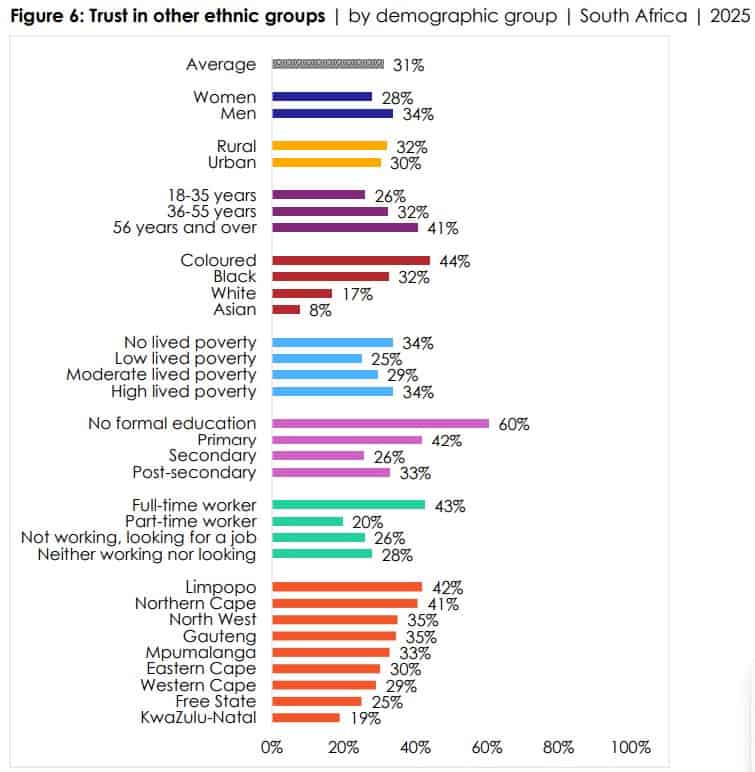
Above: The percentage of respondents answering yes to having a degree of trust in other groups. Picture: Afrobarometer.
High racial tolerance
While trust levels were low, South Africans showed a high tolerance for interracial marriage as well as living in multi-racial suburbs.
Only 20% of respondents said they would not want other races as neighbours, while 79% of all respondents stated they had no problem with people of other races marrying into their families.
However, the report notes that these figures were down from 2018.
“These data have mixed implications. On one hand, they point to the potential for future ethnic grievances and cleavages.
“On the other, they show that, despite their differences, most South Africans are tolerant toward others,” Afrobarometer stated.
Respondents showed a strong dislike of their government, believing the state discriminated against them more often than not.
Although margins varied, 75% of Coloured respondents reported that the government discriminated against their ethnic group.
Just over half of Asians, 52%, believed the same, while 46% of white respondents felt the government discriminated against them either sometimes, often or always.
“Even among the black majority, 40% think the authorities treat their ethnic group unfairly,” Afrobarometer stated.
Ethnicity and nationality
South African as an identity remained stable; however, more choose to identify solely by their ethnicity and not their nationality.
South Africa ranked the highest out of 33 countries for citizens who identified more with their ethnicity than their nationality.
Ethnicity was the identifier of choice for 26% of respondents, while 16% felt more or only South African.
However, those who made no distinction between their ethnicity and their South African nationality accounted for 58% of respondents — the highest since the question was first asked in 2006.
“South Africans are most likely to feel more or only their ethnic identity; the share of pro-ethnic feeling is almost double that of the continental average,” the report stated.
The research group conducts surveys across the continent and has compiled data on at least 45 different countries.
This was the 11th such survey conducted in South Africa and was based on the opinions of 1 600 adults responding between June and July.
The pan-African researchers reported a 95% confidence level in the results, with the survey’s demographic composition reflecting census percentages.
NOW READ: WATCH: Ramaphosa mulls taking action against groups calling on US to intervene in SA
Support Local Journalism
Add The Citizen as a Preferred Source on Google and follow us on Google News to see more of our trusted reporting in Google News and Top Stories.