Zuma and former president Thabo Mbeki each filed separate applications seeking Khampepe’s recusal from chairing the commission of inquiry.
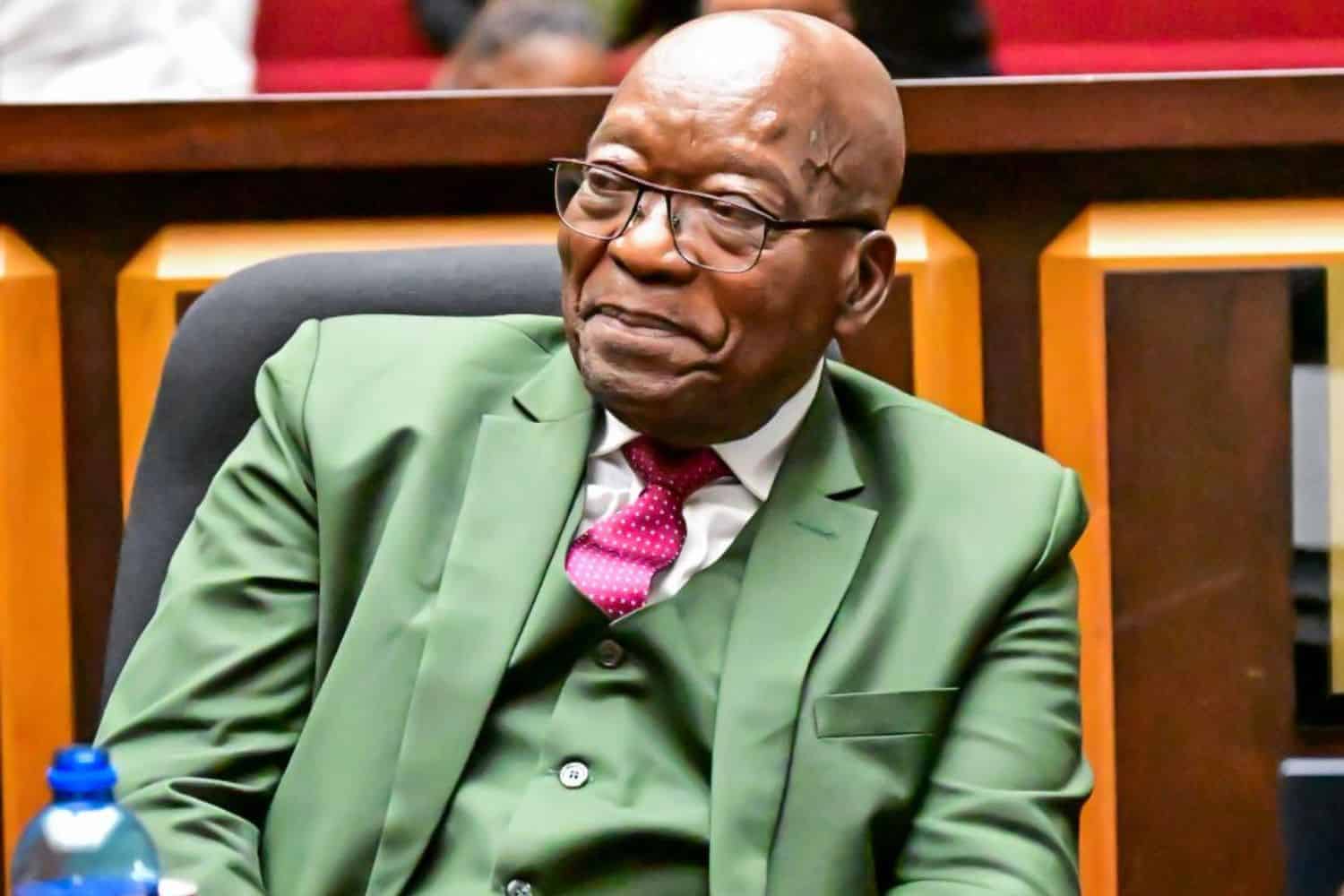
Former President Jacob Zuma in the Pietermaritzburg High Court. Picture: X/@MkhontoweSizwex


Former president Jacob Zuma claims that emails show that the Truth and Reconciliation Commission (TRC) inquiry chairperson, retired Justice Sisi Khampepe, “secretly” wrote to evidence leader Advocate Ishmael Semenya, advising him of research that would be helpful in responding to an application for his recusal, which she later dismissed.
Khampepe commission
Zuma and former president Thabo Mbeki filed separate applications for the recusal of Khampepe from chairing the commission of inquiry.
Last year, President Cyril Ramaphosa appointed Justice Khampepe to chair a judicial commission of inquiry to determine whether attempts were made to prevent the investigation and prosecution of apartheid-era crimes.
This, after about 23 families sued him for R167 million in damages over extensive delays in prosecuting apartheid-era crimes recommended by the TRC.
Oral arguments will be heard on 16 January 2026, and the commission is set to commence on 27 January.
‘Alleged advice’
In papers filed in this quest seeking Khampepe’s recusal from chairing the commission of inquiry into allegations of attempts to stop the investigation or prosecution of more than 300 TRC cases linked to him, Zuma declined to produce the email, saying it would be made available at a later stage.
“For now, it is sufficient to reiterate that I maintain that the chairperson indeed gave the alleged advice in writing, and it will become available once the necessary discovery processes have been followed in the appropriate forums.”
“To be more specific, on 5 November 2025, the chairperson personally wrote to Advocate Semenya SC advising him of research which would be helpful to his case and proposed that he should share with Vas Soni SC, who was representing him in the Semenya recusal application, which was scheduled to be argued before the very same chairperson,” Zuma said.
ALSO READ: Caiphus Nyoka killers to spend Christmas in jail as state seeks life terms
Private email
Zuma claimed this correspondence was notably not sent from the official commission email but from the “chairperson’s private email address”.
“On another occasion, the chairperson specifically advised Advocate Semenya to watch out for and/or deal with paragraph 45 of the founding affidavit in the Semenya recusal application, which alleges that Semenya SC had violated a directive of the commission.
“Again, if all of the above is denied, I invite the commission and/or the respondent in the interests of transparency and openness to disclose to the public all the email and WhatsApp correspondence exchanged in the relevant period between the two individuals,” Zuma said.
Zuma recusal application
In his recusal application, Zuma raised an additional ground based on personal hostility reflected in Khampepe’s prior judgments involving him, culminating in his detention without trial.
He argued that these circumstances reasonably give rise to an “apprehension of bias”.
“It is correctly not disputed that millions of South Africans, including me, honestly share the view that the order for my imprisonment was malicious, vindictive and vengeful. The so-called July unrest is a tragic testament to that. That being the case, it cannot be contested that to hold that view, whether rightly or wrongly, is reasonable. That is the only requirement for recusal.
ALSO READ: Conviction of apartheid cop John Marais for killing of Caiphus Nyoka lauded
‘Secret’ meetings
Zuma referred to the emails after Semenya allegedly accused him of ascribing an “improper motive” to Khampepe and “me” without providing a “morsel of evidence”.
“More disturbingly, the applicant (Zuma) alleges that the chairperson and I held ‘secret’ communications. (Zuma) does not deem it necessary to explain why the chairperson could hold “secret” meetings regarding the work of the commission. This is an egregious insult, impugning the integrity of the chairperson and me,” Semenya said.
“In the very nature of my appointment as the evidence leader, I naturally speak to the chairperson regarding matters of the commission, as I do to the other commissioners, my team and other participants in the commission.
“Nothing can be improper in my doing so, given the fact that the task of everyone in the commission is to assist the commission to establish the evidence upon which it can make factual findings and recommendations to the president on the issues of public interest that triggered the establishment of the commission (as well as any other matters incidental thereto).”
No ‘denial’
Zuma argues that Semenya, who is the recipient of the “alleged improper advice, nowhere denies being given such advice by the chairperson.
“This ought to be the end of the matter. It matters not whether such advice was given secretly or publicly.”
“The startling proposition made that it is not necessary for (Advocate Semenya SC or the chairperson) to deal in detail with the specific allegations made, in spite of their nature and seriousness, only needs to be stated to be rejected. Nor can such allegations be properly rebutted via a bare denial,” Zuma argued.
‘Amazing person’
Zuma further argued that, in the course of preparing his papers on 6 January 2026, he observed a television interview on Newzroom Afrika in which he heard the official spokesperson of the TRC, Lionel Adendorf, address whether Khampepe was “perturbed by the allegations”.
“She is an amazing person. I spoke to her earlier, and I just want to make reference to the matter she advised the chief evidence leader on. She does that to me often. She does that in the normal course of our work, where we talk regularly about things, and there is nothing wrong with that. She is not concerned about it as well… She is not concerned at all,” Zuma mentioned in his papers.
Zuma argued that the validity of the justification offered for Khampepe giving advice to “Semenya” has been “disputed, as it does not hold water”.
NOW READ: Inquest into Griffiths Mxenge assassination matter sees new developments