
Pule described the National Strategic Plan on Gender Based Violence and Femicide as "our country's blueprint" for addressing violence.
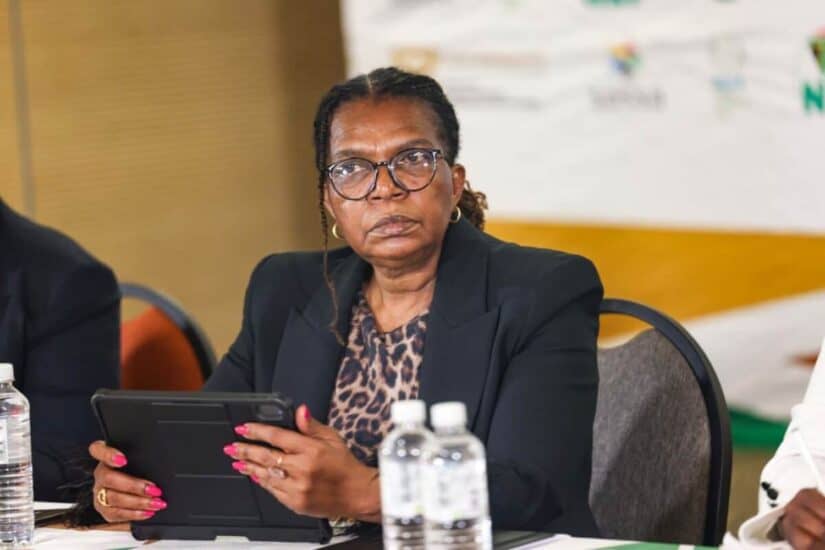
Social Development Minister Dina Pule. Picture: Gallo Images/OJ Koloti


South Africa has committed to implementing seven breakthrough areas across 52 districts as part of efforts to end violence against children.
Social Development Minister Dina Pule made the announcement on Thursday while opening the Children’s Summit on Ending Violence Against Children at Anew Hotel in White River, Mbombela.
Seven breakthrough areas across 52 districts
Pule did not set out the seven breakthrough areas individually in her opening address, but said the Bogota Call to Action reinforced South Africa’s commitment to tackling violence against children and Gender-based violence and femicide (GBVF).
“I must note that, in South Africa, this Call to Action reinforces the commitment of the government that I serve to eliminate gender-based violence and femicide,” she said.
Pule described the National Strategic Plan on Gender Based Violence and Femicide (NSP-GBVF) as “our country’s blueprint” for addressing violence.
She also pointed to the 90-Day Programme of Action approved by Cabinet in May 2025.
“Through the 90-Day Programme of Action, the country witnessed the power of an integrated approach to service delivery through the implementation of the District Development Model,” Pule said.
The model brings together government, non-governmental organisations, community-based organisations, traditional leaders and religious organisations to address GBVF.
Government response to GBVF crisis
Pule also linked the child protection commitments to the broader national response to GBVF.
She described the disaster classification as “a demand for urgent, coordinated multisectoral action” to address systemic gaps and accelerate interventions to protect vulnerable groups.
Pule said the activation of initiatives to fight GBVF included workstreams focused on “prevention and rebuilding social cohesion, enforcement, care and support, the legal and regulatory framework, statistics and systems, funding and costing, communication, partnership and community mobilisation, as well as monitoring and evaluation”.
Children’s voices in policy
The Department of Social Development has also overseen the publication of the Cabinet-approved National Strategy on Accelerated Action for Children (NSAAC).
Pule said the strategy placed “a strong focus on violence prevention and on protecting children from abuse, neglect and exploitation”.
Children were also involved in nationwide consultations on making the NSP-GBVF more inclusive of children’s issues and child-friendly.
According to Pule, children produced a report and advocated adding a seventh pillar to the existing NSP-GBVF.
“Through this Summit, I am demonstrating the need for all of us, as governments and partners, to work with children to accelerate our implementation of proven prevention and response solutions,” she said.
Pule said children’s participation was a fundamental right recognised under the United Nations Convention on the Rights of the Child and South Africa’s Children’s Act.
“Through our National Strategy to Accelerate Action for Children, I am ensuring that children actively participate in shaping our policies and legislation, as well as our public communication, instead of being passive recipients of services,” she said.
“As minister, I subscribe to the belief that ‘nothing about us without us’, and it is for this reason that I am convening this Children’s Summit.”
She called on children at the summit to reflect on their experiences of violence and the progress made in efforts to curb violence against children.