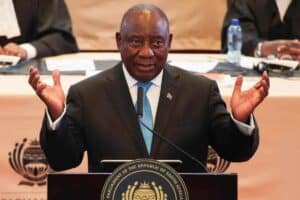
Looking at South Africa's global position in this changing world order, there is no optimism from an analyst.
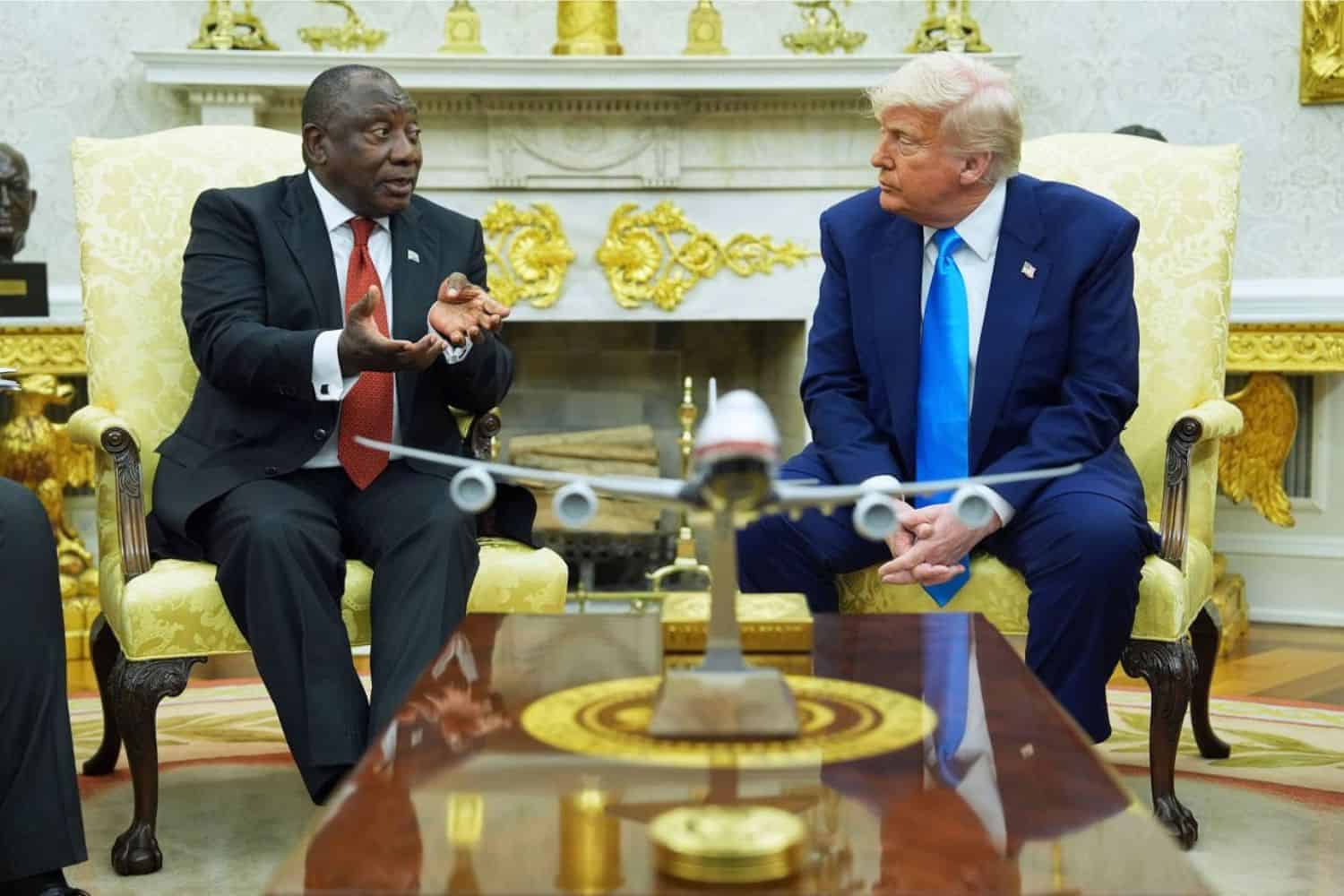
Ramaphosa and Trump met at the White House in Washington. Picture: Screengrab.


North West University Professor and political analyst Andre Duvenhage says US President Donald Trump has fundamentally shifted the global order, adding that he is not “optimistic” about South Africa’s global position.
Global order
Trump’s stated interest in the annexation of Greenland has escalated into a geopolitical flashpoint that threatens to strain the cohesion of the North Atlantic Treaty Organisation (NATO).
In early January, US authorities detained Venezuelan President Nicolás Maduro and his wife, Cilia Flores, and transferred them to the US on charges related to drug trafficking and narco-terrorism, raising renewed concerns about Washington’s approach to the sovereignty of nation-states.
Trumps’s next move
What the next move of the commander-in-chief of the world’s last remaining superpower might be remains uncertain.
However, according to Duvenhage, Trump has already begun to reshape the global order through a distinctive combination of coercive diplomacy and assertive power politics.
“We are witnessing a changing world order, and increasingly the defining feature is that the period we know, or have come to know, as the Cold War era has finally come to an end. The first major break was in 1991 with the fall of the Berlin Wall and the dynamics that followed. However, what we are entering now may be even more significant,” said Duvenhage.
ALSO READ: Lamola urged to report Iran to UN as protest death toll soars
A divide developing
Duvenhage said that one outcome is that the US is defining its own path.
“It is not particularly concerned about NATO. The approach is very much “America first”. Why, from this perspective, should it defend Europe if Europe does not take responsibility for itself?
“Clearly, a divide is developing between the United States on the one side and leading Western countries such as France, Germany, Britain and Spain on the other. Italy, perhaps, is a slight exception, although I believe Italy will also align with the broader Western European position. I have no doubt that some form of conflict will emerge from this,” Duvenhage said.
What about SA?
Looking at South Africa’s global position in this changing world order, Duvenhage said he is not optimistic.
“It is interesting to observe how South Africa’s position is being redefined within the changing world order. South Africa’s international support base is declining sharply, with far-reaching implications for its politics and economy, particularly for the ANC.
“There is little doubt that Trump has had a significant influence on this process, and I believe that there is more to come in the future,” Duvenhage said.
ALSO READ: SA concerned about deadly Iran protests, calls for ‘maximum restraint’
Iran
South Africa has been in the spotlight following the presence of three Iranian warships off False Bay, which ramped up international attention on the country, particularly from the US.
A government source confirmed that Iran had been asked to withdraw from the drills, only for the SANDF to later post a now-deleted Facebook statement saying the Iranian corvette Naghdi did participate in the sea-phase exercise.
On Saturday, Ramaphosa’s spokesperson, Vincent Magwenya, told The Citizen that the drills were facilitated and led by China and that the president had instructed defence minister Angie Motshekga to ensure Iran withdraws from the exercises.
On Friday, Motshekga said she had relayed Ramaphosa’s instructions regarding the military exercises in False Bay and had appointed a board of inquiry to determine whether they were ignored.
SA slammed
The US Embassy in South Africa also slammed Pretoria for supporting Iran while it cracks down on anti-government protesters by allowing Iranian warships into South African waters for the naval exercises, which also included Russia and China.
Damaging relations
Last week, defence analyst Helmoed-Römer Heitman told The Citizen that including Iran in the naval drills risked damaging relations with key trading partners in Europe and the US.
Heitman said while South Africa will feel the impact of exercising with Iran, Iran will not feel the pinch.
Tensions with US
Trump has singled out South Africa for harsh treatment on several issues since he returned to the White House in January, notably making debunked claims of white Afrikaners being systematically “killed and slaughtered” in the country.
He ambushed Ramaphosa in the Oval Office earlier this year, playing a video in which he alleged a campaign against white farmers by the post-apartheid government.
In May, Trump offered Afrikaners refugee status. The first group of around 50 was flown to the US on a chartered plane.
In October, South Africa criticised the decision by the US to prioritise refugee applications from white Afrikaners, saying claims of a white genocide had been widely discredited and lacked reliable evidence.
ALSO READ: US revokes Naledi Pandor’s visa despite warming up to G20 participation